Why does fried food get crispy on the outside?

 The answer lies in how water escapes from the surface.
In hot oil, the water at the surface of the food quickly turns to steam and escapes, leaving a dry, hard outer layer called the crust. The tiny holes and gaps left behind by the escaping steam also help create the crunchy texture. Meanwhile, water stays inside, so the food is crispy outside and moist inside.
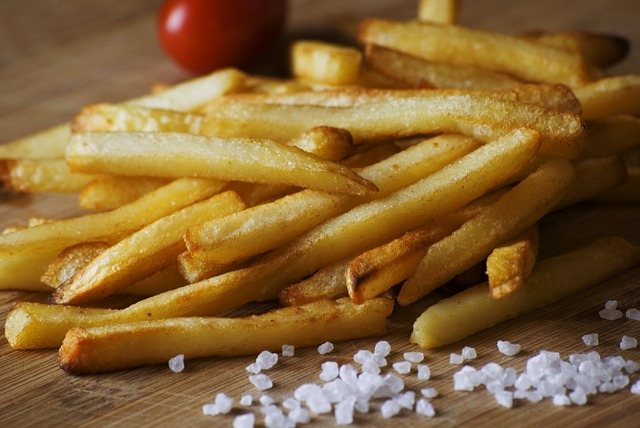
Hot oil turns water into steam
Fried food is usually cooked in oil at about 150–200℃. Oil carries heat better than air, so the surface of the food heats up quickly. When the surface reaches the boiling point of water (100℃), the water inside turns to steam and bursts out. Most of the tiny bubbles you see while frying are this steam.
A dry crust forms
As water leaves the surface, a dry, hard layer forms. This is called the "crust." A study of french fries reported that the crust gradually gets thicker as frying goes on, and the more tiny holes and gaps are left behind by the escaping steam, the crunchier the texture becomes.
Crispy outside, moist inside
While the surface hardens first, water stays inside the food. That is why it ends up crispy outside and moist inside. The golden-brown color and toasty smell also come partly from the "Maillard reaction," a change in which sugars and amino acids react with heat.
Most of the tiny bubbles you see while frying are this steam.

Why does it go soggy over time?
But the crispiness doesn't last long. According to a paper by researchers in the Netherlands, fried foods that are crispy outside and moist inside tend to lose their crispness in about 3–20 minutes. The likely causes are that water from the inside moves into the crust and softens it, and that oil on the surface gets soaked into the crust as the food cools.
Want to know more?
- Most of the oil in fried food is soaked up not while it is in the oil, but while it cools after being taken out. One report found that about 80% of the oil in tortilla chips was absorbed while they cooled.
- In a study that fried french fries at 150–190℃ to compare them, the fries cooked at 170℃ got the highest scores for color and texture.
- Frying is said to be similar to "drying." That is because it uses hot oil instead of hot air to drive water out of food.

Quick quiz: test yourself
Why does fried food get crispy on the outside?
Show the answer
- The oil hardens into a shell
- Water escapes from the surface
- The coating gets burnt
Water escapes from the surface In hot oil, water at the surface quickly turns to steam and escapes, leaving a dry, hard crust. The tiny holes left behind add to the crunch.
In hot oil, water at the surface quickly turns to steam and escapes, leaving a dry, hard crust. The tiny holes left behind add to the crunch.
Next quiz ›Sources
- Monitoring the Changes in Heat Transfer and Water Evaporation of French Fries during Frying to Analyze Its Oil Uptake and QualityFoods(MDPI)/PubMed Central
- Heat and Mass Transfer in Foods During Deep-Fat FryingCereals & Grains Association(著者:University of California, Davis ほか)
- Chemical Changes in Deep-Fat Frying: Reaction Mechanisms, Oil Degradation, and Health ImplicationsFood Science & Nutrition/PubMed Central
- On the mechanism by which oil uptake decreases crispy/crunchy behaviour of fried productsFood Research International(Elsevier)
This article was written after checking the sources above as of 2026-10-03. Explanations may change as research progresses. Photo credits are shown below each photo.