Do we really use only 10% of our brains?

 But that number has no scientific basis. Shall we see where it came from?
No, that's a myth. Brain scans show that, over the course of a day, almost every part of the brain is active. The "10%" figure has no scientific basis. It is thought to have spread through self-help stories saying people have not yet tapped their full potential.
A saying that existed by 1907
Nobody knows for sure where this saying came from. According to an article in the British medical journal BMJ, it appeared by 1907 at the latest and spread through books and talks promising that self-improvement could unlock hidden abilities. Some say Albert Einstein said it, but no record of him saying so has been found.
How the "10%" number spread
The psychologist William James wrote that people have untapped mental energy, but he gave no number. Then, in 1936, the preface to a self-help book by Dale Carnegie claimed that "James used to say the average person develops only 10 percent of his hidden mental ability." In addition, when the researcher Penfield electrically stimulated parts of the brain, some areas showed no effect, which led to the idea that some parts do nothing.
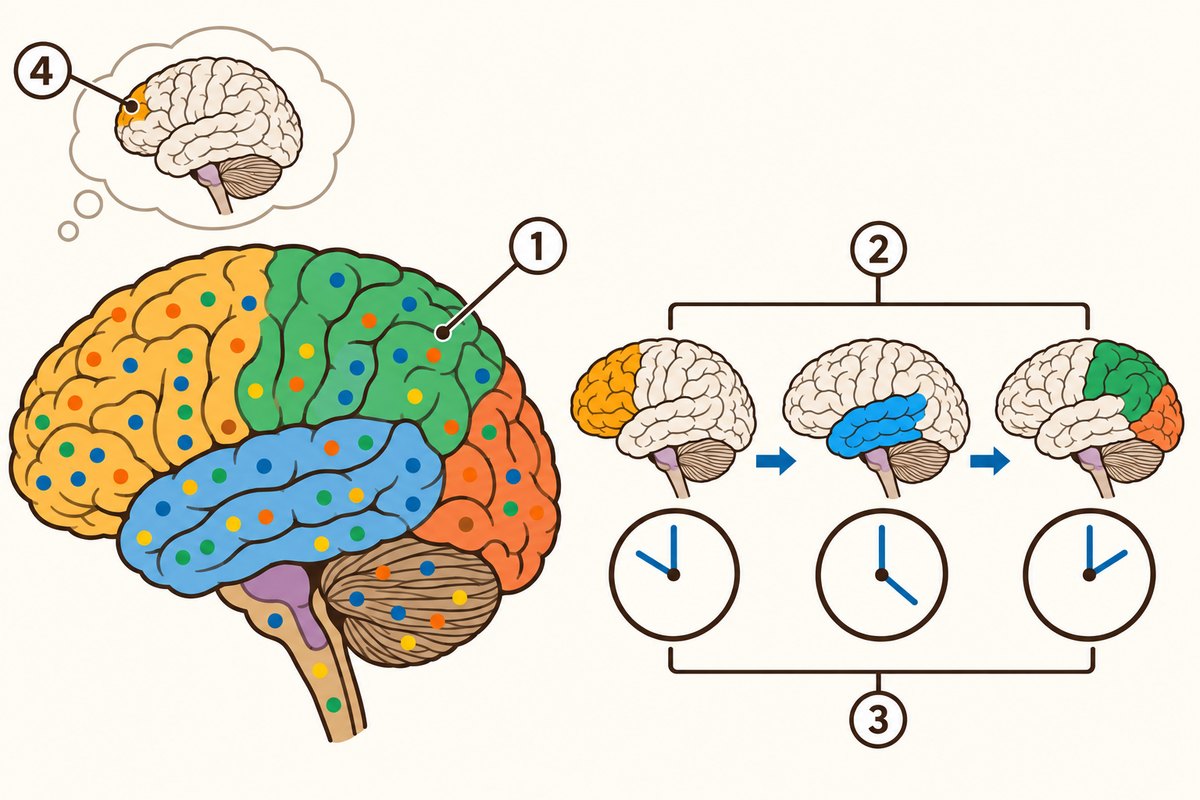
- 1Over a whole day, almost all of the brain is active
- 2An example of how the active areas change with time
- 3Three clocks showing different times
- 4The belief that we use only part of the brain

Scans show nearly the whole brain at work
In reality, brain scans show waves of activity spreading across the whole brain, even when people try to think of nothing. A neurologist at the Mayo Clinic in the United States says that over a day, you use 100% of the brain. The BMJ article also notes that damage to almost any part of the brain has specific, lasting effects, and that careful study has never found a "non-working 90%."
An energy-hungry organ
Energy use also makes the 10% idea hard to believe. The brain makes up only about 2 to 3% of body weight, yet it uses about 20% of the body's energy. An explainer in the magazine of the British Psychological Society points out that evolution tends to weed out wasteful body parts, so a brain that goes mostly unused is very unlikely.
Want to know more?
- In a 2002 survey of more than 2000 people in Brazil, 59% of college-educated people believed this saying.
- In a 2012 survey, 48% of teachers in England and 46% of teachers in the Netherlands believed it.
- Of 35 brain scientists asked for comparison, only 6% believed it.
Quick quiz: test yourself
Remember what you just read? Give it a try!Over a full day, how much of the brain gets used?
Show the answer
- Almost all of it
- About 10%
- About half
Almost all of it Brain scans show that, over the course of a day, almost every part of the brain is active.
Brain scans show that, over the course of a day, almost every part of the brain is active.
Next quiz ›Sources
- Medical mythsBMJ(PMC 掲載、Vreeman & Carroll、2007年)
- Do People Only Use 10 Percent of Their Brains?Scientific American
- Great myths of the brain: We only use 10 per centThe Psychologist(イギリス心理学会 BPS)
This article was written after checking the sources above as of 2026-10-03. Explanations may change as research progresses. Photo credits are shown below each photo.
Next fun fact ▶
 Human BodyDoes cracking your knuckles make them bigger?Has anyone ever told you that cracking your knuckles will make them bigger?

40 surprising animal facts with big photos and short, easy text. A fun-facts book for kids and grown-ups to read together.
See it on Amazon