Why do deserts change so much from day to night?

 The key is dry air and the lack of clouds. Shall we find out?
Deserts have very dry air and few clouds. So during the day, sunlight heats the ground directly, and at night the ground's heat escapes into the sky. With almost no clouds or moist air to hold the heat in, the difference between day and night temperatures becomes large. But desert nights are not always cold.
By day, sunlight heats the ground directly
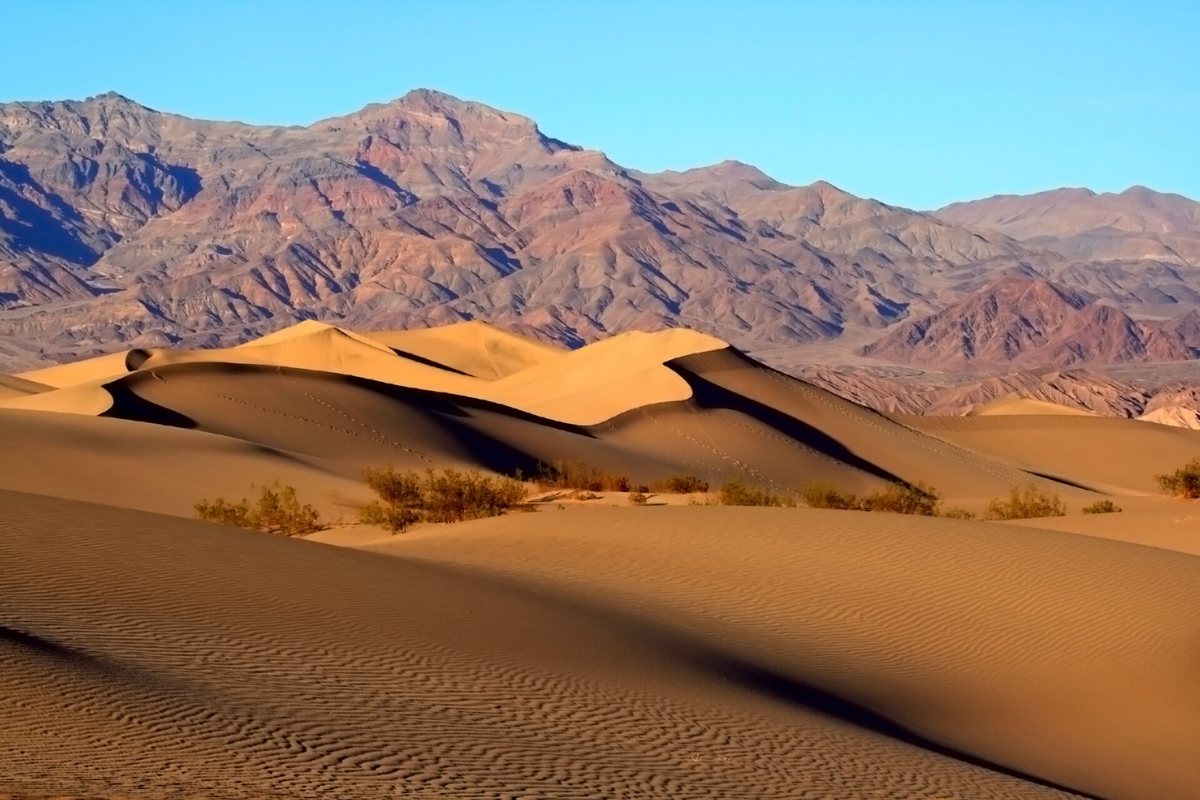
The U.S. National Park Service explains that in Death Valley, a desert, the clear, dry air and the few plants let sunlight heat the desert ground. With few clouds or shady trees, almost nothing blocks the sunlight. The heated ground then warms the air around it too.
At night, the ground's heat escapes to the sky
After the sun sets, the ground gives off heat and cools down. This is called radiative cooling. The Fukuoka Regional Headquarters of the Japan Meteorological Agency explains that clouds overhead keep the ground from cooling, like a blanket, and that radiative cooling works most strongly on clear, cloudless nights with little wind.
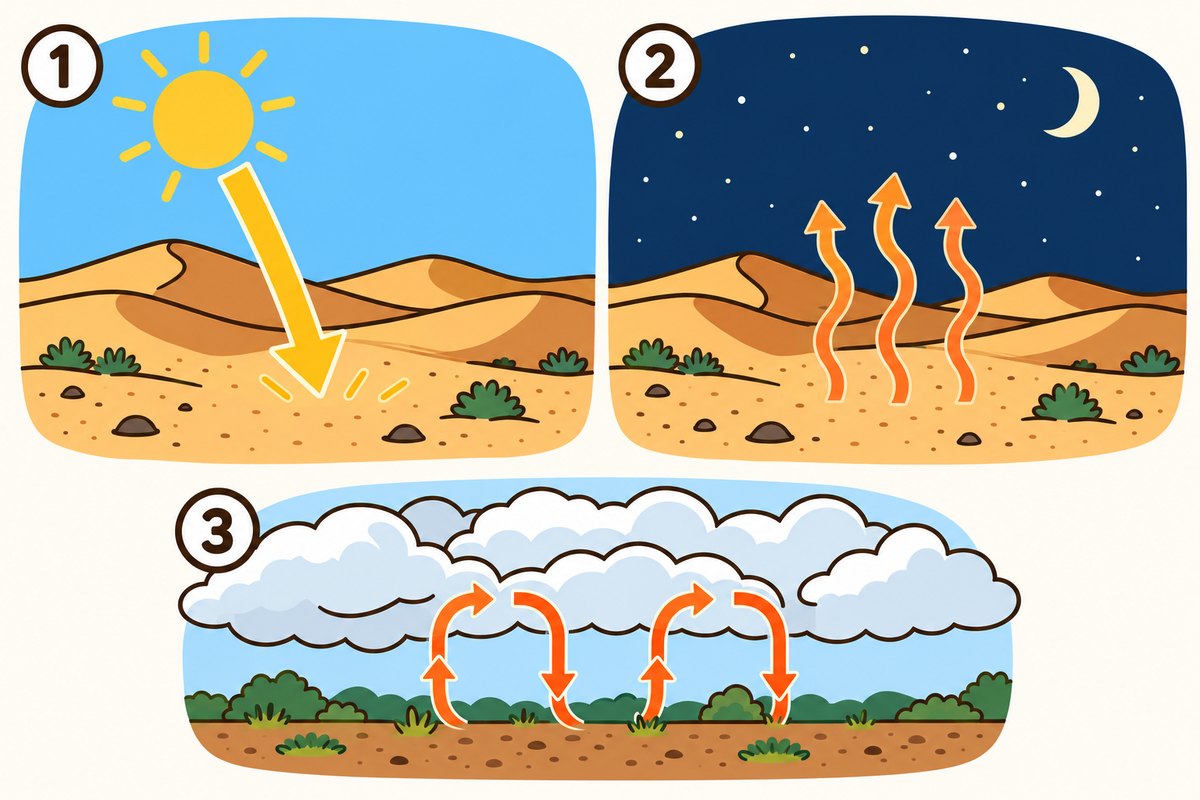
- 1Daytime sunlight heats the sand
- 2At night, heat from the ground escapes to the sky
- 3Comparison: clouds and humid air send heat back to the ground

Dry air lets heat escape easily
NASA's page for kids explains that desert air is so dry that heat escapes quickly at night, so temperatures change a lot between day and night. As a rough guide, it gives an average of about 38°C during the day and about -3.9°C at night, but temperatures vary greatly depending on where the desert is.
Some deserts stay hot at night
According to the National Park Service, on summer nights in Death Valley the lowest temperature may only fall to about 30 to 35°C. The valley is deep and narrow and surrounded by high mountains, so the heated air gets trapped inside it. Desert nights are not always cold; they change greatly with place and season.
Frost in Japan works the same way
In Japan, too, clear nights with little wind get chilly. According to the Fukuoka Regional Headquarters, even when the air 1.5 m above the ground is about 4°C, it can be 0°C or below near the ground, and frost forms. The cold of desert nights comes from the same radiative cooling.
Want to know more?
- According to NASA, deserts get about 250 mm of rain a year, the least of all the world's major kinds of natural environments, such as forests and grasslands.
- On July 10, 1913, a temperature of 57°C was recorded at Furnace Creek in Death Valley, and it is listed as the world's highest air temperature on record.
- Some plants, like cacti, survive in the dry desert by storing water in their stems and using it little by little.

Quick quiz: test yourself
Remember what you just read? Give it a try!Why does the temperature drop so much on desert nights?
Show the answer
- The sand gives off water at night
- Strong winds always blow at night
- Heat escapes easily through dry air
Heat escapes easily through dry air Desert air is dry and there are few clouds, so at night the ground's heat keeps escaping into the sky.
Desert air is dry and there are few clouds, so at night the ground's heat keeps escaping into the sky.
Next quiz ›Sources
- Weather - Death Valley National ParkNational Park Service
- Biome: DesertNASA Science
- はれるんマガジン 2020年11月26日号(霜は晴れた日におりるのはどうして?)福岡管区気象台 (in Japanese)
This article was written after checking the sources above as of 2026-10-03. Explanations may change as research progresses. Photo credits are shown below each photo.
Next fun fact ▶
 NatureWhy does bamboo grow so fast?Bamboo shoots seem to tower over us before we know it. Why are they so fast?

40 surprising animal facts with big photos and short, easy text. A fun-facts book for kids and grown-ups to read together.
See it on Amazon