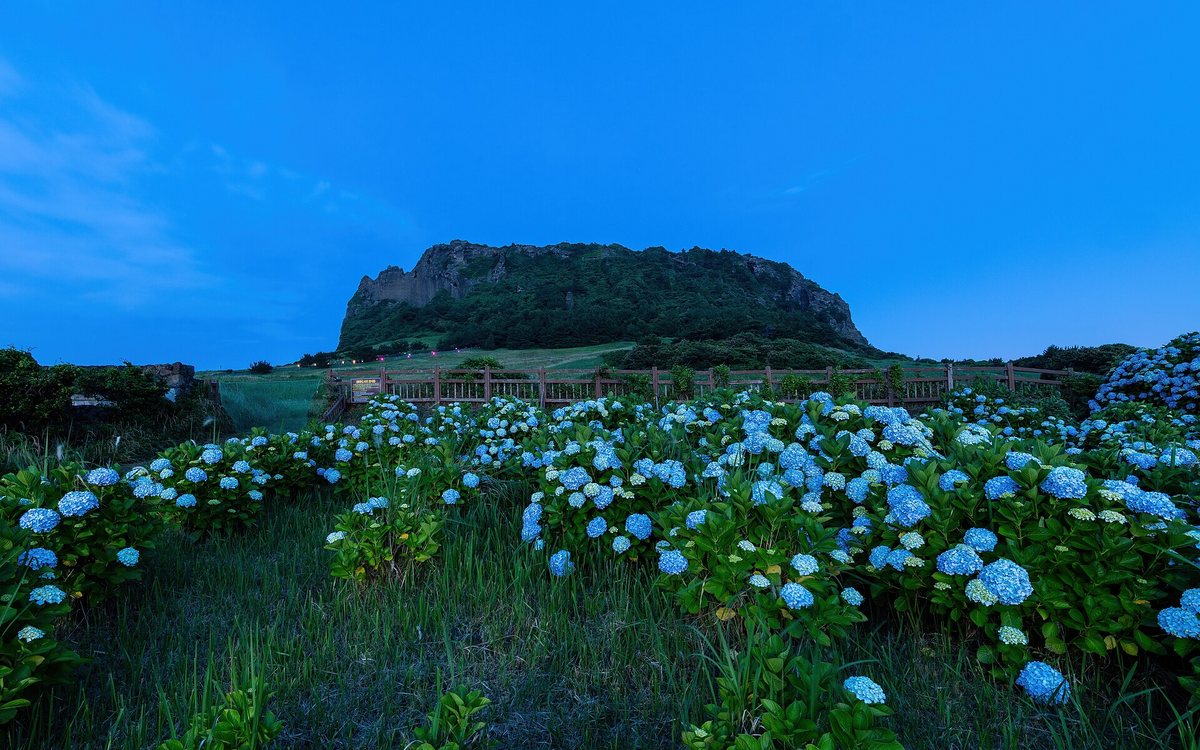
Why do hydrangeas change color?

 The deciding factor is aluminum in the soil.
Hydrangeas change color because the amount of aluminum their roots take up changes the color of the flower pigment. In acidic soil, aluminum is taken up easily and joins the pigment to make blue. In soil closer to neutral, there is little aluminum, so the flowers turn red or pink.
Every color comes from the same pigment
The parts of a hydrangea that look like petals are called decorative flowers, and they are actually sepals, not petals. According to a research group at Nagoya University in Japan, the blue, purple and red colors of hydrangeas all come from the same anthocyanin (a flower pigment) called delphinidin 3-glucoside. The pigment is the same, yet the colors look different.
Aluminum makes the blue
According to a 2019 announcement from Nagoya University, hydrangea blue comes from a molecule in which 3 things join together in a 1:1:1 ratio: the pigment, aluminum ions, and a co-pigment (a substance that is colorless by itself but helps the pigment show its color). When the researchers froze sepals at -160°C and examined them, the blue molecule and aluminum were found only where the blue cells were, and there was almost none in red sepals.
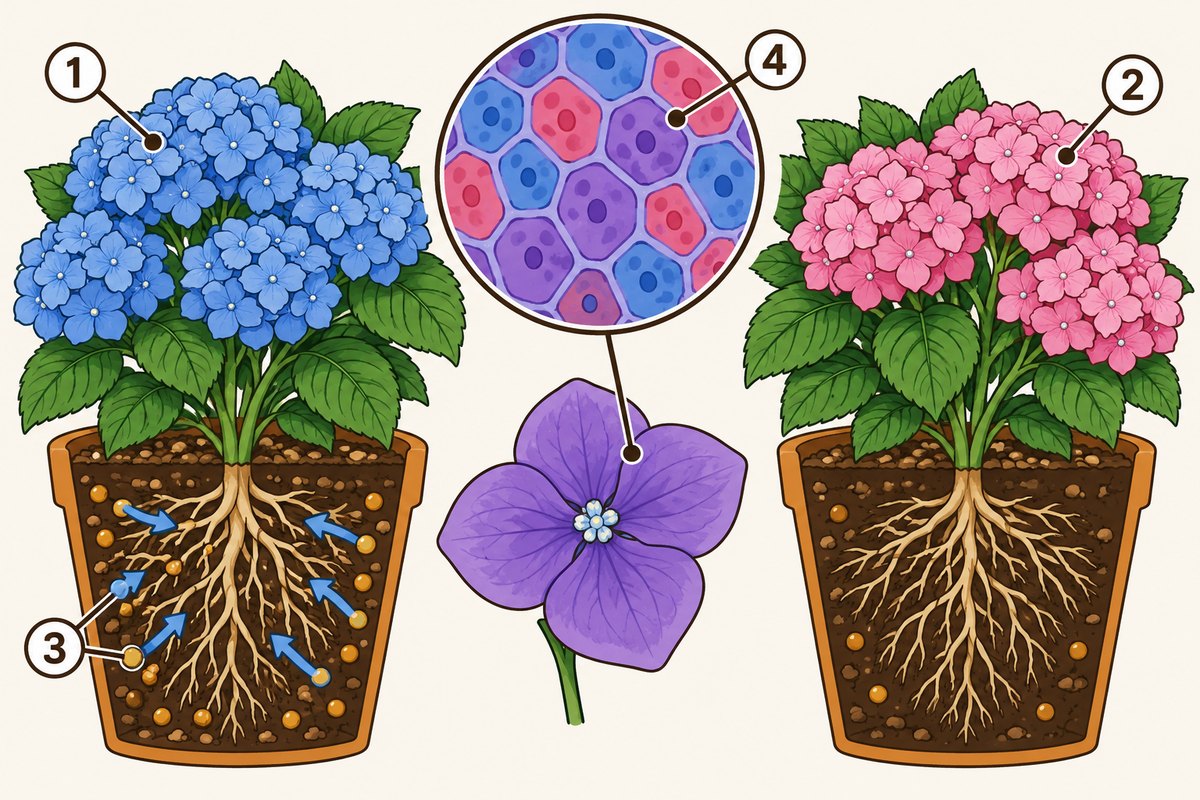
- 1A hydrangea that took up aluminum and turned blue
- 2A hydrangea that took up little aluminum and turned red to pink
- 3Dots and arrows showing aluminum being taken up by the roots
- 4A purple sepal and, inside it, a mix of blue, red and purple cells

Soil acidity is the key
What decides how much aluminum reaches the flowers is how acidic the soil is. According to the University of Georgia in the US, when soil has a pH (a scale of how acidic or alkaline something is) of 5.5 or lower, aluminum is easier for the roots to take up, and in neutral or alkaline soil of pH 7.0 or higher, there is less. Mississippi State University gives a guide of pH 5 to 5.5 for blue flowers, 5.5 to 6 for purple, and 6 to 6.5 for pink.
Based on Mississippi State University Extension, for bigleaf and mountain hydrangeas.
Purple flowers are a cell mosaic
In a 2020 announcement from Nagoya University, a blue variety grown in neutral soil produced purple flowers. Under a microscope, the flowers were not made only of purple cells: blue, red and purple cells were mixed together like a mosaic. The bluer a cell was, the more aluminum ions and a certain co-pigment it contained. Why neighboring cells can differ so much is still not known.
Want to know more?
- Only bigleaf hydrangeas (Hydrangea macrophylla) and mountain hydrangeas can change color through the soil. White hydrangeas do not change color this way.
- Hydrangeas are native to Japan, and the original wild species has blue flowers.
- Even after the soil is changed, it can take about 1 year to see a clear change in flower color.
Quick quiz: test yourself
Remember what you just read? Give it a try!Which substance turns hydrangea flowers blue?
Show the answer
- Iron
- Calcium
- Aluminum
Aluminum The pigment, aluminum ions and a co-pigment join to form a blue molecule. Acidic soil makes aluminum easier to take up.
The pigment, aluminum ions and a co-pigment join to form a blue molecule. Acidic soil makes aluminum easier to take up.
Next quiz ›Sources
- アジサイの青色色素の可視化に成功(プレスリリース、2019年)名古屋大学 (in Japanese)
- アジサイの色は細胞ごとに変化する(プレスリリース、2020年)名古屋大学 (in Japanese)
- Aluminum is the key to changing hydrangea bloom colorUniversity of Georgia College of Agricultural and Environmental Sciences
- How to Change the Color of HydrangeasMississippi State University Extension
This article was written after checking the sources above as of 2026-10-03. Explanations may change as research progresses. Photo credits are shown below each photo.
Next fun fact ▶
 NatureWhy does the sea look blue?The sea is blue as far as the eye can see. Is it simply reflecting the color of the sky?

40 surprising animal facts with big photos and short, easy text. A fun-facts book for kids and grown-ups to read together.
See it on Amazon