Why does an eraser remove pencil marks?

 First, let me give you the answer in 30 seconds.
Pencil writing is a powder of graphite, a form of carbon, stuck thinly and weakly to the surface of the paper. When you rub it with an eraser, that weak hold is rubbed loose, and the powder sticks to the eraser rather than to the paper. Tiny grains inside the eraser also help by lightly scraping the surface.
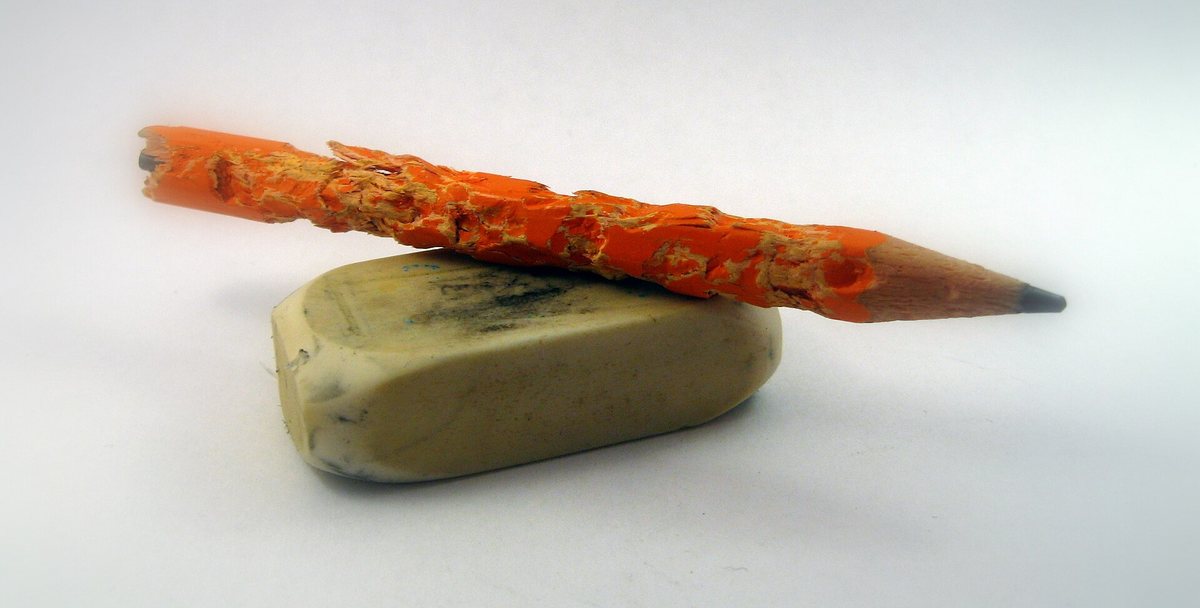
Pencil writing is graphite on the surface
Pencil "lead" has the word "lead" in its name, but it is not made of the metal lead. It is made of graphite, a form of carbon. When you write with a pencil, a thin layer of graphite is left on the surface of the paper. This graphite does not soak into the paper. It is only held on the surface by a force that pulls things together, and that force is described as quite weak.
Graphite moves to the eraser
When you rub with an eraser, the rubbing force breaks the weak hold between the graphite and the paper. The loose graphite particles are pulled more easily toward the eraser than toward the paper, so they stick to the eraser and leave the paper. That is how the writing seems to disappear.

It also lightly scrapes the surface
The eraser has one more job: lightly scraping the surface. Rubber erasers have a much finer powder of the same material used in sandpaper mixed into them, which helps rub the graphite away. But if it were too strong, it would damage the paper, so erasers are made with just the right strength so they don't scrape away too much paper. Even so, rubbing does scrape away a tiny bit of the paper's surface.
Why ink is hard to erase
Pen ink is hard to erase because ink soaks into the paper. Rubbing the surface cannot reach it, and scraping deeply would damage the paper. It is because graphite only sits on the surface that an eraser can remove it.
Want to know more?
- The person who found that rubber could remove pencil marks was Priestley, an English chemist also known for discovering oxygen. In Britain, an eraser is still called a "rubber."
- Before rubber was used, balls of hardened bread and wax were used to remove writing.
- Plastic erasers appeared in the 20th century. Plastic erasers are said to tend to be gentler on paper than rubber ones.

Quick quiz: test yourself
Why does an eraser remove pencil marks?
Show the answer
- Graphite sticks to the eraser
- Rubber dissolves the graphite
- It paints the paper white
Graphite sticks to the eraser Pencil marks are graphite powder weakly stuck to the paper's surface. Rubbing knocks it loose, and the powder sticks to the eraser rather than the paper.
Pencil marks are graphite powder weakly stuck to the paper's surface. Rubbing knocks it loose, and the powder sticks to the eraser rather than the paper.
Next quiz ›Sources
- How do erasers work?McGill University Office for Science and Society
- How do erasers actually work? It's surprisingly complicatedPopular Science
This article was written after checking the sources above as of 2026-10-03. Explanations may change as research progresses. Photo credits are shown below each photo.