Why do things look bigger through a magnifying glass?

 First, let me give you the answer in 30 seconds.
The lens of a magnifying glass is thick and bulging in the middle, and it bends the light passing through it inward. When you place an object close to the lens, inside a point called the focal point, your eyes and brain take the bent light as if it came from a much bigger object. That is why the object looks bigger and stays right side up.
A bulging lens bends light
The lens of a magnifying glass bulges out, thicker in the middle than at the edges. Light changes direction when it enters and leaves a lens (refraction), and with this kind of lens it bends inward. Light that enters straight and parallel comes together at one point on the other side of the lens. This point is called the focal point.
A big image inside the focal point
Try placing an object between the lens and the focal point. The light from the object is bent by the lens, but instead of coming together, it spreads out as it reaches your eyes. Your eyes and brain assume the light traveled in a straight line and think the object is where those lines lead back to. There, you see an image that is bigger than the real thing and still right side up. This is called a virtual image, and the light is not actually gathering at that spot.
Clear even close to your eye
Our eyes cannot focus on things that are too close. The closest distance at which normal eyes can focus comfortably is said to be about 25 centimeters as a rule of thumb. With a magnifying glass, you can see things clearly even when they are closer than that, so you can see small things bigger.
Farther away, it flips upside down
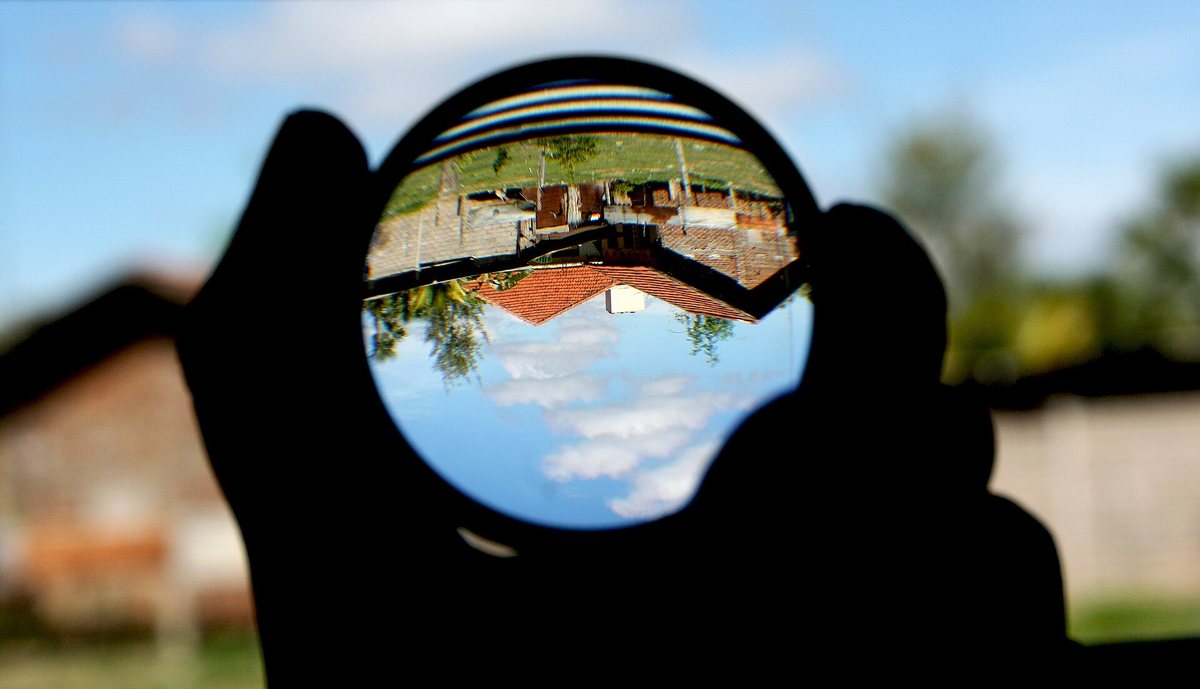
If you move the object farther than the focal point, the view changes. The image turns upside down and gets smaller the farther away you move it. If you place it exactly at the focal point, no image forms. A magnifying glass makes things look bigger only when the object is close to the lens.

Want to know more?
- A round drop of water can also work like a tiny magnifying glass and make things behind it look bigger.
- There are "convex lenses," which are thick in the middle, and "concave lenses," which are thin in the middle. Magnifying glasses use convex lenses.
- Our eyes also use the bending of light (refraction) to gather light at the back of the eye so we can see.

Quick quiz: test yourself
Why do things look bigger through a magnifying glass?
Show the answer
- It makes the light brighter
- It bends light inward
- It makes colors darker
It bends light inward The lens, thick in the middle, bends light inward, so your eyes and brain take the light as if it came from a much bigger object.
The lens, thick in the middle, bends light inward, so your eyes and brain take the light as if it came from a much bigger object.
Next quiz ›Sources
- Converging Lenses - Object-Image RelationsThe Physics Classroom
- Simple MagnifierHyperPhysics (Georgia State University)
- Refraction of lightScience Learning Hub (University of Waikato)
This article was written after checking the sources above as of 2026-10-03. Explanations may change as research progresses. Photo credits are shown below each photo.