Why do fireflies light up at the tail?

 First, let me give you the answer in 30 seconds.
Fireflies glow from a "light organ" near the end of the abdomen, where a substance called luciferin reacts with oxygen with help from an enzyme called luciferase. The light gives off almost no heat. Most adult fireflies look for mates using a flash pattern that is set for each species. The larvae glow too, and the light is thought to have started as a warning to enemies.
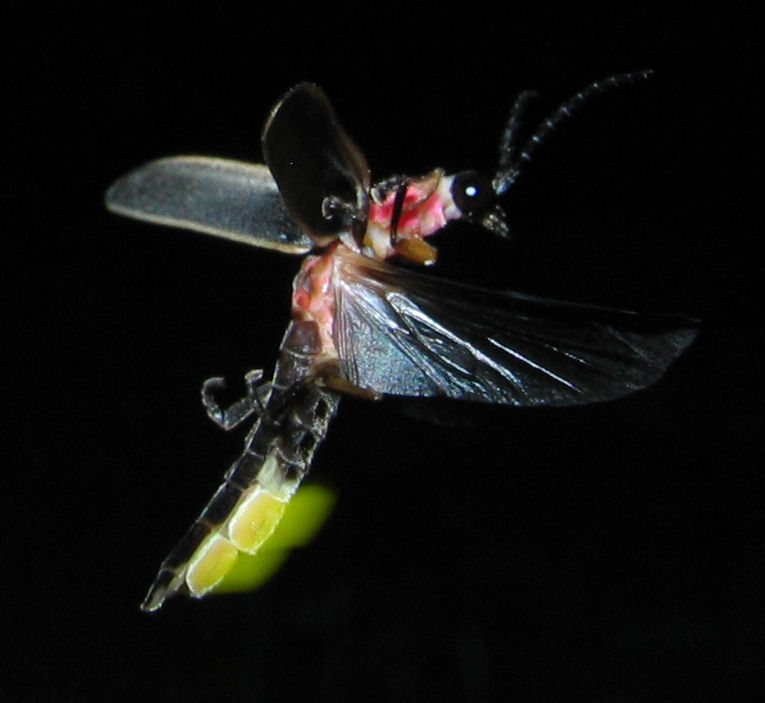
The glow comes from a light organ in the belly
The part of a firefly that glows is often called its "tail," but it is actually a "light organ" near the back end of its belly (abdomen). If you look at a firefly from underneath, it is the whitish-looking part.
Light that makes almost no heat
Inside the light organ, a substance called luciferin gives off light together with oxygen and an enzyme called luciferase (a protein that helps a reaction happen). This reaction makes almost no heat, and nearly all of the energy becomes light. In an incandescent light bulb, only about 10% becomes light and the other 90% or so turns into heat, so a firefly's light is very efficient by comparison. The color is usually yellow-green, but some kinds glow bluish or whitish.

For adults, a signal to find a mate
The main reason adult fireflies glow is to find a mate. Each kind of firefly has its own set flash pattern, so they can recognize their own kind even in the dark. In many cases, the males flash while flying, and the females near the ground answer by glowing from below. Some kinds blink, while others glow steadily.
Larvae glow too, first as a warning
It is not only adults that glow. All known firefly larvae in the world glow. Firefly light is thought to have started as a warning to enemies, saying "I have nasty-tasting substances, so don't eat me." This warning role is believed to remain in the light of adults as well. However, some kinds of adult fireflies do not glow.
Want to know more?
- More than 2,000 kinds of fireflies have been found around the world, and they spend most of their lives as larvae. The larval stage lasts 1–2 years, while adult life lasts only about 3–4 weeks.
- The larvae grow up in fallen leaves, eating snails, slugs, and other small animals. That is why places with lots of fallen leaves are said to be important for fireflies to grow.
- In the United States, there is a firefly whose many males flash 5–8 times all at once, go dark for about 8 seconds, and then flash again, matching their timing with each other.

Quick quiz: test yourself
How does a firefly make its light?
Show the answer
- Its body heat glows
- A substance reacts with oxygen
- Glowing bacteria live inside it
A substance reacts with oxygen In the light organ, a substance called luciferin reacts with oxygen with help from the enzyme luciferase. This light gives off almost no heat.
In the light organ, a substance called luciferin reacts with oxygen with help from the enzyme luciferase. This light gives off almost no heat.
Next quiz ›Sources
- Fireflies - Great Smoky Mountains National ParkU.S. National Park Service
- Why Do Fireflies Light Up? And How Can I Bring More Fireflies to My Yard?NC State News (North Carolina State University)
This article was written after checking the sources above as of 2026-10-03. Explanations may change as research progresses. Photo credits are shown below each photo.