Why do we get motion sickness?

 The stars of the story are the balance organ deep in your ear, and your eyes.
The leading explanation for motion sickness is a sensory mismatch. The balance organ deep in the ear reports that we are moving, while the eyes, looking at still things inside the car, report that nothing is moving. When the brain detects this mismatch, signs such as feeling unwell are thought to appear.

The ears and eyes disagree
Deep inside the ear is an organ that senses tilting and movement. When we ride in a car or on a boat, it tells the brain that we are moving. But if we look at things inside the vehicle that seem still, such as the seats or a book, our eyes report that nothing is moving. The NHS, the UK's National Health Service, explains that these confusing messages make us feel unwell.
A mismatch with the brain's prediction
According to the U.S. Centers for Disease Control and Prevention (CDC), the leading idea is the sensory conflict theory. The brain predicts what signals should come from the ears, the eyes and the body's sense of movement when we move. When the signals that actually arrive don't match that prediction, certain centers in the brain become active, and the symptoms of motion sickness are thought to appear.
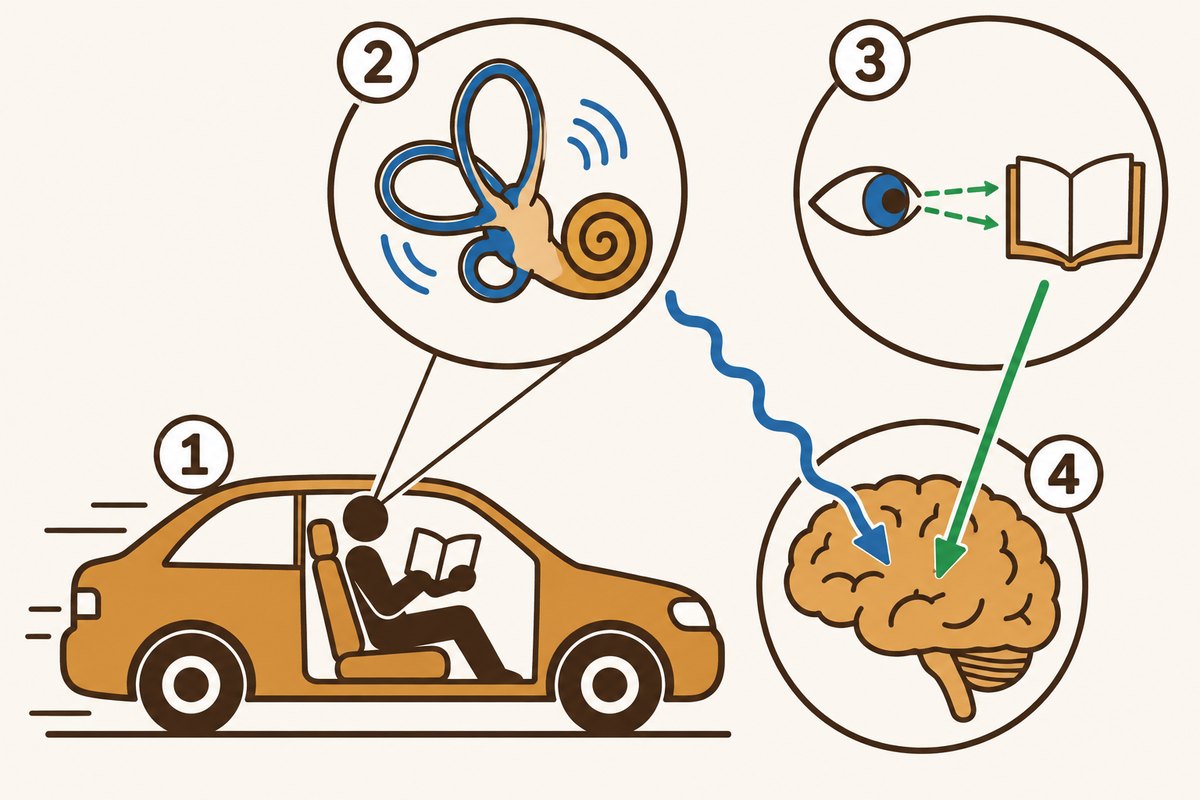
- 1A person reading a book in a car
- 2The organ deep in the ear that senses motion
- 3The eyes looking at a book that seems still
- 4The two messages that disagree when they reach the brain

The first signs
Motion sickness usually builds up gradually. According to the CDC, it often starts with stomach awareness, a warm feeling, yawning and sweating, and can move on to dizziness and nausea. The face may turn pale, with a cold sweat. People can also get sick in VR (virtual reality) and simulators, where eyestrain and headaches are said to be more common.
Everyone is different
Children under 2 usually do not get motion sickness. Sensitivity peaks around ages 7 to 12 and goes down in adulthood, perhaps because the brain gets used to motion after many rides. People with migraines or dizziness problems are more prone to it, and twin studies suggest that 55 to 70% of the differences in how easily people get it come from inherited traits. If it is hard on you or you are worried, talk to a doctor.
Want to know more?
- Some surveys say women get motion sickness more easily than men, but that difference is much smaller than the difference by age.
- It takes time for the brain to get used to motion, and keeping that tolerance is said to require riding again from time to time.
- Motion sickness can happen not only in cars and on boats, but also on planes and trains.
Quick quiz: test yourself
Remember what you just read? Give it a try!What is the leading explanation for motion sickness?
Show the answer
- Food sloshing around in the stomach
- Signals from the ears and eyes don't match
- The air in the car is thin
Signals from the ears and eyes don't match The inner ear says we are moving and the eyes say we are not, and when this doesn't match the brain's prediction, motion sickness symptoms are thought to appear.
The inner ear says we are moving and the eyes say we are not, and when this doesn't match the brain's prediction, motion sickness symptoms are thought to appear.
Next quiz ›Sources
- Motion sicknessNHS(イギリス国民保健サービス)
- Motion Sickness | CDC Yellow BookCDC(アメリカ疾病予防管理センター)
This article was written after checking the sources above as of 2026-10-03. Explanations may change as research progresses. Photo credits are shown below each photo.
Next fun fact ▶
 Human BodyIs yawning contagious? Why do people yawn when others do?When we see someone yawn, we often end up yawning too. Why might that be?

40 surprising animal facts with big photos and short, easy text. A fun-facts book for kids and grown-ups to read together.
See it on Amazon