How many hearts does an octopus have?

 The answer is three. Let me show you what each heart does.
An octopus has three hearts. Two of them sit next to the gills and send blood to the gills, and the remaining one sends the blood that has picked up oxygen in the gills all around the body. Octopus blood carries oxygen with a substance that contains copper, so it is blue.
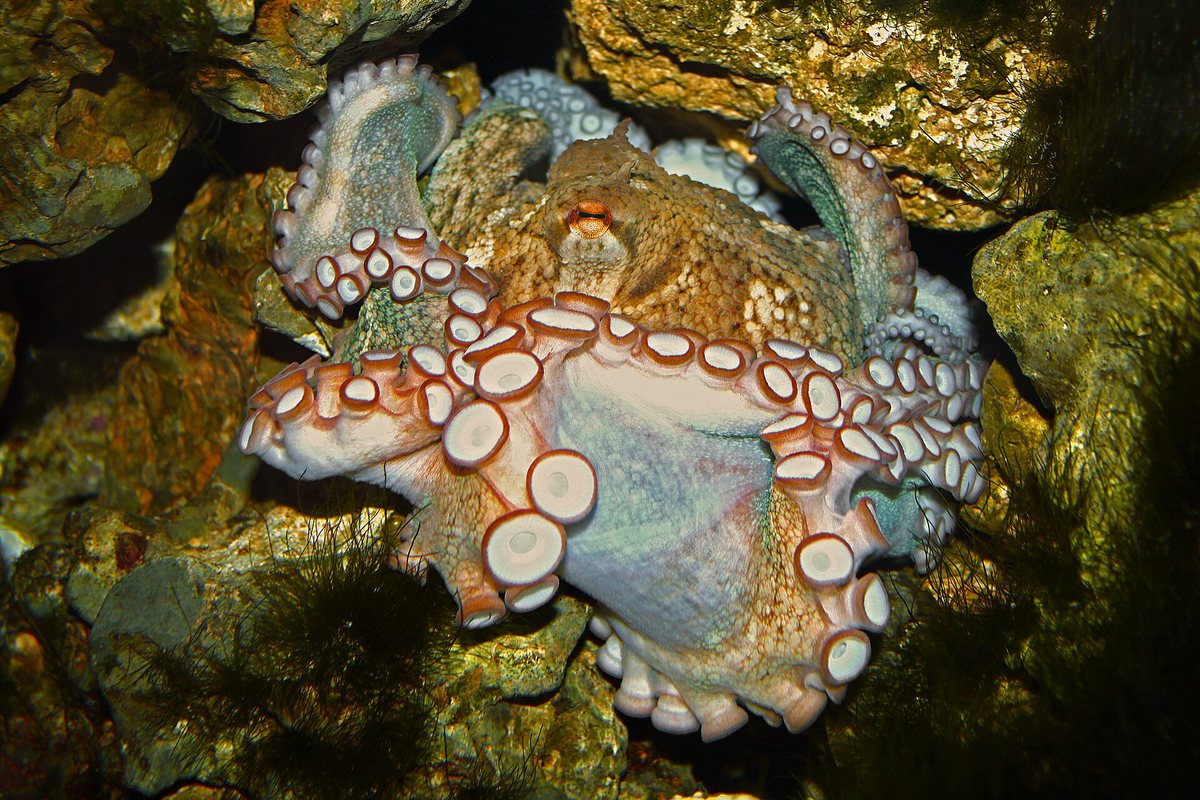
Two hearts for the gills, one for the body
According to the National Aquarium in the United States, two of an octopus's three hearts are called "branchial hearts" (gill hearts), and they send blood to the gills. In the gills, the blood gives off carbon dioxide and takes in oxygen. Then the remaining "systemic heart" (body heart) sends the oxygen-rich blood all around the body.
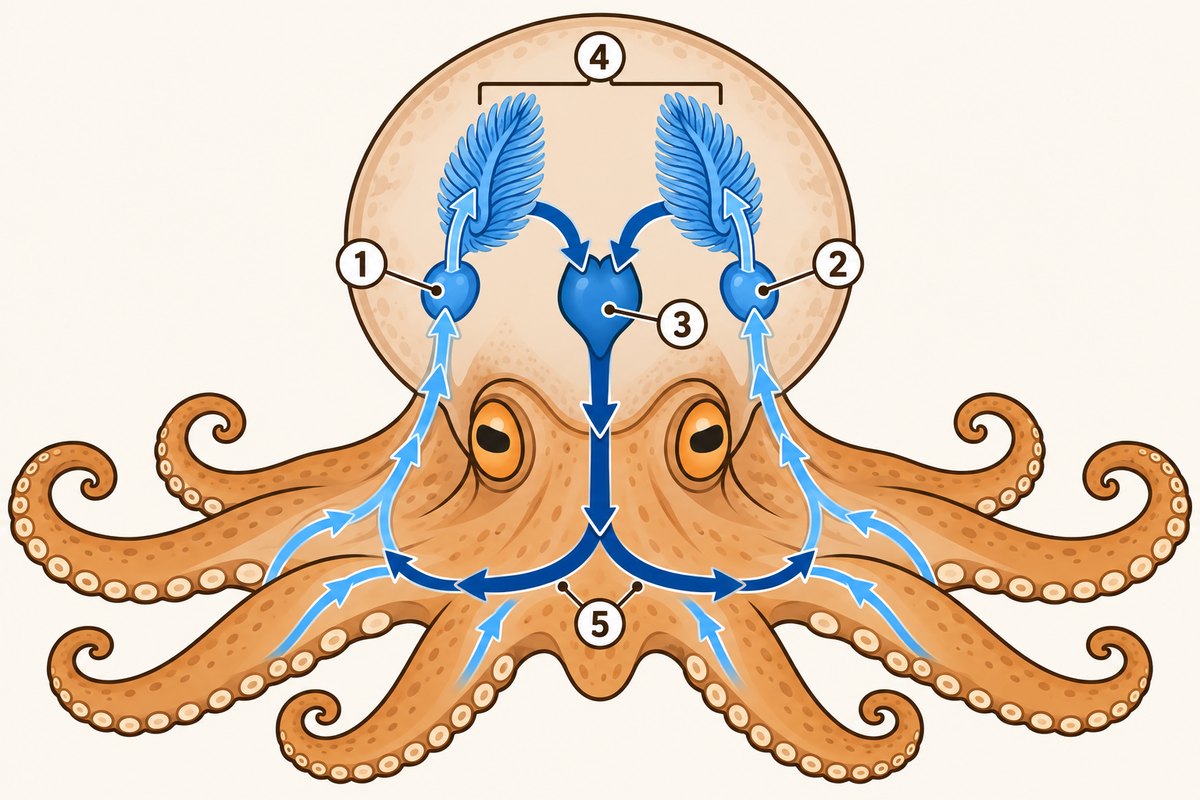
- 1Gill heart (left)
- 2Gill heart (right)
- 3Systemic heart (to the whole body)
- 4Gills (a pair)
- 5Blood going out to the body and coming back
Jobs like those of the human heart
Their jobs are much like those of the human heart. In the human heart, the right side sends blood to the lungs and the left side sends it around the body. It is easy to understand if you think of the octopus as having separate hearts for these two jobs.
Why their blood is blue
Octopus blood is blue. Human blood carries oxygen with hemoglobin, which contains iron, so it looks red. Octopuses carry oxygen with a substance called hemocyanin, which contains copper, so their blood looks blue. The Smithsonian Institution's magazine explains that hemocyanin is good at carrying oxygen in places like the deep sea, where the water is cold and low in oxygen.
The body heart stops when they swim
The Smithsonian's magazine also says that an octopus's body heart stops when it swims. A 1987 study of the common octopus also reported that when it swims by "jet propulsion," shooting out water to move forward, its heart stops, and it cannot keep swimming for more than a few meters. This is thought to be why octopuses crawl along the seafloor more often than they swim.

Want to know more?
- Two-thirds of an octopus's nerve cells are in its arms, not its head, so the arms can sense taste and touch and move on their own.
- In English, an octopus's eight limbs are called "arms," not "tentacles."
- An octopus's eyes are built much like human eyes, but they do not have the "blind spot" that human eyes have.

Quick quiz: test yourself
How many hearts does an octopus have?
Show the answer
- One
- Two
- Three
Three Two hearts sit next to the gills and pump blood to the gills, and the third sends the oxygen-rich blood all around the body.
Two hearts sit next to the gills and pump blood to the gills, and the third sends the oxygen-rich blood all around the body.
Next quiz ›Sources
- Otherworldly OctopusesNational Aquarium
- Ten Wild Facts About Octopuses: They Have Three Hearts, Big Brains and Blue BloodSmithsonian Magazine(Smithsonian Institution)
- Blood flow and pressure changes in exercising Octopuses (Octopus vulgaris)Journal of Experimental Biology(University of Southampton 収蔵)
This article was written after checking the sources above as of 2026-10-03. Explanations may change as research progresses. Photo credits are shown below each photo.