Why are snowflakes shaped like hexagons?

 I've summed up the secret of the hexagon in 30 seconds.
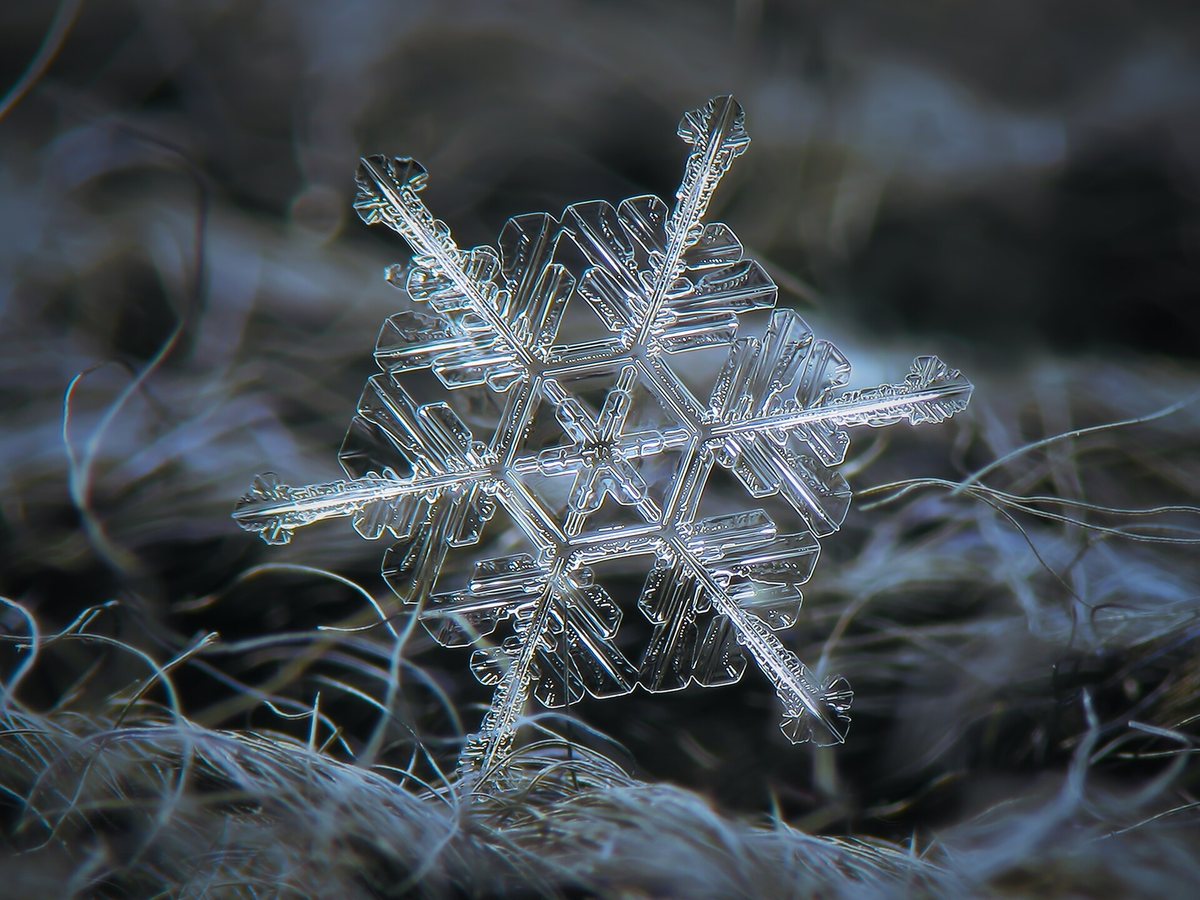
Snowflakes are hexagonal because, in ice, water molecules line up in a pattern that forms hexagons. A tiny grain of ice first grows into a hexagonal prism, and then branches grow out from its 6 corners. The 6 branches fall together through the same air, so they grow into very similar shapes.
It starts with how molecules line up
A snowflake is not a frozen raindrop. It forms inside a cloud when water vapor in the air turns directly into ice. In ice, water molecules link to each other as if holding hands, lining up in a pattern with hexagon-shaped gaps. This arrangement is the source of the snowflake's hexagon shape.
First, a tiny hexagonal prism
A tiny grain of ice born in a cloud first becomes a hexagonal prism surrounded by flat faces. Water molecules have a hard time sticking to faces where the molecules are neatly lined up, so those faces grow slowly and stay flat. In this way, an arrangement of molecules far too small to see shows up as a hexagon we can see.
6 branches grow from the corners
As the crystal gets bigger, the water vapor in the surrounding air starts to run short. The sharp corners can catch water vapor coming from farther away more easily, so they grow faster than the other parts. Branches then sprout from the 6 corners, forming the familiar snowflake shape.

Why the 6 branches match
The 6 branches look alike, but not because they are somehow communicating with each other. Inside a small crystal, every branch feels almost the same temperature and humidity, so they all grow in the same way. Each crystal takes a different path through the cloud, so every one ends up with a different shape.
Want to know more?
- Crystals with wide, spreading branches are said to form most easily at about minus 15℃. Depending on the temperature, a crystal may grow into a column-like shape instead of a flat plate.
- In snow that actually falls, crystals with broken or uneven shapes are said to be far more common than neat hexagonal ones.
- Snow looks white because light bounces off the surfaces of the clear ice crystals in many different directions.

Quick quiz: test yourself
Why are snowflakes six-sided?
Show the answer
- Water molecules line up in hexagons
- Frozen raindrops crack apart
- Wind wears down the corners
Water molecules line up in hexagons In ice, water molecules line up in a hexagon pattern. A tiny ice grain first grows into a six-sided prism, and branches grow out from its corners.
In ice, water molecules line up in a hexagon pattern. A tiny ice grain first grows into a six-sided prism, and branches grow out from its corners.
Next quiz ›Sources
- Frequently Asked Questions about Snow CrystalsCalifornia Institute of Technology(カリフォルニア工科大学, Kenneth G. Libbrecht)
- Why do snowflakes crystallize into such intricate structures?Scientific American(米国大気研究センター Charles A. Knight の解説)
This article was written after checking the sources above as of 2026-10-03. Explanations may change as research progresses. Photo credits are shown below each photo.