Does sugar really make kids hyper?

 The answer lies in careful experiments where no one knew what the children had eaten.
Research suggests it's mostly a myth. An analysis of experiments that compared sugar with sweeteners, without telling anyone which was which, concluded that sugar does not affect children's behavior or thinking. In another experiment, parents who were told their child had eaten sugar saw the child as more restless.

Why do people say sugar makes kids hyper?
Many parents feel that "when kids eat sweets, they get wild and can't settle down." There had also long been reports that sugar causes restlessness or behavior problems in children. So researchers set out to test, with careful experiments, whether sugar was really to blame.
Experiments comparing sugar and sweeteners
In a 1994 study, 25 children aged 3 to 5, and 23 children aged 6 to 10 whose parents thought they were "sensitive to sugar," each followed 3 different diets for 3 weeks at a time: one high in sugar, and others using the sweeteners aspartame or saccharin. The study was run without telling which diet was which, and for the "sugar-sensitive" children there was no difference between the diets in any of 39 measures.
What 16 reports show together
In 1995, a paper analyzed such studies together. It looked at 16 reports that gave children a set amount of sugar, compared it with a sweetener, and kept the children, parents and researchers from knowing which was which. It concluded that sugar does not affect children's behavior or thinking. However, it also said that a very small effect, or effects on only some children, could not be ruled out.
From a 1995 paper in JAMA.

Expectations change what we see
So why do so many people believe it? In another 1994 experiment, 35 boys aged 5 to 7 and their mothers were split into 2 groups, and only one group of mothers was told, "Your son has had a lot of sugar." In fact, all the boys had only had a sweetener, yet the mothers who heard this rated their sons as more restless. The 1995 paper says that parents' expectations, and the way sweets and excitement are often linked, may explain the belief.
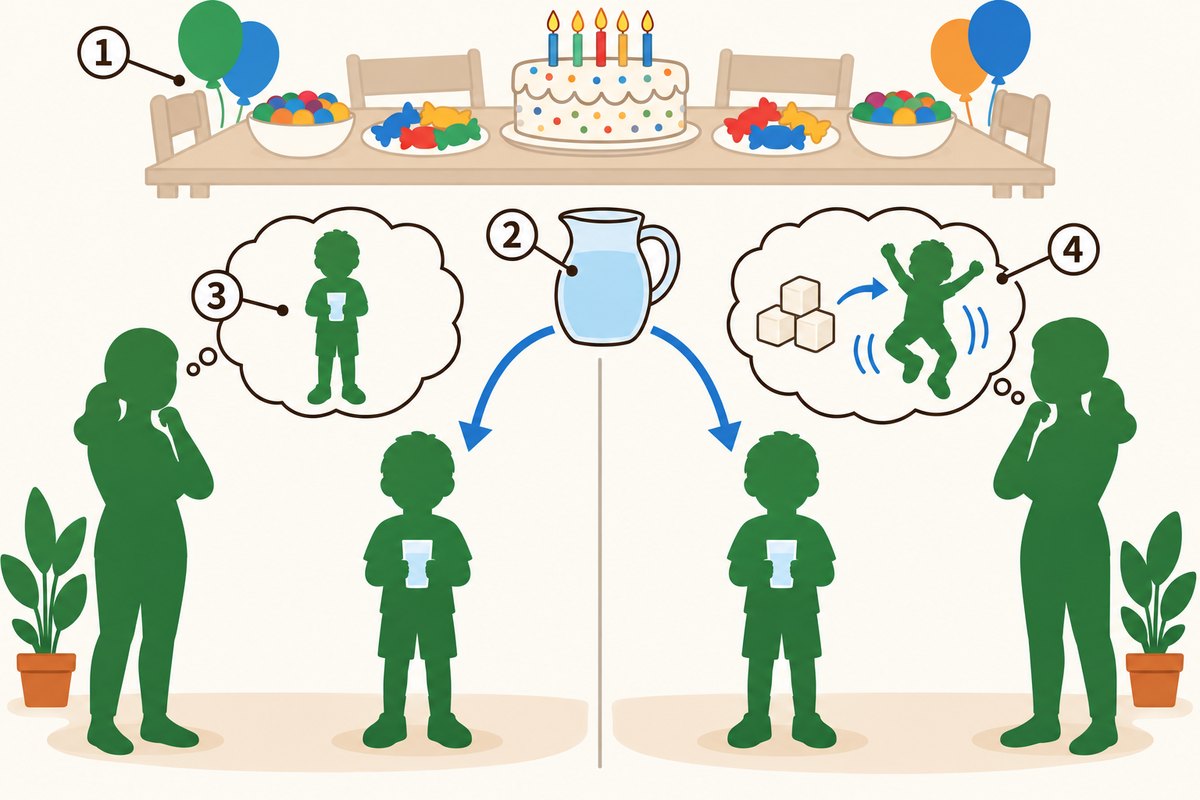
- 1A birthday party, where sweets and wild behavior are easily linked
- 2The same sweetener drink that both children had
- 3An adult who sees the child as calm
- 4An adult who believes the child had sugar and sees them as restless
Want to know more?
- In the 1994 study, young children on the high-sugar diet ate an average of about 5600mg of sugar per 1kg of body weight per day, more than in a usual diet.
- Mothers who were told their son had had sugar also tended to stay closer to him and to criticize and talk to him more.
- The same 1994 study reported that the sweetener aspartame did not affect children's behavior or thinking either.
Quick quiz: test yourself
Remember what you just read? Give it a try!What did research conclude about sugar and children's behavior?
Show the answer
- No effect was found
- Kids always get hyper
- Only boys get hyper
No effect was found An analysis of 16 reports concluded that sugar does not affect children's behavior or thinking.
An analysis of 16 reports concluded that sugar does not affect children's behavior or thinking.
Next quiz ›Sources
- The effect of sugar on behavior or cognition in children. A meta-analysisJAMA(PubMed 掲載の査読論文)
- Effects of diets high in sucrose or aspartame on the behavior and cognitive performance of childrenThe New England Journal of Medicine(PubMed 掲載の査読論文)
- Effects of sugar ingestion expectancies on mother-child interactionsJournal of Abnormal Child Psychology(PubMed 掲載の査読論文)
This article was written after checking the sources above as of 2026-10-03. Explanations may change as research progresses. Photo credits are shown below each photo.
Next fun fact ▶
 Human BodyDoes each part of the tongue taste something different?Many of us learned that the tip of the tongue tastes sweet and the back tastes bitter. Do you remember that?

40 surprising animal facts with big photos and short, easy text. A fun-facts book for kids and grown-ups to read together.
See it on Amazon