How does wireless charging work without a cable?

 The stars of the story are two coils hidden inside the charger and the phone.
Because the charger and the phone each have a coil (a wire wound into a spiral), and power is sent between them using a magnetic field. When a current that keeps changing direction flows through the charger's coil, it creates a magnetic field, and that field produces a voltage in the phone's coil. This is called electromagnetic induction.
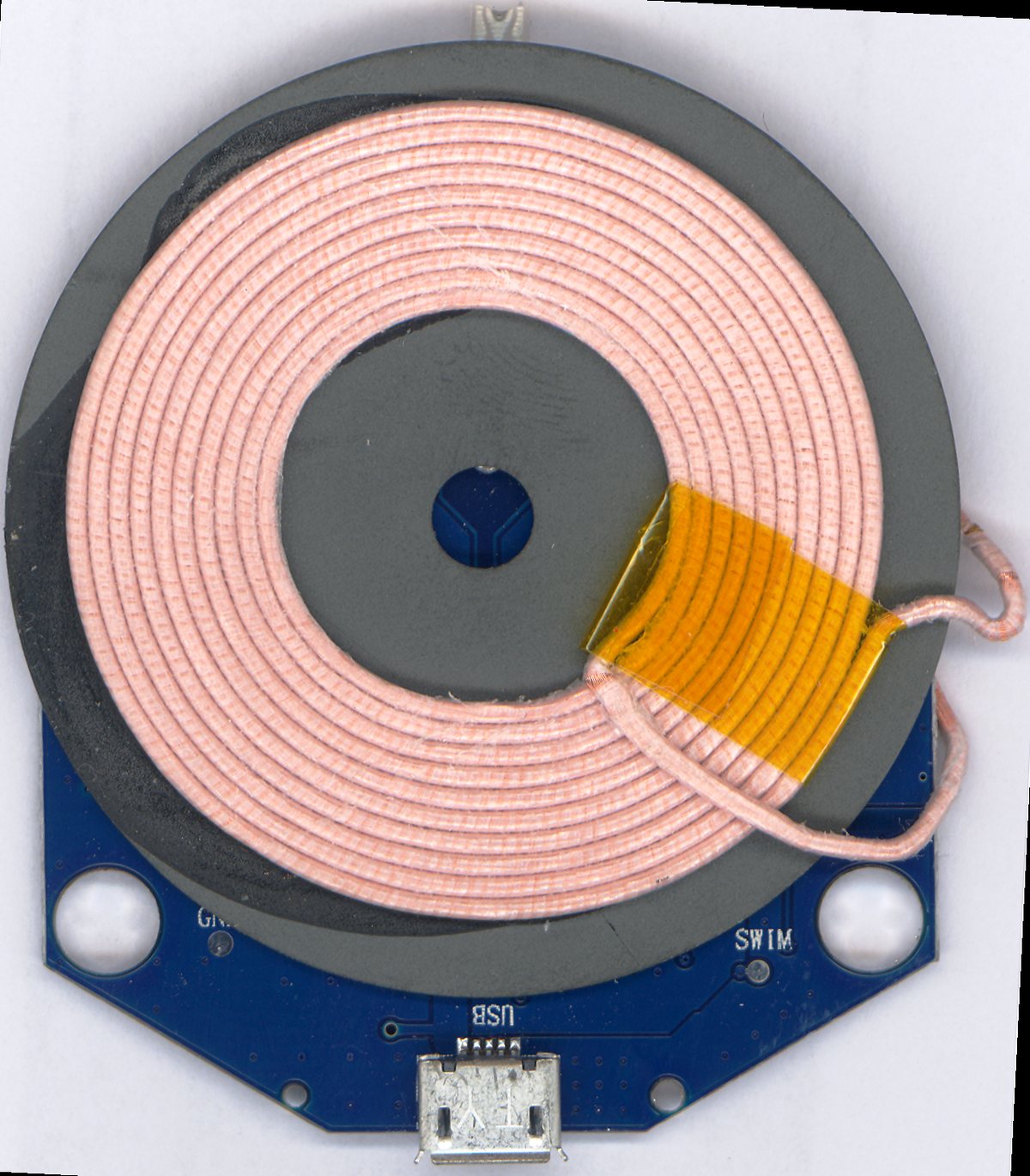
Two coils face each other inside
One standard for wireless charging, where you simply set your phone down, is called Qi. According to the Wireless Power Consortium (WPC), which develops it, you need two coils: a transmitter coil in the charger and a receiver coil in the phone. An alternating current (a current that keeps changing direction) in the transmitter coil creates a magnetic field, and that field produces a voltage in the receiver coil. This voltage charges the battery.
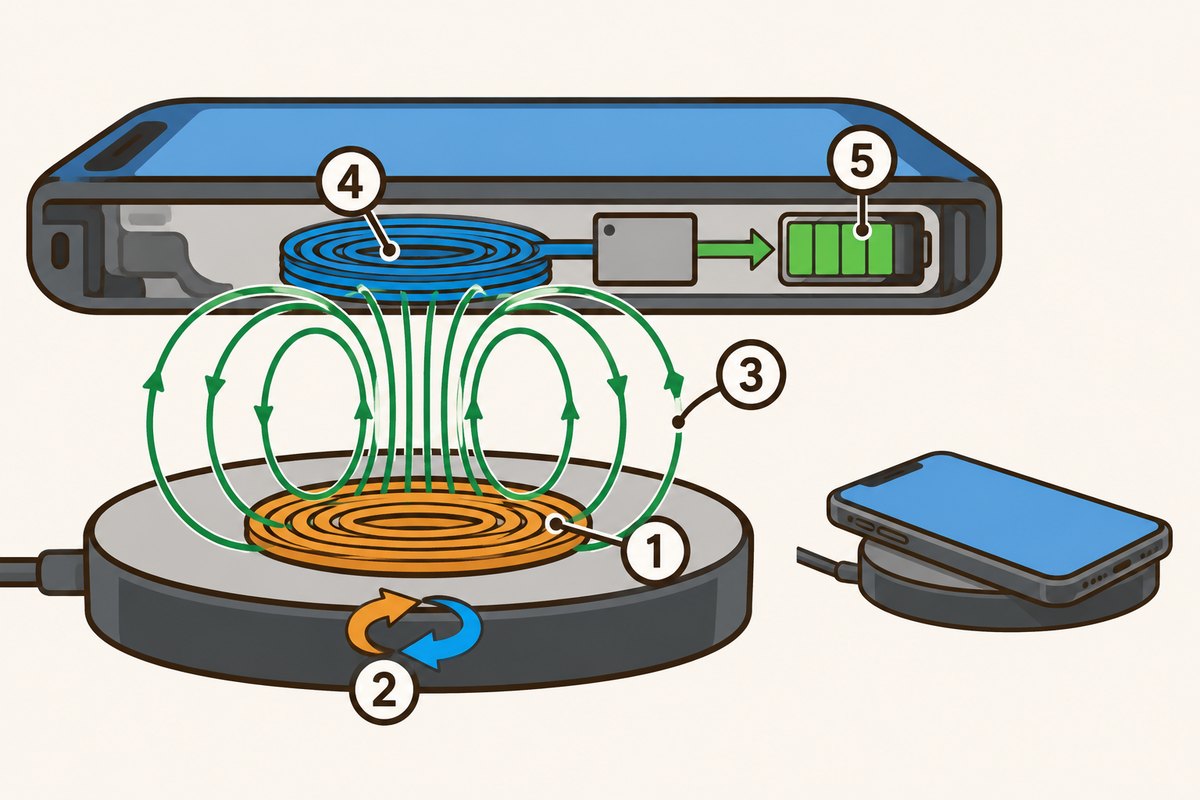
- 1The sending coil inside the charging pad
- 2Current that keeps changing direction
- 3The changing magnetic field
- 4The receiving coil inside the phone
- 5Charging the battery
The magnetic field has to change
It is based on electromagnetic induction, discovered in 1831 by Michael Faraday and others. According to OpenStax, a textbook from Rice University, moving a magnet relative to a coil makes a current flow, but a magnet that stays still does not. The voltage produced depends on how fast the magnetic field changes. That is why the charger uses alternating current to keep the magnetic field changing.

Closer and better lined up works best
According to the WPC, only part of the magnetic field made by the transmitter coil passes through the receiver coil. How much depends on the distance between the coils, their size, their shape and their angle, and it drops when the coils' centers are out of line. Apple also advises placing an iPhone in the center of the charger for the best performance.
Based on the WPC and Apple.
The phone and charger send signals
Coils and current alone are not enough for good charging. The WPC explains that, to send power without waste, the phone must send signals to the charger and be able to stop it when the battery is full.
Tips for charging well
Apple advises not placing anything between the phone and the charger, because it could damage magnetic strips or RFID chips (chips read by radio) found in some credit cards. If the phone will not charge with a thick or metal case, take the case off. The phone may get slightly warmer while charging, and if the battery gets too warm, charging above 80% may be held back.
Want to know more?
- Electromagnetic induction is also used in generators and transformers (OpenStax).
- According to Apple, an iPhone will not charge wirelessly while it is connected by a USB cable.
- The coupling factor, which shows how strongly two coils are linked, is a number from 0 to 1. Values of about 0.3 to 0.6 are typical (WPC).
Quick quiz: test yourself
Remember what you just read? Give it a try!What is the name of the effect that lets a phone charge just by being set down?
Show the answer
- Static electricity
- Electromagnetic induction
- The photoelectric effect
Electromagnetic induction The changing magnetic field from the charger's coil produces a voltage in the phone's coil. This is called electromagnetic induction.
The changing magnetic field from the charger's coil produces a voltage in the phone's coil. This is called electromagnetic induction.
Next quiz ›Sources
- How Qi WorksWireless Power Consortium(ワイヤレスパワーコンソーシアム)
- Principle of Inductive PowerWireless Power Consortium(ワイヤレスパワーコンソーシアム)
- Coupling FactorWireless Power Consortium(ワイヤレスパワーコンソーシアム)
- 20.3 Electromagnetic InductionOpenStax(ライス大学)
- How to wirelessly charge your iPhoneApple サポート
This article was written after checking the sources above as of 2026-10-03. Explanations may change as research progresses. Photo credits are shown below each photo.
Next fun fact ▶
 TechnologyWhy does AI state wrong things as if they were true?Sometimes an AI answers with great confidence about things that aren't true. Why might that be?

40 surprising animal facts with big photos and short, easy text. A fun-facts book for kids and grown-ups to read together.
See it on Amazon