Why does the back of a CD shine in rainbow colors?

 Let me give you the answer in 30 seconds first.
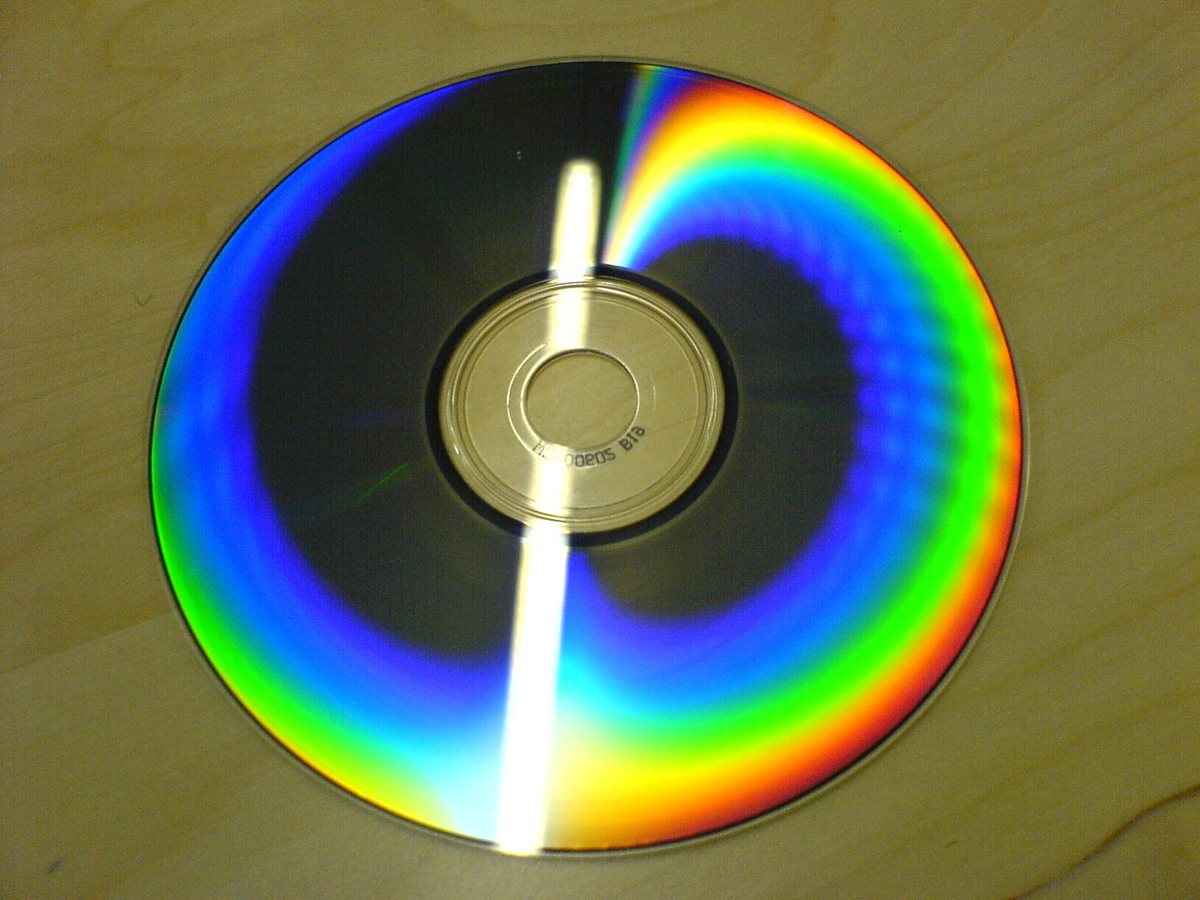
The back of a CD looks rainbow-colored because the thin tracks that hold its data are lined up very close together, just 1.6 micrometers apart. Light reflected from each track overlaps, and which color gets stronger depends on the angle you look from, so white light splits into rainbow colors. The CD itself is not giving off light.
Data tracks split the light
A CD has tracks that hold its data, packed tightly together in a spiral. According to a physics demonstration page from the University of Colorado Boulder, the tracks are 1.6 micrometers apart (about 1/600 of a millimeter). These fine, regular tracks work the same way as a "diffraction grating," a tool that splits light into colors, and they separate white light into rainbow colors.
The strongest color changes with the angle
According to Nicolaus Copernicus University in Poland, when light hits a CD, each of the evenly spaced tracks acts like its own source of light. The light coming from the tracks either adds up or cancels out, depending on the color and the angle you view it from. Each color gets stronger at a different angle, so you see different colors in different places, and the colors change when you tilt the CD just a little.
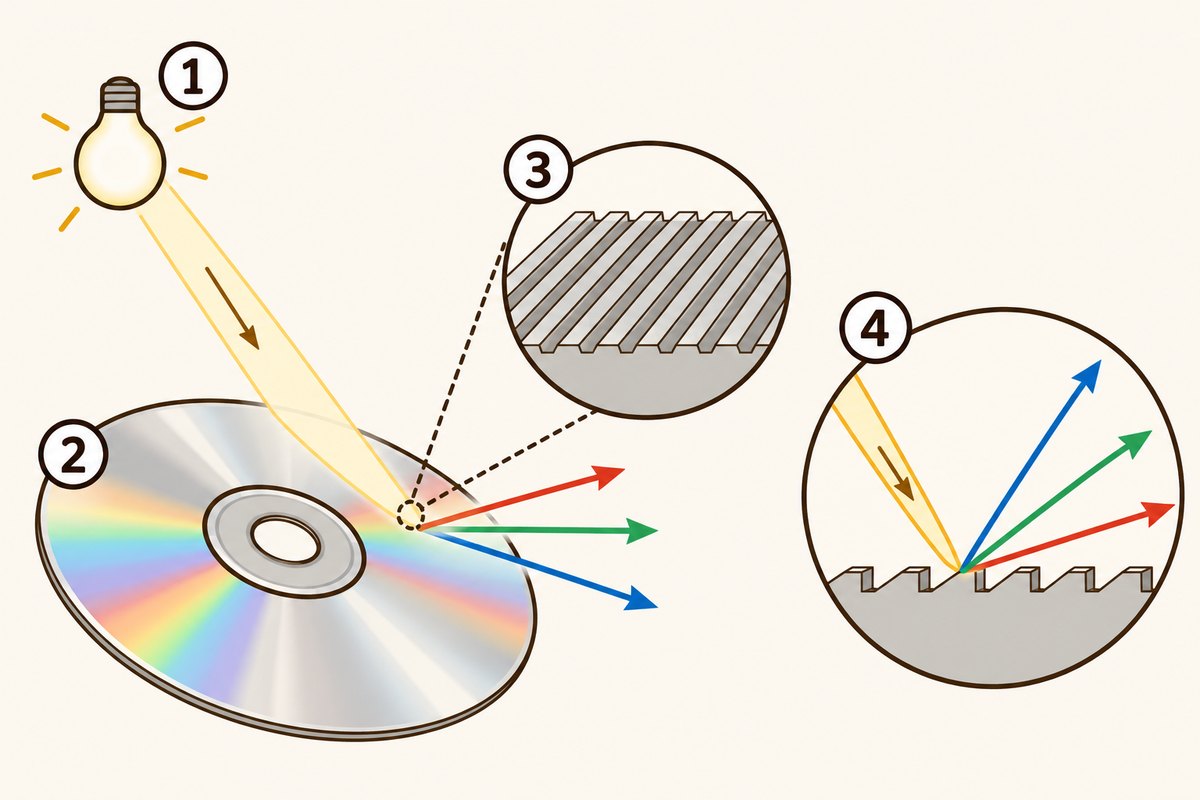
- 1White light from a light bulb
- 2The readable side of a CD
- 3Close-up of evenly spaced fine tracks
- 4Blue, green and red light reflecting at different angles for each color

White in the middle, rainbow around it
In an experiment at the University of Colorado, white light was shone on the data side of a CD and reflected onto a wall. Around the bright white light bounced back like a mirror, rainbow colors appeared, from violet to red. A prism also splits white light into colors, but a CD is different: it sends each color off at a different angle because of how finely its tracks are spaced.
DVDs work the same way
According to the University of Vermont, most diffraction gratings sold commercially are made of many fine grooves lined up close together, and an everyday example is the surface of a DVD. The data dots on a DVD are about 400 nanometers wide (1/2500 of a millimeter), and a DVD splits light into colors just like a CD.
Want to know more?
- If you reflect light from a compact fluorescent bulb on a CD, some rainbow colors look missing. Which colors appear depends on the gas inside the bulb.
- Light split by a CD separates into crisp colors, close to what a real spectrometer (a device that sorts light by color) can tell apart.
- The rainbow colors of a soap bubble come from light reflected off the front and back of its thin film, so they form in a different way from a CD's colors.

Quick quiz: test yourself
Remember what you just read? Give it a try!Why does the back of a CD look rainbow-colored?
Show the answer
- It is coated with rainbow paint
- The CD itself gives off light
- Fine tracks split light into colors
Fine tracks split light into colors Light reflected from tracks lined up 1.6 micrometers apart builds up at a different angle for each color.
Light reflected from tracks lined up 1.6 micrometers apart builds up at a different angle for each color.
Next quiz ›Sources
- CD RainbowUniversity of Colorado Boulder, Physics Undergraduate Labs
- CD spectrometerNicolaus Copernicus University in Toruń, Faculty of Physics(Physics Toys)
- Diffraction And InterferenceThe University of Vermont
This article was written after checking the sources above as of 2026-10-03. Explanations may change as research progresses. Photo credits are shown below each photo.
Next fun fact ▶
 ScienceWhy do soap bubbles look rainbow-colored?Rainbow-like colors swirl across the surface of a soap bubble. Soapy water has no color at all, so isn't that strange?

40 surprising animal facts with big photos and short, easy text. A fun-facts book for kids and grown-ups to read together.
See it on Amazon