Why does a compass needle point north?

 Its partner is the Earth itself.
A compass points north because the whole Earth acts like a giant magnet, and the needle lines up with the direction of its magnetic field. Most of Earth's magnetic field is created by the movement of the liquid outer core deep inside the planet. However, the north a compass points to (magnetic north) is slightly off from the north on a map (true north). In almost all of Japan, it is a few degrees to the west.
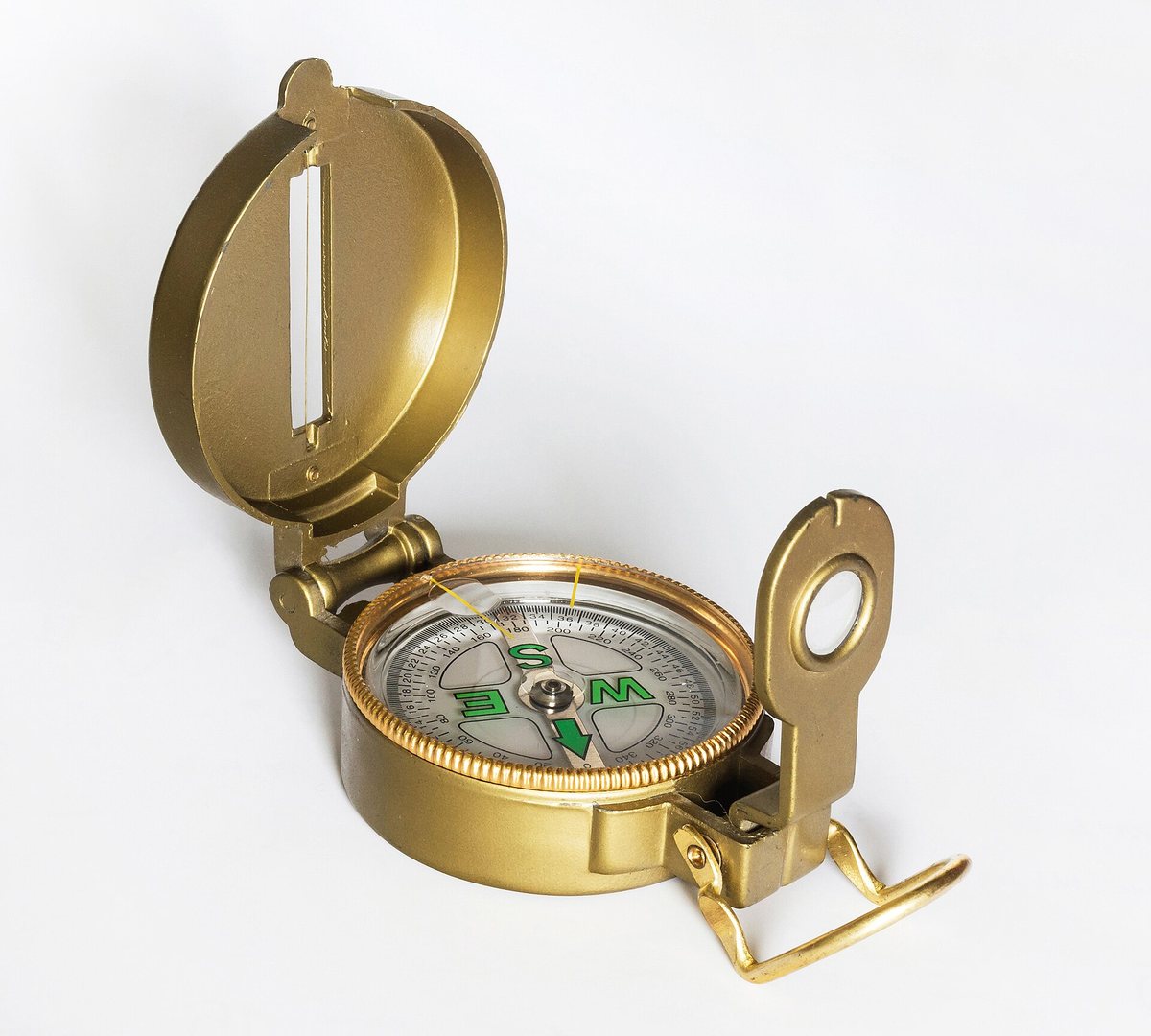
Earth is a giant magnet
According to the National Centers for Environmental Information of the U.S. National Oceanic and Atmospheric Administration (NOAA), Earth is wrapped in a magnetic field much like the one you would get from a bar magnet placed at its center. More than 90% of the magnetic field measured at the surface is created in Earth's outer core. An explanation from the University of Colorado says this field is produced by the flowing liquid of the outer core.
The pole in the north is actually an S pole
With magnets, opposite poles attract each other. Since the N pole of a compass needle points north, Earth's magnetic pole in the north is actually an S pole by the rules of physics. Because compasses were used long before people understood how magnets work, it is still called the "north magnetic pole" by custom.

It's off from map north
The axis of Earth's magnet is tilted a little from the axis Earth spins on. So "magnetic north," where a compass points, is off from "true north" on a map. According to the Geospatial Information Authority of Japan, magnetic north is shifted to the west everywhere in Japan except Minamitorishima, a remote island. Based on 2020 values, the shift is about 10 degrees in Sapporo and about 6 degrees in Naha. When hiking with a map and compass, you need to take this difference into account.
The angle in the figure is drawn larger than it really is to make it easy to see. The numbers are from the Geospatial Information Authority of Japan.
The difference changes slowly
Earth's magnetic field changes slowly over the years. According to the Geospatial Information Authority of Japan, the westward shift across Japan as a whole grew by about 1.4 degrees on average over the past 50 years. The direction a compass points is also changing little by little over time.
Want to know more?
- A compass needle does not point at the north magnetic pole itself, but along the horizontal direction of the magnetic field where you are. That is why the size of the shift changes from place to place.
- Compasses made for the Northern and Southern Hemispheres have their small balancing weights in different places to keep the needle level.
- Minamitorishima is the only place in Japan where magnetic north is not shifted west. The shift there is 0 degrees.
Quick quiz: test yourself
Why does a compass needle point north?
Show the answer
- The North Star pulls it
- Earth acts like a giant magnet
- It follows Earth's spin
Earth acts like a giant magnet The whole Earth acts like a big magnet, and the needle lines up with its magnetic field, which comes mostly from movement in the liquid outer core.
The whole Earth acts like a big magnet, and the needle lines up with its magnetic field, which comes mostly from movement in the liquid outer core.
Next quiz ›Sources
- Geomagnetism Frequently Asked QuestionsNOAA National Centers for Environmental Information (NCEI)
- Historical Main Field Change and DeclinationUniversity of Colorado Boulder, Geomag
- 地磁気を知る国土地理院 (in Japanese)
This article was written after checking the sources above as of 2026-10-03. Explanations may change as research progresses. Photo credits are shown below each photo.