Why do your ears get blocked on a plane?

 The keys are a little air pocket behind the eardrum and a thin tube leading to the back of the nose.
It happens because the pressure in the middle ear, behind the eardrum, becomes different from the pressure outside. As a plane climbs, cabin pressure drops quickly, and as it descends, the pressure rises quickly. If the eustachian tube, which links the middle ear to the back of the nose, doesn't open well, air can't move in or out fast enough, and your ears feel blocked or hurt.
There's an air pocket behind the eardrum
Behind the eardrum is a small air-filled space called the middle ear. Normally its air pressure is about the same as the air outside. A thin tube called the eustachian tube connects the middle ear to the back of the nose and the upper throat. When you swallow or yawn, the tube opens, air moves in or out, and the pressure on both sides of the eardrum evens out.
Cabin pressure changes
According to the US Centers for Disease Control and Prevention (CDC), the cabin of a passenger plane is not kept at ground-level pressure. Instead, it is kept at about the same pressure as a place 1,830 to 2,440 meters (about 6,000 to 8,000 feet) above sea level. As the plane climbs, cabin pressure drops quickly, and as it descends to land, the pressure rises quickly. These fast changes are what cause ear trouble.

Why ears feel blocked or hurt
If the eustachian tube is blocked and can't even out the pressure, the pressure stays different on each side of the eardrum. This is called ear barotrauma. It can cause a blocked feeling, ear pain, slightly muffled hearing, or dizziness. A stuffy nose from a cold or allergies makes the tube more likely to get blocked. The CDC says it is usually not severe.
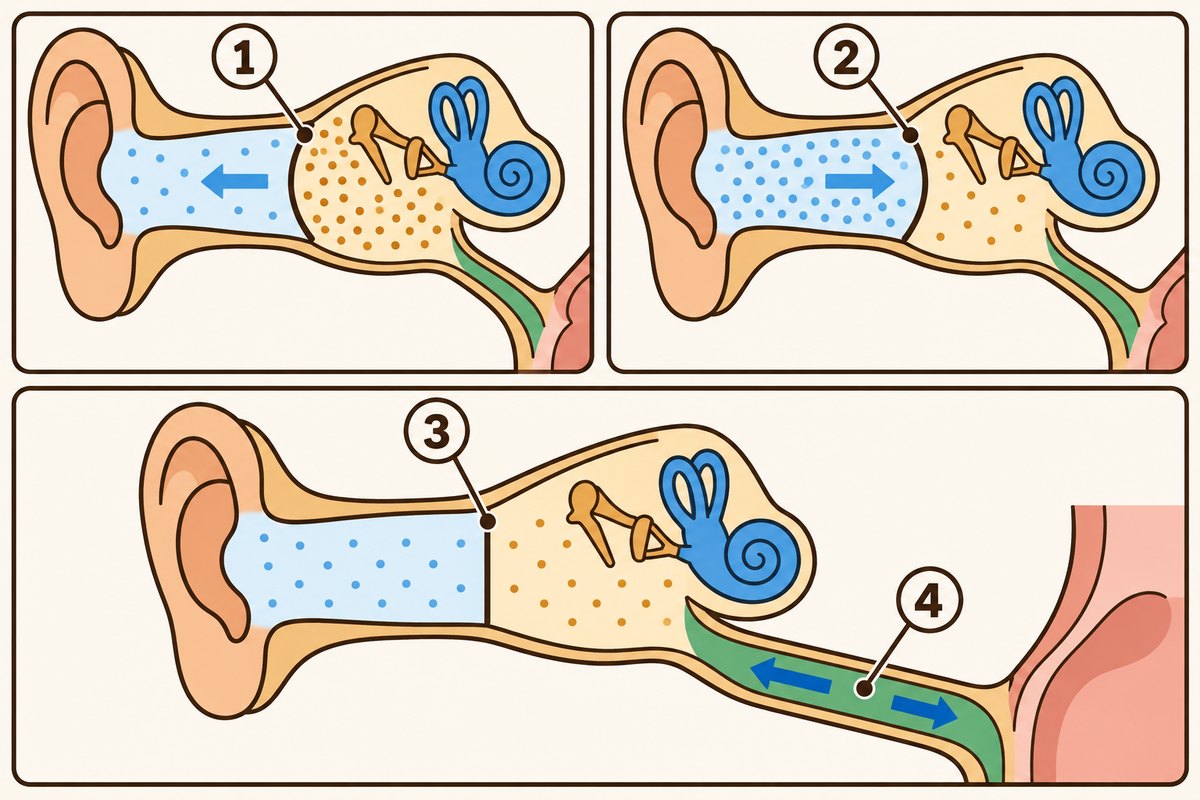
- 1Going up: pressure inside the middle ear is higher, so the eardrum bulges outward
- 2Coming down: outside pressure is higher, so the eardrum bulges inward
- 3Pressure equal on both sides of the eardrum
- 4Air moving in and out through the Eustachian tube
Ways to ease it, and when to get help
MedlinePlus from the US National Library of Medicine suggests chewing gum, sucking on candy, yawning, or breathing in and then gently breathing out with your mouth closed and your nostrils pinched. It advises staying awake while the plane gets ready to land and repeating these steps. For babies, nursing or sipping a drink may help. If the discomfort doesn't ease after a few hours, or if you have severe pain or a fever, see a doctor.
Based on advice from MedlinePlus (US National Library of Medicine).
Want to know more?
- The blocked-ear feeling can also happen when scuba diving or driving on mountain roads, not just when flying.
- Under US aviation rules, cabin pressure on passenger planes must be kept equal to an altitude of 2,440 meters (about 8,000 feet) or lower.
- Some newer planes can keep the cabin at a pressure closer to that of a lower altitude.
Quick quiz: test yourself
Remember what you just read? Give it a try!Which tube connects the middle ear behind the eardrum to the back of the nose?
Show the answer
- The windpipe
- The eustachian tube
- The food pipe
The eustachian tube The eustachian tube connects the middle ear to the back of the nose and upper throat. Swallowing or yawning opens it and evens out the pressure.
The eustachian tube connects the middle ear to the back of the nose and upper throat. Swallowing or yawning opens it and evens out the pressure.
Next quiz ›Sources
- Ear barotrauma: MedlinePlus Medical EncyclopediaMedlinePlus(米国国立医学図書館)
- Air Travel (CDC Yellow Book)CDC(米国疾病予防管理センター)
This article was written after checking the sources above as of 2026-10-03. Explanations may change as research progresses. Photo credits are shown below each photo.
Next fun fact ▶
 Human BodyWhy does hitting your funny bone tingle?That zing the moment your elbow hits the corner of a desk! What exactly are you hitting?

40 surprising animal facts with big photos and short, easy text. A fun-facts book for kids and grown-ups to read together.
See it on Amazon