How do emperor penguins survive the freezing Antarctic?

 Let me give you the answer in about 30 seconds first.
Emperor penguins keep heat from escaping with many layers of feathers and body fat, and they also have a way to bring heat from blood headed to their feet and flippers back into the body. On cold days, they also pack tightly together in a "huddle," which cuts heat loss by up to 50%.
Penguins that raise chicks in winter
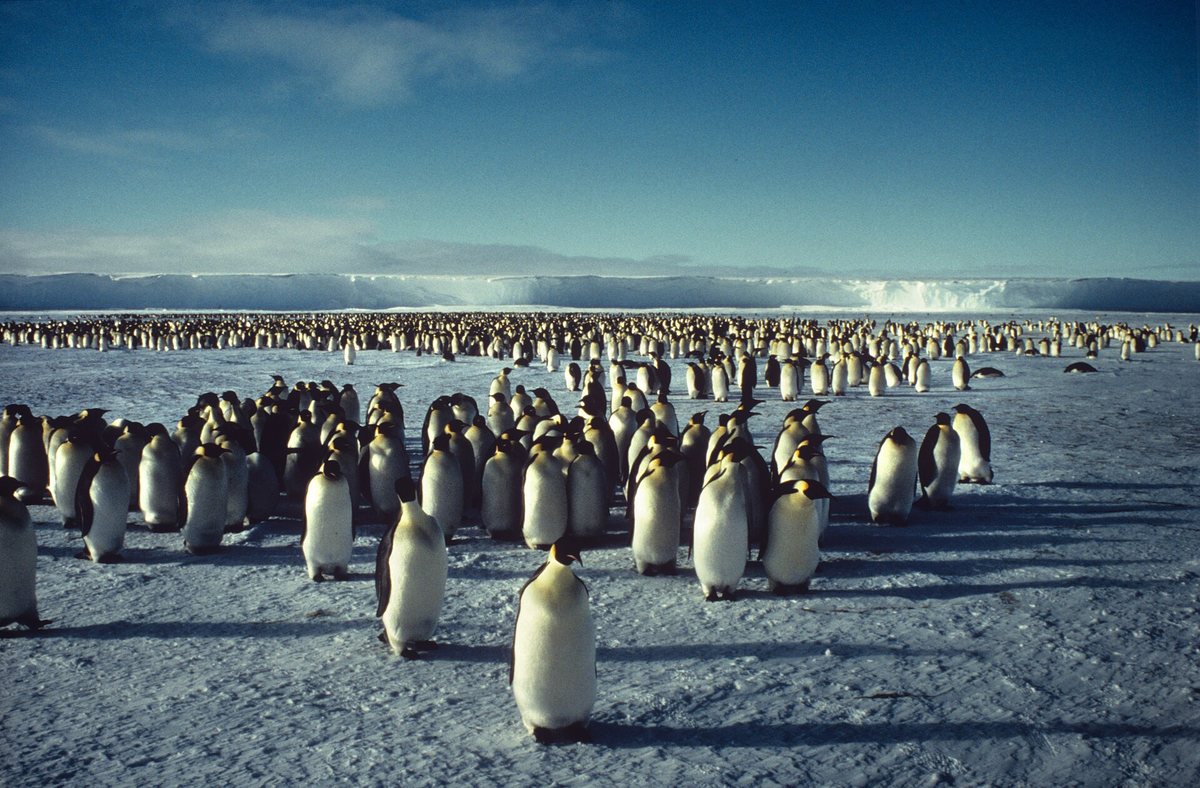
According to the Australian Antarctic Program, emperor penguins are the only animals that raise their young during the Antarctic winter. They are the largest of all penguins and can weigh up to 40 kg at the start of the breeding season. Their colonies are hit by icy winds that blow down from inland and by blizzards of up to 200 km/h.
Feathers and fat hold in heat
Their bodies are covered with several layers of feathers that overlap like scales, so well that it takes winds of over about 110 km/h to ruffle them. Under the skin, they store plenty of fat. Their bills and flippers are small for their body size, which means fewer places for heat to escape. Inside the nose, there is even a system that takes back heat from the air they breathe out.
Blood vessels that recycle heat
The blood vessels going to the feet, flippers and bill lie right alongside the vessels returning to the heart. Because of this, blood heading outward is cooled in advance, and blood coming back is warmed, so the penguin can recycle its own body heat. Their feet also contain special fats that keep them from freezing.
Gathering together in a "huddle"
Only the males keep the eggs warm, and they go about 120 days without eating anything. So the males pack together in a "huddle." On cold days, about 10 birds crowd into each square meter, cutting heat loss by up to 50%. Birds on the windward edge take turns moving around to the downwind side, so everyone takes a turn passing through the warm center. Researchers think that without huddles, the males could go without food for only about 60 days and could not keep the eggs warm until they hatch.
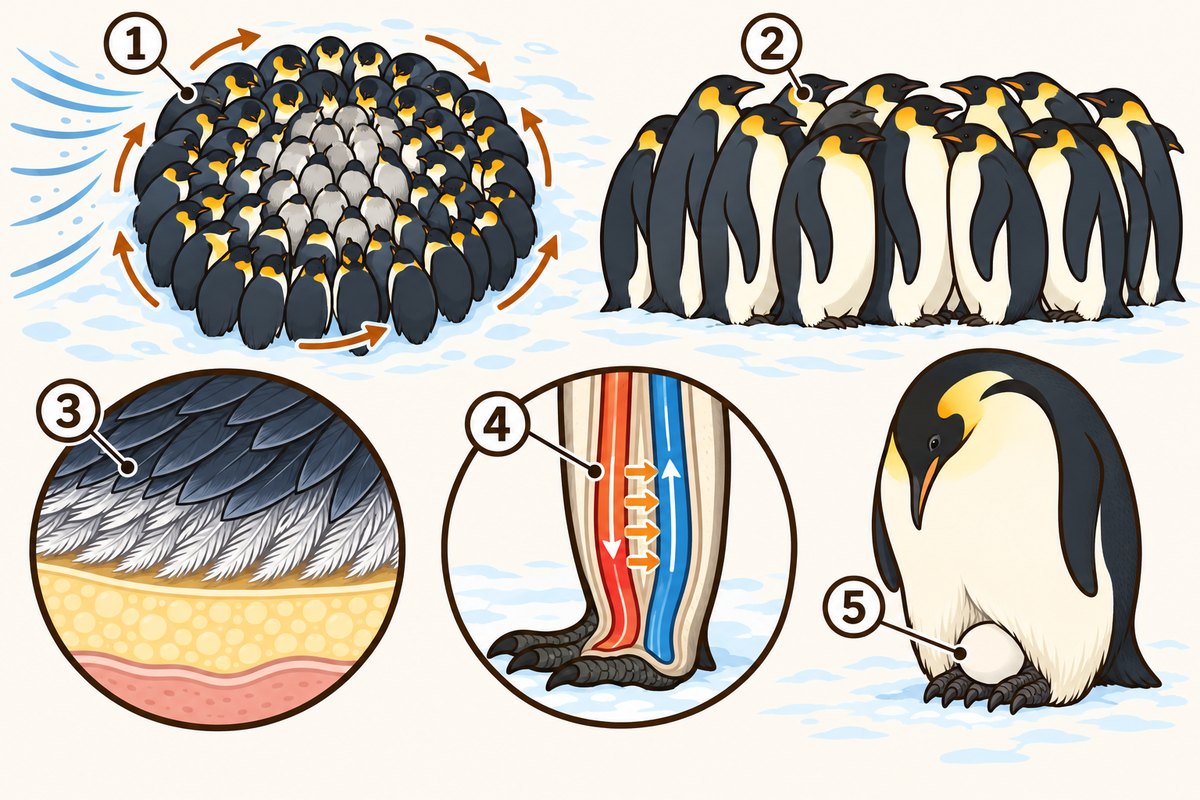
- 1A huddle seen from above, with birds rotating around the edge
- 2The tightly packed group seen from the side
- 3Cross-section of layered feathers and fat under the skin
- 4Outgoing and returning blood vessels side by side that recover heat
- 5A male keeping an egg warm on his feet

Want to know more?
- The temperature inside a huddle can rise as high as about +24℃.
- Huddles do not keep the same shape all the time. Studies report that they form and break apart again and again, each lasting about 2 hours.
- Females go about 45 days without eating until they lay their egg. After passing the egg to the male, they head out to sea to find food.

Quick quiz: test yourself
Remember what you just read? Give it a try!How do male emperor penguins keep warm in winter?
Show the answer
- Dig holes in the snow
- Crowd tightly together
- Take turns swimming in the sea
Crowd tightly together The males form a "huddle," crowding together to cut heat loss by up to 50%.
The males form a "huddle," crowding together to cut heat loss by up to 50%.
Next quiz ›Sources
- Emperor penguinAustralian Antarctic Program(オーストラリア南極局)
- Adapting to the coldAustralian Antarctic Program(オーストラリア南極局)
- Emperor penguin mates: keeping together in the crowdProceedings of the Royal Society B(PubMed Central 収蔵)
This article was written after checking the sources above as of 2026-10-03. Explanations may change as research progresses. Photo credits are shown below each photo.
Next fun fact ▶
 AnimalsWhy can't penguins fly?Penguins are birds with real wings. So why can't they fly?

40 surprising animal facts with big photos and short, easy text. A fun-facts book for kids and grown-ups to read together.
See it on Amazon