How can geckos climb smooth, slippery walls?

 First, let me give you the answer in 30 seconds.
The undersides of a gecko's toes are packed with very fine hairs, and the tip of each hair splits further into hundreds to thousands of branches. When these tiny tips get very close to a wall, weak forces that pull molecules together come into play, and a huge number of them add up to hold the gecko's body. Geckos do not stick with suction cups or glue.
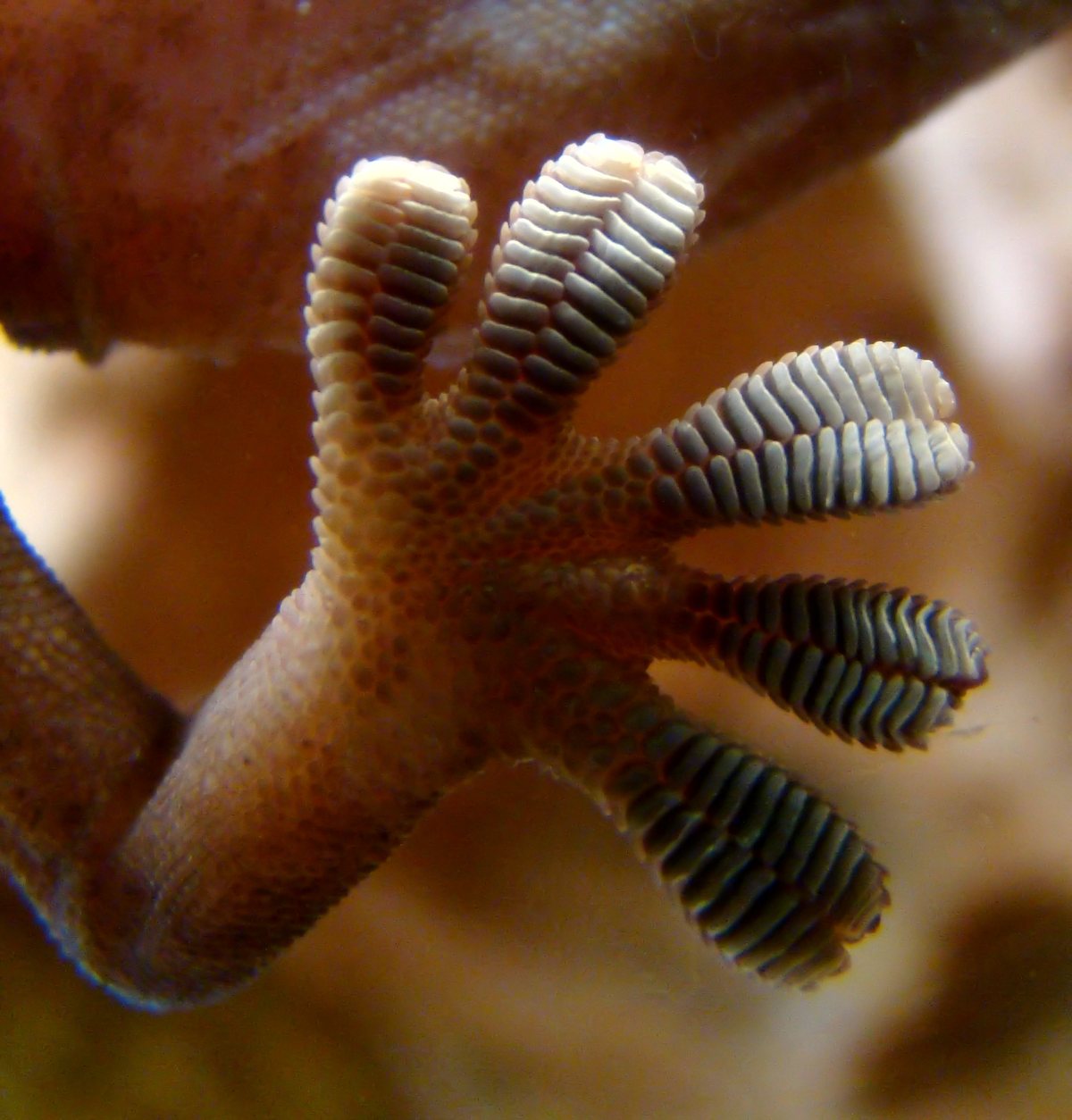
Toes packed with fine hairs
If you magnify the underside of a gecko's toe, you can see fine hairs packed closely together. In the tokay gecko, the species studied in research, there are about 2 million of these hairs, and each one is about 1/10 as thick as a human hair. The tip of each hair then splits into hundreds to thousands of branches, each ending in a tiny spatula-shaped pad. In all, there are about 1 billion of these pads.
Forces that pull molecules together
When two things get very close to each other, weak forces pull their molecules toward one another. These forces are called van der Waals forces, and usually they are hidden by other forces and go unnoticed. A gecko's tiny pads can get extremely close to a wall, so even though each force is weak, together they add up to a strong force. It has been calculated that all the hairs together could produce 10 times the force reported as needed to pull a gecko off a wall.
Not suction cups, not glue
People often think gecko feet work like suction cups, but researchers' calculations show that suction alone is not strong enough to explain how well geckos stick. What's more, geckos stick to walls even in a vacuum, where there is no air. Their feet have no glands that make glue, and they leave no marks on the wall. A 2002 experiment showed that they stick even without a film of water, and the main force is thought to be van der Waals forces.

Letting go by peeling the toes
Being able to let go quickly matters just as much as sticking. A hair sticks firmly when it is pressed against a surface and pulled slightly, and when the hair is lifted to an angle of 30 degrees, the pads at its tip come off easily. Geckos let go of a surface by peeling their toes up. When they run, they stick and unstick their feet as many as 15 times a second.
Want to know more?
- A single gecko hair sticks strongly enough to lift an ant, and by calculation, the 1 million hairs growing in an area about the size of a coin could lift a small child.
- Gecko hairs have been reported to be "self-cleaning": even when dirtied with tiny particles, they become clean again after the gecko walks about 5 steps.
- Geckos can't stick to every surface. They have trouble sticking to surfaces like fluororesin, where forces between molecules don't work well.

Quick quiz: test yourself
How can a gecko stick to a smooth wall?
Show the answer
- Suction cups on its feet
- Its feet give off glue
- Tiny hairs pull by molecular force
Tiny hairs pull by molecular force When the tips of the tiny hairs on its toes get very close to the wall, a weak pull between molecules acts. Added together, these pulls hold up its body.
When the tips of the tiny hairs on its toes get very close to the wall, a weak pull between molecules acts. Added together, these pulls hold up its body.
Next quiz ›Sources
- It's not glue, suction or static electricity that keep geckos from falling off the ceilingUniversity of California, Berkeley
- Evidence for van der Waals adhesion in gecko setae (PNAS 2002)Proceedings of the National Academy of Sciences / PubMed Central (NIH)
This article was written after checking the sources above as of 2026-10-03. Explanations may change as research progresses. Photo credits are shown below each photo.