Why is katsuobushi called the world's hardest food?

 The secret is the water that is taken out of the fish.
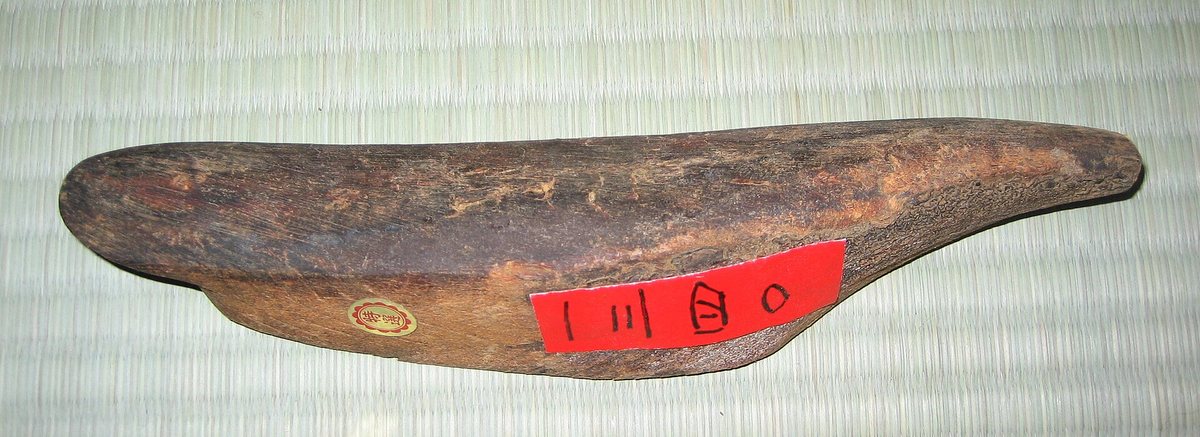
Katsuobushi (dried bonito) is called the world's hardest food because it is made by removing as much water as possible from skipjack tuna. Raw fish is about 70% water, but after boiling, smoke-drying and adding mold again and again, honkarebushi (the top grade) gets down to about 15%. With so little water, it is very hard and keeps for a long time.
The secret is water
Katsuobushi is a traditional Japanese food made by boiling skipjack tuna (bonito), drying it over smoke, and growing mold on it. Japan's Ministry of Agriculture, Forestry and Fisheries notes that katsuobushi is called "the world's hardest food." The secret of its hardness is removing as much water as possible. Raw skipjack is about 70% water, but honkarebushi, which has been through several rounds of mold, gets down to about 15%.
Boil, smoke, and dry
First, the fish, with its head and guts removed, is boiled in water at about 80°C for 60 to 90 minutes. After the bones are taken out, it is dried over wood smoke, a step called baikan, which is repeated about 10 to 20 times with breaks of days in between. According to the ministry, once the water drops to 26% or less, the result is called arabushi. Its surface turns pitch black from the smoke's tar.
Mold dries it even more
Next, the black surface is shaved off and mold is added. When the surface is covered in mold after 1 to 2 weeks, it is dried in the sun, the mold is brushed off, and mold is added again. Repeating this removes even more water and improves the aroma. The mold also breaks down fat, so the broth made from it stays clear. In a Chiba Prefecture test on mackerel flakes made the same way, the water went from 27.6% before molding down to 15.6% after the fourth round of mold.
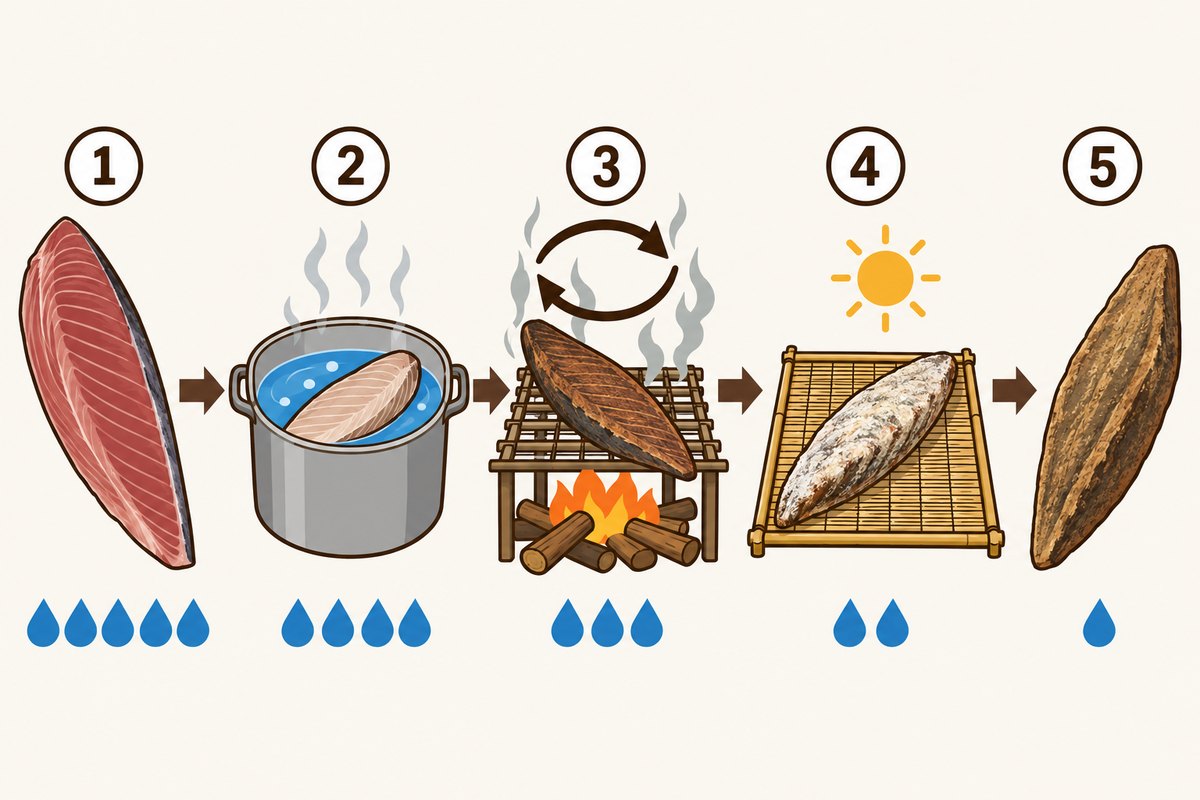
- 1A raw fillet of skipjack tuna
- 2Simmering in a pot
- 3Smoking and drying it many times
- 4Applying mold and drying it in the sun
- 5Katsuobushi, hardened as its water is lost

About one sixth the weight
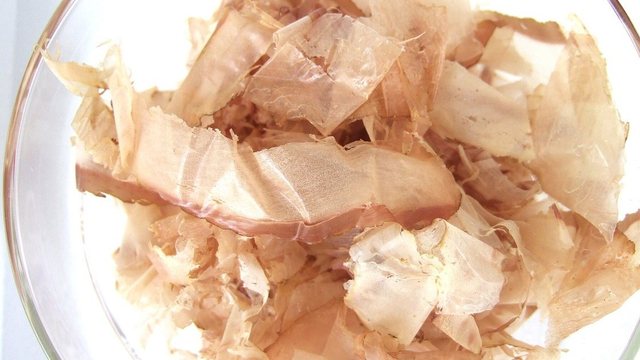
As the water leaves, katsuobushi becomes much smaller and lighter. Honkarebushi made from a skipjack of about 6.0 kg weighs about 900 g for 4 pieces, about one sixth of the raw fish. Finishing takes several months, and in some cases 4 to 6 months. Because it holds so little water, microbes have a hard time growing, so it keeps for a long time. It is so hard that people shave it thinly before using it.
Based on FOOD CULTURE, Kikkoman Institute for International Food Culture.
Want to know more?
- Kagoshima Prefecture produces the most katsuobushi in Japan (according to a 2022 Japanese government survey of seafood processing).
- In Japan's Warring States period, the name could be read as "victorious warrior," so it was seen as lucky, and because it kept well it was eaten by soldiers on campaigns.
- The method used today is said to have started in 1674 in Kishu (around today's Wakayama Prefecture) and to have reached Makurazaki in Kagoshima in 1707.
Quick quiz: test yourself
Remember what you just read? Give it a try!About how much water is left in honkarebushi?
Show the answer
- About 70%
- About 40%
- About 15%
About 15% Raw skipjack is about 70% water, but after boiling, smoke-drying and repeated mold, honkarebushi gets down to about 15%.
Raw skipjack is about 70% water, but after boiling, smoke-drying and repeated mold, honkarebushi gets down to about 15%.
Next quiz ›Sources
- 節類|にっぽん伝統食図鑑農林水産省 (in Japanese)
- かつお節(かつおぶし)|にっぽん伝統食図鑑農林水産省 (in Japanese)
- 江戸の食を彩る「かつお節だし」(FOOD CULTURE No.36)キッコーマン国際食文化研究センター『FOOD CULTURE』 (in Japanese)
- さば節のかび付け工程中における成分変化(千葉水試研報 No.53)千葉県水産試験場 (in Japanese)
This article was written after checking the sources above as of 2026-10-03. Explanations may change as research progresses. Photo credits are shown below each photo.
Next fun fact ▶
 FoodWhy do bonito flakes dance on hot food?When you put bonito flakes on hot rice, they start to wriggle and dance. What is making them move, I wonder?

40 surprising animal facts with big photos and short, easy text. A fun-facts book for kids and grown-ups to read together.
See it on Amazon