Why is cotton candy so fluffy?

 The secret lies in a whirling machine that turns sugar into thin threads.
Cotton candy is fluffy because melted sugar is flung out through tiny holes in a spinning machine, and the thin threads that harden right away tangle together. The sugar does not form crystals; it hardens into a glass-like state. A tangle of thin threads, cotton candy is mostly air.
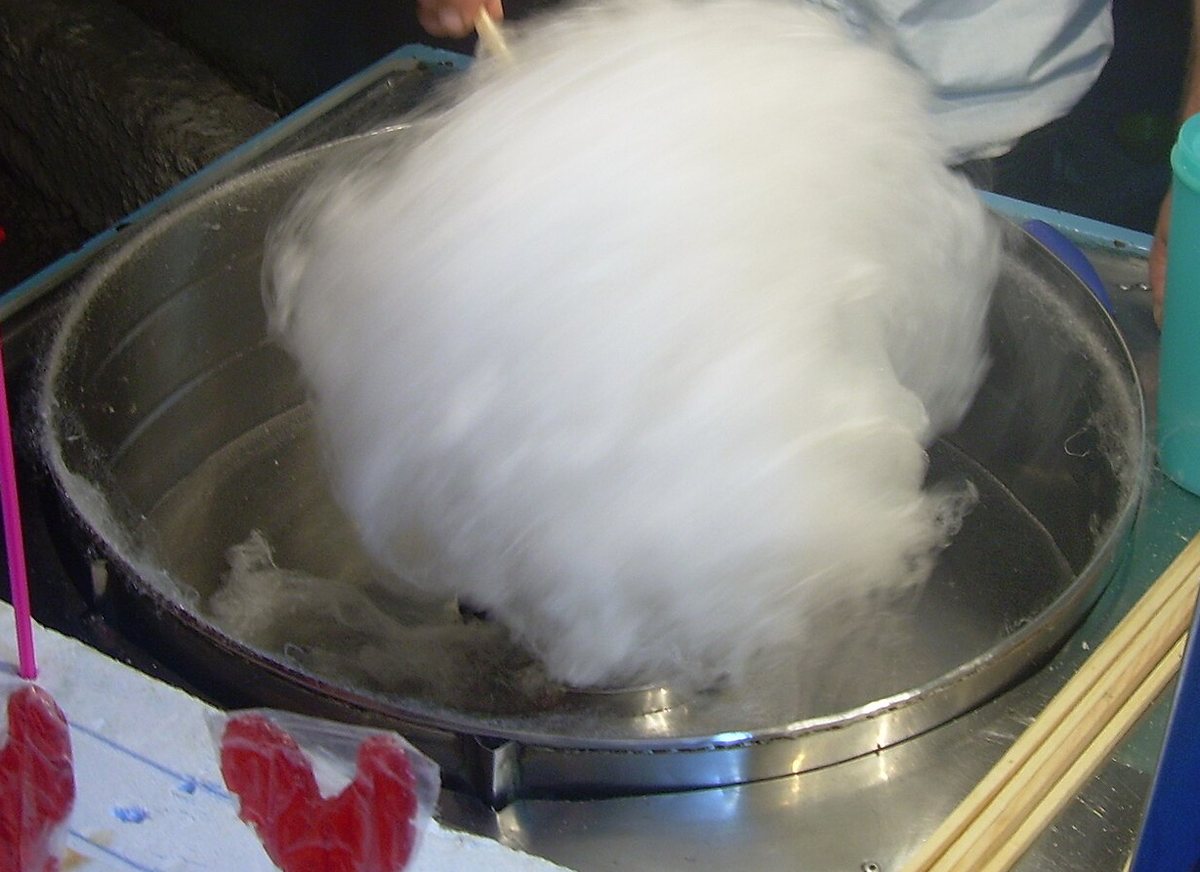
Turning melted sugar into thin threads
A cotton candy machine first melts sugar with heat until it becomes a liquid. According to teaching material from the American Ceramic Society Foundation, the melted sugar is pushed through small holes in a spinning part into a larger bowl around it. A student science magazine at the University of Southern California says each hole is about 50 micrometers (50 thousandths of a millimeter) across. The thin threads of sugar harden almost as soon as they meet the air, and they gather around the edge of the bowl.
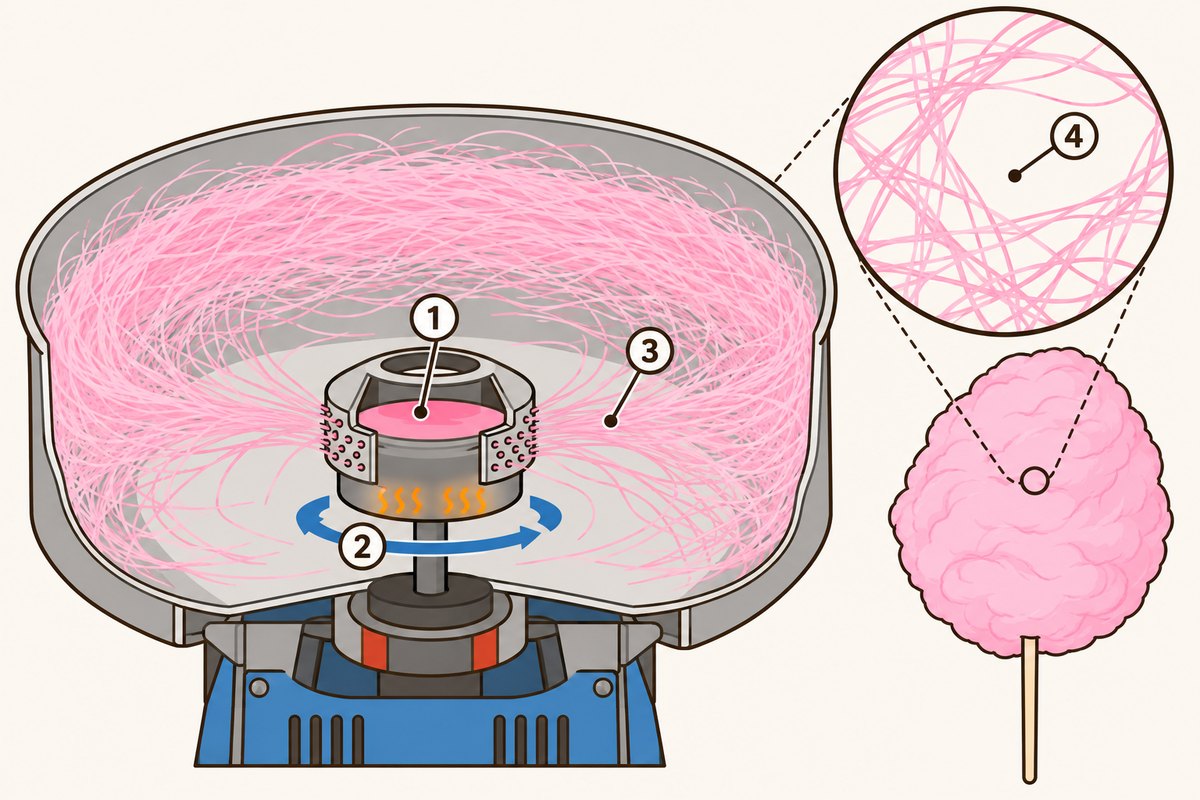
- 1Sugar melted by heat in the center container
- 2The spinning center part
- 3Thin threads of sugar flying out of tiny holes and hardening in the air
- 4Air gaps spreading between the tangled threads
No time to form crystals
Ordinary sugar is made of grains called crystals, in which the molecules are lined up neatly. According to the same student magazine, when sugar melts at about 190°C, this order breaks down, and the sugar cools and hardens before the molecules can line up into crystals again. That is why it can take the shape of threads while its order stays jumbled. The American Ceramic Society Foundation material calls a solid without this regular order "amorphous," and it describes cotton candy and lollipops as glasses made from sugar.

Cotton candy is mostly air
According to National Geographic, cotton candy, a tangle of thin threads, is mostly air, and the rest is sugar. With lots of air between the thin threads, it looks big and fluffy. When you put it in your mouth, the heat of your tongue melts the threads back into liquid, so it seems to disappear.
Why it dislikes humidity
Cotton candy does not like moisture. According to the student magazine, when sugar meets moisture, it can trigger the molecules to line up into crystals again, and the sugar tends to form clumps. That is why, to make colored cotton candy, the color is mixed into the sugar before it is melted, instead of being added to the finished cotton candy.
Want to know more?
- The cotton candy machine was made by a dentist, William Morrison, with confectioner John C. Wharton, and they patented it in 1897.
- At the 1904 St. Louis World's Fair, it was sold under the name "fairy floss," and 68,655 boxes were sold.
- In 2016, researchers at Vanderbilt University reported using a cotton candy machine to spin networks of threads as fine as capillaries, to help build artificial organs.
Quick quiz: test yourself
Remember what you just read? Give it a try!What makes up most of cotton candy?
Show the answer
- Air
- Water
- Sugar crystals
Air Cotton candy is a tangle of thin sugar threads. It is mostly air, and the rest is sugar.
Cotton candy is a tangle of thin sugar threads. It is mostly air, and the rest is sugar.
Next quiz ›Sources
- Candy Glass(Teacher Instructions)The American Ceramic Society Foundation(アメリカ陶磁器学会)
- Cotton Candy: Carnival Snack to Medical WonderIllumin(南カリフォルニア大学の学生科学誌)
- The Sticky Sweet History of Cotton CandyNational Geographic
- Cotton candy machines may hold key for making artificial organsVanderbilt University
This article was written after checking the sources above as of 2026-10-03. Explanations may change as research progresses. Photo credits are shown below each photo.
Next fun fact ▶
 FoodWhy does mint feel cool?When you have a mint, your mouth feels chilly. But is it really getting colder?

40 surprising animal facts with big photos and short, easy text. A fun-facts book for kids and grown-ups to read together.
See it on Amazon