Why does mint feel cool?

 The secret lies in a cold sensor inside our bodies.
Mint feels cool because menthol, a substance in mint, switches on TRPM8, a sensor that detects cold. Even though the temperature has not actually dropped, a "cold" signal reaches the brain, so your mouth feels chilly.

The body's cold sensor
The sensory nerves that serve the skin, mouth and eyes have a cold sensor made of a protein called TRPM8. According to an article from the Biophysical Society, TRPM8 opens when it senses cold, lets ions (tiny particles that carry an electric charge) flow into the nerve, and sends a signal to the brain. According to a paper by a researcher at the University of Southern California, TRPM8 starts working when things get colder than about 28°C, and it responds more strongly the colder it gets, down to 8°C.
Menthol presses the same switch
Mint leaves contain a substance called menthol. Menthol attaches to a specific spot on TRPM8 and makes the sensor open. Even when nothing is actually cold, the brain gets the same signal as it does from cold, so your mouth feels cool. David Julius and Ardem Patapoutian, who won the 2021 Nobel Prize in Physiology or Medicine, each used menthol separately to discover TRPM8.
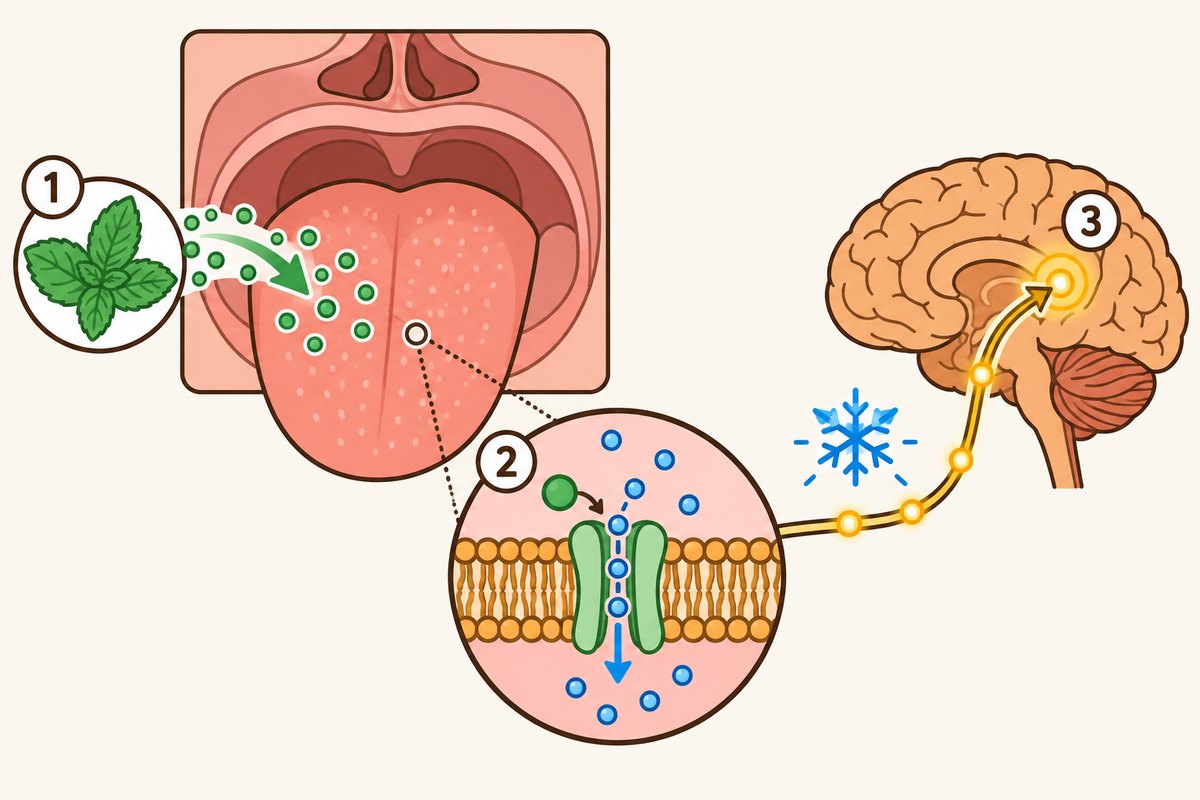
- 1Menthol from mint reaching the inside of the mouth
- 2The cold sensor that opens with menthol and lets ions through
- 3The "cold" signal traveling along a nerve to the brain

How it differs from chili heat
Julius also used capsaicin, the hot substance in chili peppers, to find TRPV1, a sensor that responds to heat. Sensors in the same family also react to menthol, the hot substance in mustard (allyl isothiocyanate), a substance that gives cinnamon its smell, and more. The paper says this explains, at the level of molecules, why we sense these foods differently, such as mint feeling cold and chili peppers feeling hot.
Too much can sting
According to the same paper, a small amount of menthol gives a pleasant cool feeling, but a large amount can cause burning, stinging and pain. Also, when nerves are exposed to a lot of menthol for a long time, the cold-sensing nerves get used to it and respond less. In 1951, scientists proposed that menthol raises the temperature at which cold-sensing nerves start to respond, and the discovery of TRPM8 supported this idea.
Want to know more?
- How strongly TRPM8 responds to cold differs between animals: it is weak in emperor penguins living in the Antarctic and strong in African elephants living in the Sahel desert.
- Menthol is used in many products, such as sweets, candy, toothpaste and rubs.
- Research presented at a scientific meeting in 2026 reported that cold and menthol act on different parts of TRPM8 to make the sensor open.
Quick quiz: test yourself
Remember what you just read? Give it a try!Which substance gives mint its cool feeling?
Show the answer
- Capsaicin
- Menthol
- Carbonation
Menthol Menthol in mint opens TRPM8, the cold sensor, so it feels cold even when nothing is actually cold.
Menthol in mint opens TRPM8, the cold sensor, so it feels cold even when nothing is actually cold.
Next quiz ›Sources
- Press release: The Nobel Prize in Physiology or Medicine 2021The Nobel Assembly at Karolinska Institutet(ノーベル賞公式サイト)
- How cold is it? TRPM8 and TRPA1 in the molecular logic of cold sensationMolecular Pain(PMC 掲載の査読論文、南カリフォルニア大学)
- Scientists Show How Your Body Senses Cold—and Why Menthol Feels CoolBiophysical Society(アメリカ生物物理学会)
- A paradigm of thermal adaptation in penguins and elephants by tuning cold activation in TRPM8PNAS(PMC 掲載の査読論文)
This article was written after checking the sources above as of 2026-10-03. Explanations may change as research progresses. Photo credits are shown below each photo.
Next fun fact ▶
 ScienceWhy doesn't stainless steel rust?Iron rusts, yet a stainless steel spoon stays shiny. What makes the difference?

40 surprising animal facts with big photos and short, easy text. A fun-facts book for kids and grown-ups to read together.
See it on Amazon