Why is there dew on the grass in the morning?

 The answer lies in the night.
Dew forms on clear nights with little wind, when the surface of the grass loses heat to the sky and cools down, and the water vapor in the air next to it turns into water droplets. Dew does not suddenly appear in the morning; it forms during the night, and we find it in the morning. It forms less easily on cloudy or windy nights.
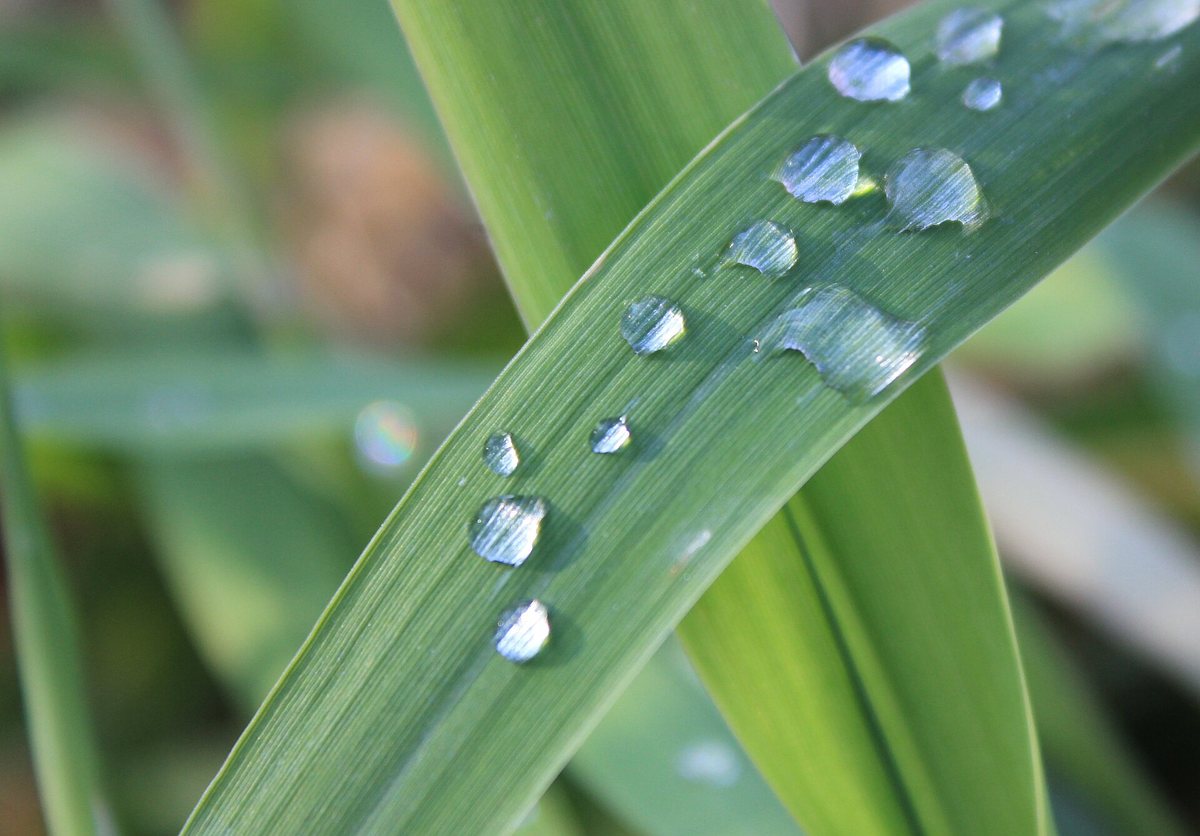
Dew comes from water vapor in the air
Air contains water vapor that we cannot see. As air cools, the water vapor starts to turn into water droplets at a certain temperature. This temperature is called the dew point. When the surface of the grass becomes colder than the dew point, the water vapor next to it turns into droplets and clings to the surface. This is dew.
Grass cools on clear nights
At night there is no sunlight, so the ground and the grass lose heat to the sky and cool down. Grass leaves and flower petals lose heat more easily than the air, so at night they become colder than the air around them. On clear nights with no clouds, heat escapes even better, so the grass gets colder still.

Where and on which nights dew forms
Dew forms easily on the surfaces of things that heat from the ground does not reach well; grass and car roofs are good examples. Also, strong wind stirs up the cooled air, so dew forms most on calm nights with little wind, when an area of high pressure covers the region. Moist air near the ground is another condition.
Dew forms during the night
In other words, dew does not suddenly appear once morning comes. It forms little by little during the night, and we find what is still there in the morning. It can also form in the evening. When the temperature drops below 0℃, dew freezes or turns into frost.
Want to know more?
- In some areas, up to about 0.5 mm of dew can form in a single night, making it an important source of water for plants and animals in dry regions.
- Drops lined up evenly along the edges or tips of leaves may not be dew. They can be "guttation": water a plant has taken up through its roots and pushed out through tiny holes in its leaves.
- Though it is rarely seen, dew on grass can catch the sunlight and make a band of colors like a rainbow.

Quick quiz: test yourself
When does the dew on morning grass form?
Show the answer
- When the morning sun hits it
- On clear nights with little wind
- At noon after it rains
On clear nights with little wind On clear nights with little wind, grass loses heat to the sky and cools, and water vapor nearby turns into droplets. It forms at night and is found in the morning.
On clear nights with little wind, grass loses heat to the sky and cools, and water vapor nearby turns into droplets. It forms at night and is found in the morning.
Next quiz ›Sources
- DewMet Office
- dewEncyclopaedia Britannica
- dew - Glossary of MeteorologyAmerican Meteorological Society
- Guttation: A Pressure Relief for PlantsUniversity of Missouri Integrated Pest Management
This article was written after checking the sources above as of 2026-10-03. Explanations may change as research progresses. Photo credits are shown below each photo.