Why can owls turn their heads so far?
 Let me give you the answer in 30 seconds.
An owl's eyes are shaped like tubes and held in place by bone, so it cannot move its eyeballs. The only way to look around is to turn its head, and many kinds of owls can turn their heads up to about 270 degrees to the left or the right. They have 14 neck bones, twice as many as humans, and a special system of blood vessels that keeps blood flowing to the brain and eyes even when the neck is twisted.
They turn their heads because their eyes can't move
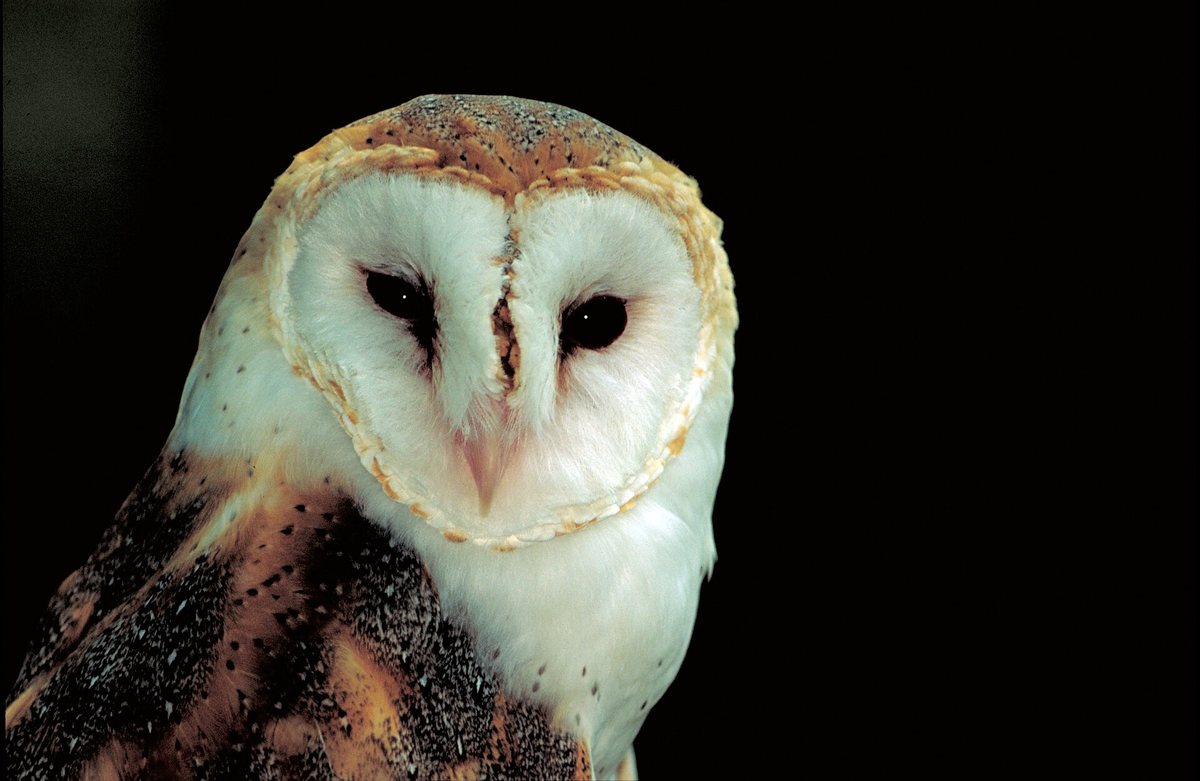
Human eyes are round, so we can move our eyeballs up, down, left, and right without moving our heads. But an owl's eyes are long, like tubes, and held in their sockets by bone. They cannot move, so the owl can only look straight ahead. The Forest Preserve District of Will County in the United States explains that this is why owls turn their heads so far to look around.
About 270 degrees, not all the way around
Many people think owls can turn their heads 360 degrees, all the way around, but that is a myth. Many kinds of owls can turn their heads up to about 270 degrees, to either the left or the right. According to the bird program BirdNote, an owl has 14 neck bones, twice as many as a human. When it hears a sound, it swings its head quickly from one shoulder to the other, so it looks as if it turned all the way around.
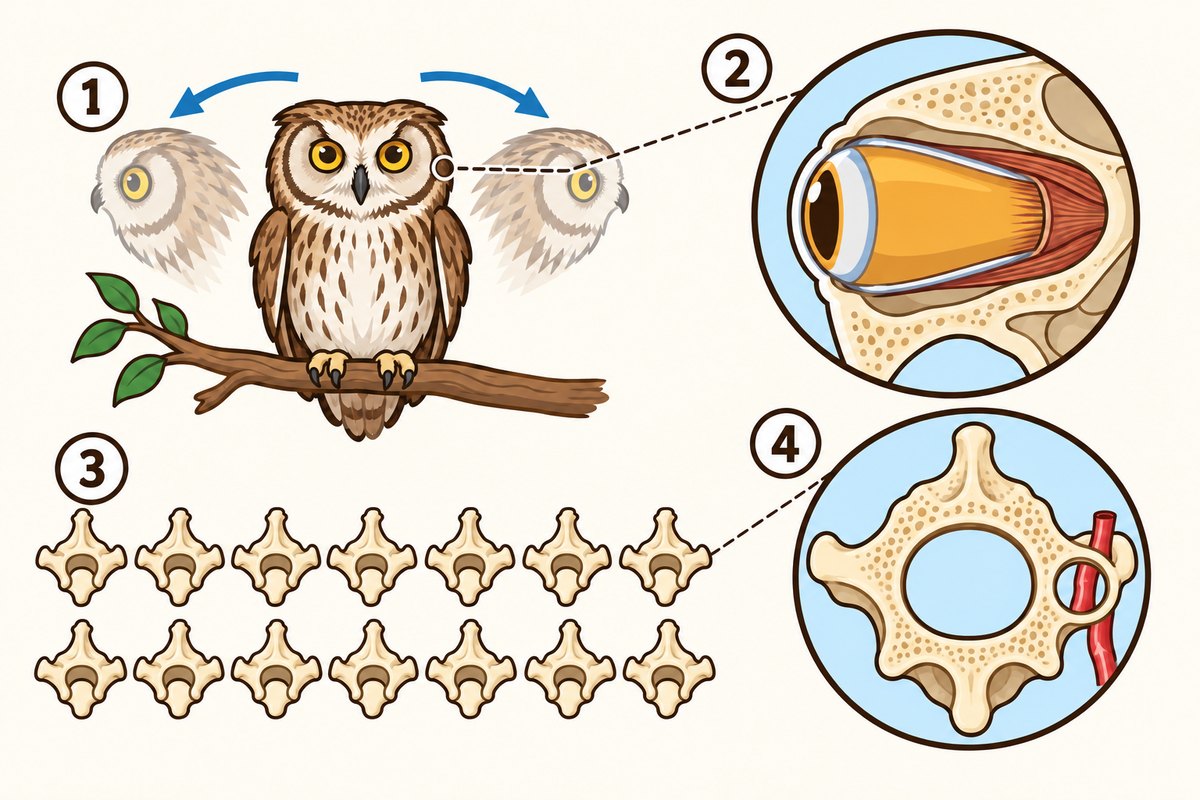
- 1Turning the head far to the left and right (not a full circle)
- 2Cross-section of tube-shaped eyes held in place by bone
- 314 neck vertebrae
- 4Wide holes in the vertebrae, with blood vessels inside and room around them
Roomy passages for blood vessels
If a person twisted their neck as fast and as far as an owl, they could hurt the blood vessels in their neck. In 2013, a research team at the Johns Hopkins University School of Medicine in the United States studied the necks of 12 owls that had died of natural causes, using blood-vessel imaging and CT scans. They found that the holes in the neck bones that the blood vessels pass through are about 10 times as wide as the vessels themselves. The extra space acts as a cushion, letting the vessels move when the neck twists.
Places to store blood
The study also found that blood vessels at the base of the head, just under the jawbone, swell up as the head turns and become places where blood can collect. This is the opposite of human blood vessels, which get narrower as they branch out. The researchers think this system delivers the blood that the owl's large brain and eyes need, even while its head is turning.
Want to know more?
- An owl's neck blood vessel enters the neck bones higher up than in other birds, which gives the vessel more slack.
- The large blood vessels in the neck are connected, so even if blood stops flowing through one vessel while the head turns, blood keeps reaching the brain.
- With its body facing forward, an owl can even tilt its head until it is almost upside down.

Quick quiz: test yourself
Remember what you just read? Give it a try!Why do owls turn their heads so far?
Show the answer
- They can't move their eyeballs
- Their necks are very long
- Their bodies are too heavy to turn
They can't move their eyeballs An owl's eyes are shaped like tubes and held in place by bone, so it can't move its eyeballs. That's why it turns its head to look around.
An owl's eyes are shaped like tubes and held in place by bone, so it can't move its eyeballs. That's why it turns its head to look around.
Next quiz ›Sources
- Owl mystery unravelled: Scientists explain how bird can rotate its head without cutting off blood supply to brainScienceDaily(Johns Hopkins Medicine 提供資料)
- Nature curiosity: How do owls turn their heads so far?Forest Preserve District of Will County
- The Amazing, Head-turning OwlBirdNote
- Why Do Owls Rotate Their Heads?The Children's Museum of Indianapolis
This article was written after checking the sources above as of 2026-10-03. Explanations may change as research progresses. Photo credits are shown below each photo.
Next fun fact ▶
 AnimalsDo octopus arms really think for themselves?Does each octopus arm think for itself?

40 surprising animal facts with big photos and short, easy text. A fun-facts book for kids and grown-ups to read together.
See it on Amazon