Why is Pluto no longer a planet?

 Pluto itself did not change. What changed were the rules.
In 2006, the International Astronomical Union (IAU) decided what a "planet" is, and Pluto did not meet the third condition: having cleared the neighborhood around its orbit of other objects. Pluto was placed in a newly created group called "dwarf planets."
Once the ninth planet
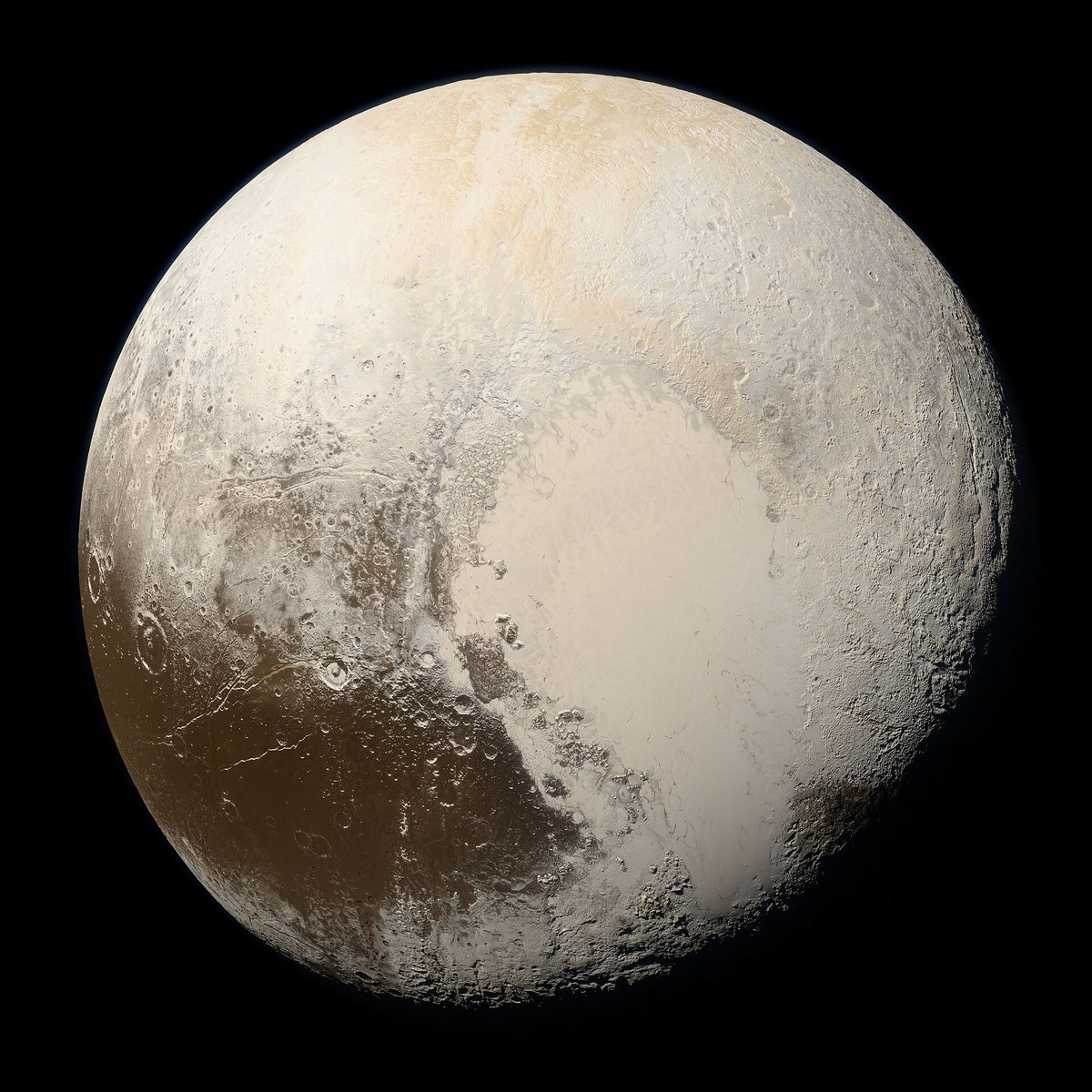
Pluto was discovered in 1930 and was long considered the ninth planet of our solar system. Its average distance from the Sun is 5.9 billion km, and it takes 248 years to go once around its long, oval-shaped orbit. It is only about two-thirds the diameter of Earth's Moon.
It began with a "tenth planet"
Pluto orbits in a disc-shaped region beyond Neptune called the Kuiper Belt. In 2005, a team of astronomers announced they had found an object in the Kuiper Belt about the same size as Pluto, and called it the "tenth planet." This made people start asking what a planet really is.

Three conditions for a planet
In 2006, at the IAU General Assembly in Prague, Czech Republic, rules for planets were set. A planet is an object that orbits the Sun, has enough mass for its own gravity to make it nearly round, and has cleared the neighborhood around its orbit of other objects. It must meet all three. More than 2500 astronomers took part in this assembly.
Pluto becomes a "dwarf planet"
Pluto meets the first and second conditions, but other objects might cross its orbit, so it does not meet the third. It was therefore classed as a "dwarf planet" and named the prototype of a new group of objects beyond Neptune. However, not all astronomers agree with these rules, and the debate still continues today.
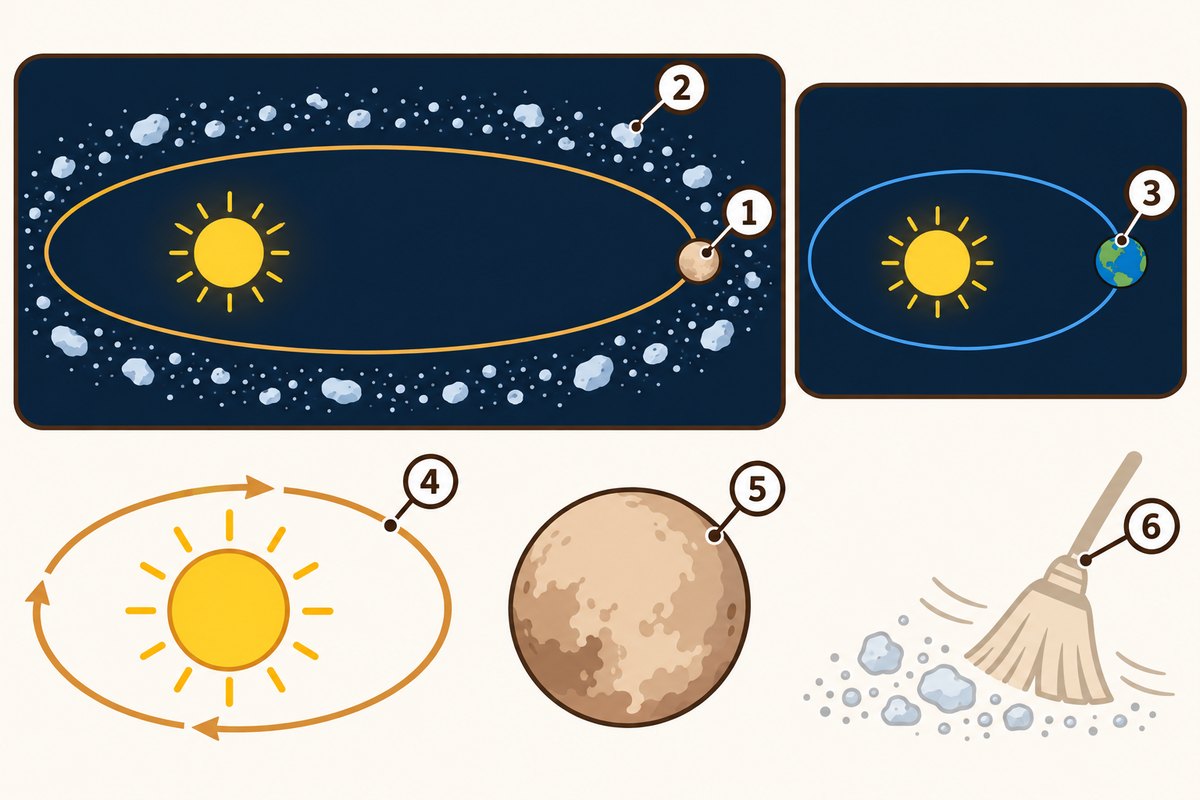
- 1Pluto orbiting the Sun
- 2Kuiper Belt objects still around its orbit
- 3Earth and its orbit, for comparison
- 4Condition 1: orbits the Sun
- 5Condition 2: nearly round from its own gravity
- 6Condition 3: has cleared its orbit (Pluto doesn't)
Want to know more?
- The IAU recognizes five dwarf planets: Pluto, Eris, Ceres, Haumea, and Makemake.
- Pluto has five known moons, and the largest is Charon.
- In 2015, NASA's New Horizons spacecraft flew past Pluto and photographed a bright, heart-shaped region.
Quick quiz: test yourself
Remember what you just read? Give it a try!Which planet condition did Pluto fail to meet?
Show the answer
- It orbits the Sun
- It is nearly round from its own gravity
- It has cleared other objects near its orbit
It has cleared other objects near its orbit Other objects might cross Pluto's orbit, so it does not meet the third condition and was classed as a "dwarf planet."
Other objects might cross Pluto's orbit, so it does not meet the third condition and was classed as a "dwarf planet."
Next quiz ›Sources
- IAU 2006 General Assembly: Result of the IAU Resolution votes国際天文学連合(IAU)
- Pluto: FactsNASA Science
- What is a Planet?NASA Science
This article was written after checking the sources above as of 2026-10-03. Explanations may change as research progresses. Photo credits are shown below each photo.
Next fun fact ▶
 SpaceWhat is Jupiter's Great Red Spot?That big red mark on Jupiter's face. What do you suppose it is?

40 surprising animal facts with big photos and short, easy text. A fun-facts book for kids and grown-ups to read together.
See it on Amazon