How does a phone screen feel your finger?

 The answer is a tiny change in electricity that you cannot see.
"Capacitive" touch panels, widely used in smartphones, sense your finger through changes in electricity. Under the screen, clear electrodes run in rows and columns. When your finger, which conducts electricity, touches the screen, electric charge builds up between the electrode and your finger, and the measured value changes. By checking which electrodes changed, the phone works out where you touched.

Clear electrodes lie under the screen
Most touch panels used on smartphone screens are a type called "capacitive." There are 2 kinds of capacitive panels: "surface" and "projected." According to an explanation by Mitsubishi Electric, a projected panel has electrodes made of a clear film that conducts electricity, packed tightly in rows running both across and up and down. The electrodes are shaped like chains of diamonds.
A touch makes charge build up
Let's look at what happens inside, step by step. First, the device sends an electric signal to the electrodes. When a finger touches the screen, the electrode and the finger become electrically linked, and electric charge builds up. When this charge is measured, the value is different from when there is no finger. The device remembers the no-finger value as a "baseline" and checks the difference from each new measurement. The position of the electrodes with a big difference shows where the finger is.
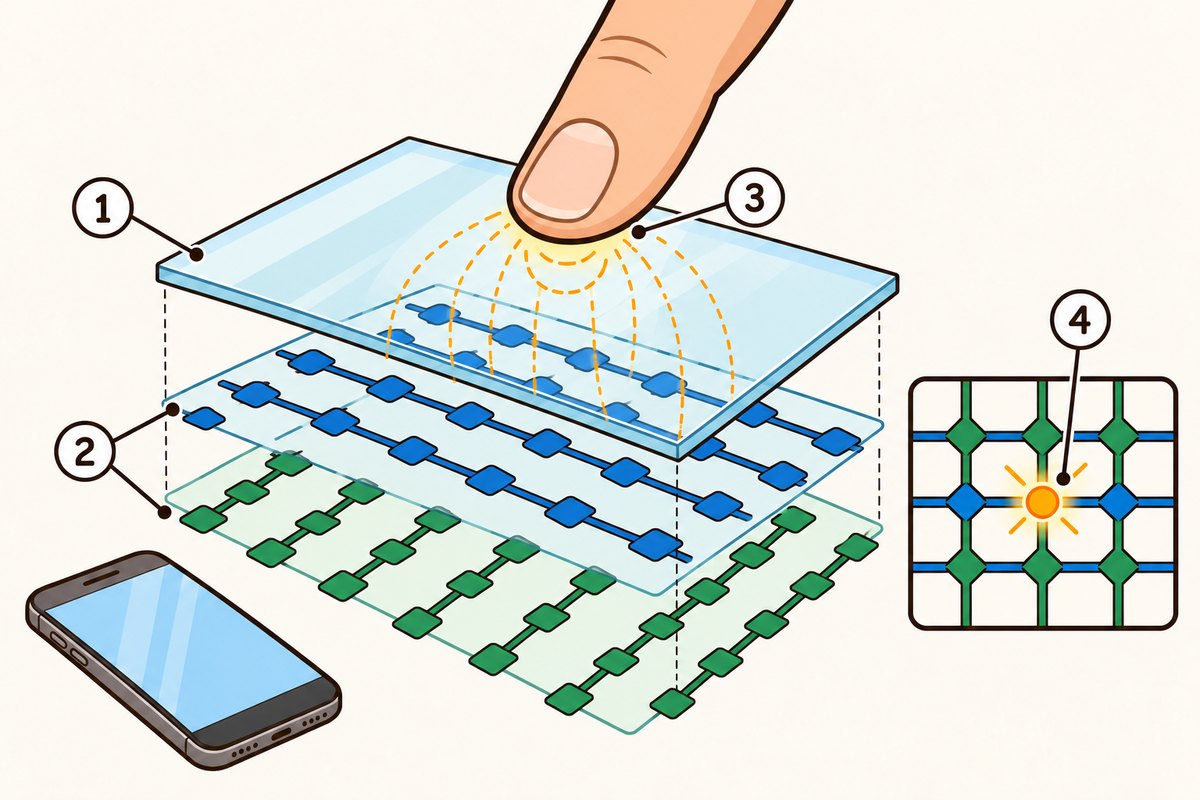
- 1The glass on top
- 2Layers of clear electrodes crossing in rows and columns
- 3The change as charge builds up between the finger and the electrodes
- 4The touch point found from that change
Why gloves don't work well
This system responds to things that conduct electricity, like human skin. That is why it reacts poorly when you wear ordinary gloves. Cloth does not conduct electricity, though gloves made with conductive thread do work. Also, the farther apart the electrode and finger are, the less charge builds up. Mitsubishi Electric has been researching ways to raise sensitivity so a finger can be sensed even through plastic 2 mm thick.

"Resistive" screens you press
There is another kind of touch panel, called "resistive." It works when you press the screen with some force. 2 films that carry electricity are kept apart by tiny dots, and pressing makes them touch, changing the flow of electricity at that spot. These screens have been used in bank ATMs and in signature pads at stores. If you press hard, you can feel the screen bend slightly.
Want to know more?
- The amount of charge that builds up between an electrode and a finger is larger when the touching area is bigger, and smaller when they are farther apart.
- Mitsubishi Electric has tested combining 2 neighboring electrodes and using them as 1 large electrode to sense fingers more strongly.
- In the surface type of capacitive panel, a thin film covers the whole screen, and sensors at the 4 corners work out the finger's position.
Quick quiz: test yourself
Remember what you just read? Give it a try!What does a phone screen sense from your finger?
Show the answer
- Its warmth
- A change in electricity
- How hard you press
A change in electricity When a finger, which conducts electricity, touches the screen, charge builds up between the electrode and the finger and the value changes. That change shows where you touched.
When a finger, which conducts electricity, touches the screen, charge builds up between the electrode and the finger and the value changes. That change shows where you touched.
Next quiz ›Sources
- タッチパネル感度向上技術(三菱電機技報 Vol.88 No.7)三菱電機 (in Japanese)
- Okay, but how do touch screens actually work?Scienceline(ニューヨーク大学 科学報道プログラム)
This article was written after checking the sources above as of 2026-10-03. Explanations may change as research progresses. Photo credits are shown below each photo.
Next fun fact ▶
 TechnologyHow does GPS know where you are?Even in a town you have never visited, a map app can say "You are here." How does your phone know where it is?

40 surprising animal facts with big photos and short, easy text. A fun-facts book for kids and grown-ups to read together.
See it on Amazon