How does noise cancelling make sound disappear?

 Curiously enough, to remove a sound, it adds another sound.
A microphone on the earphones or headphones picks up the noise around you, and the device makes a sound with the peaks and valleys flipped (an "opposite-phase" sound) and adds it to the noise to cancel it out. But it does not erase sound completely; it makes noise less noticeable. It works well on low, steady sounds like a running train, but not so well on voices or sudden sounds.

Flipped sound cancels noise
Sound travels as a "wave" that makes the air vibrate. A wave has high points (peaks) and low points (valleys). According to Panasonic, when you add a sound whose peaks and valleys are flipped to another sound, the 2 sounds cancel each other out and become quieter. This flipped sound is called an "opposite-phase" sound. Noise cancelling uses this property.
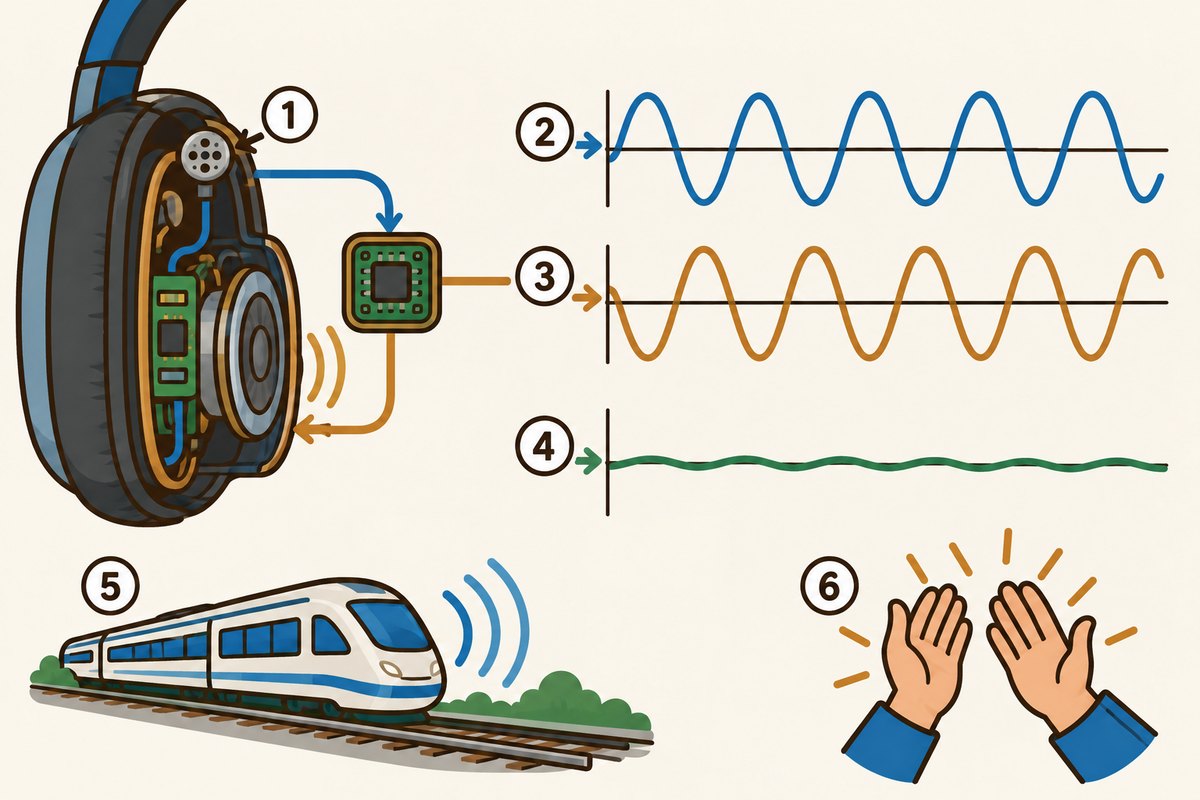
- 1The microphone that picks up surrounding sound
- 2The original noise wave
- 3A sound wave with peaks and dips flipped
- 4The sound made smaller when the two overlap
- 5A low, steady sound it handles well
- 6A sudden sound it handles poorly
Pick up, create, then add
Based on Sony's explanation, let's look at what happens inside, step by step. 1st, a microphone inside the headphones picks up the surrounding noise, and a circuit analyzes it. 2nd, it creates an opposite-phase sound that cancels that noise. 3rd, it adds the opposite-phase sound to the original noise to cancel it, reducing the noise that reaches your eardrums. Many products also combine this with "sound isolation," where ear tips seal your ears to physically block sound.

Mic placement changes its strengths
There are also different places to put the microphone. The "feedforward" type picks up noise with a microphone on the outside of the earphone. It reacts quickly but is said to be easily affected by wind noise. The "feedback" type uses a microphone on the inside to pick up the sound actually reaching your ear and correct it. It tends to reduce noise accurately, but it struggles with high-pitched sounds. There is also a "hybrid" type that combines both.
Good with steady hums, weak with sudden sounds
Noise cancelling is good at low, steady sounds such as a running train, an air conditioner, or an airplane engine. These sounds change little and are easy to predict, so it is easy to match them with an opposite-phase sound. On the other hand, it struggles with sudden or high-pitched sounds, such as people talking, car horns, or station announcements. Because you may not notice the sounds around you, it is safer to turn it off, or use the feature that lets outside sound in, when you are walking or riding a bike.
Want to know more?
- If you cover the microphone part with your hand, the noise cancelling effect may stop working.
- In a quiet place, you may hear a faint hiss. That is the sound of noise cancelling at work, not a fault.
- With less noise, it is easier to hear at a low volume, which helps you avoid turning the volume up too high. But because it keeps calculating sounds, the battery tends to run down faster.
Quick quiz: test yourself
Remember what you just read? Give it a try!Which sound is hardest for noise cancelling?
Show the answer
- A running train
- People talking
- An air conditioner
People talking Sudden or high-pitched sounds like people talking change in hard-to-predict ways, so it is difficult to match them with an opposite-phase sound.
Sudden or high-pitched sounds like people talking change in hard-to-predict ways, so it is difficult to match them with an opposite-phase sound.
Next quiz ›Sources
- ノイズキャンセリングとは(“ウォークマン”取扱説明書)ソニー (in Japanese)
- ノイズキャンセリングとは?仕組みやメリット、疑問をわかりやすく解説パナソニック(UP LIFE) (in Japanese)
This article was written after checking the sources above as of 2026-10-03. Explanations may change as research progresses. Photo credits are shown below each photo.
Next fun fact ▶
 TechnologyWhy does Wi-Fi get weaker through walls?Wi-Fi works so well near the router, yet it weakens on the other side of a wall. Isn't that curious?

40 surprising animal facts with big photos and short, easy text. A fun-facts book for kids and grown-ups to read together.
See it on Amazon