How does an AI chatbot come up with its answers?

 In truth, it picks words one at a time and strings them together.
An AI chatbot takes your question and builds an answer by repeating one step: pick a likely "next word" and add it on. To do this, it is first trained on huge amounts of text to predict the next word, and then tuned so its answers move closer to the ones people rated as better.

Splitting text into small "tokens"
The text you type into a chatbot is first split into small pieces called "tokens." A token can be a whole word, part of a word, or a single character. Inside the AI, your text is handled as a string of these tokens.
Practice predicting the next word, then fine-tuning
According to Anthropic, the company that makes the AI Claude, the base model is trained on huge amounts of text to predict the next word from the words that came before. This is called "pretraining." At this stage, though, the model is not good at answering questions or following instructions. So it is refined with further training and with a method called RLHF, in which people compare two or more answers and rank them, and the model is encouraged to give answers like the higher-ranked ones. This turns it into a helpful assistant.
Choosing one piece at a time
When it writes an answer, it looks at your question and the part of the answer it has written so far, picks one next token, and adds it on. Repeating this many times produces the full answer. The reason the same question can get a slightly different answer each time is that there is a setting that adds some randomness to how the next word is chosen.
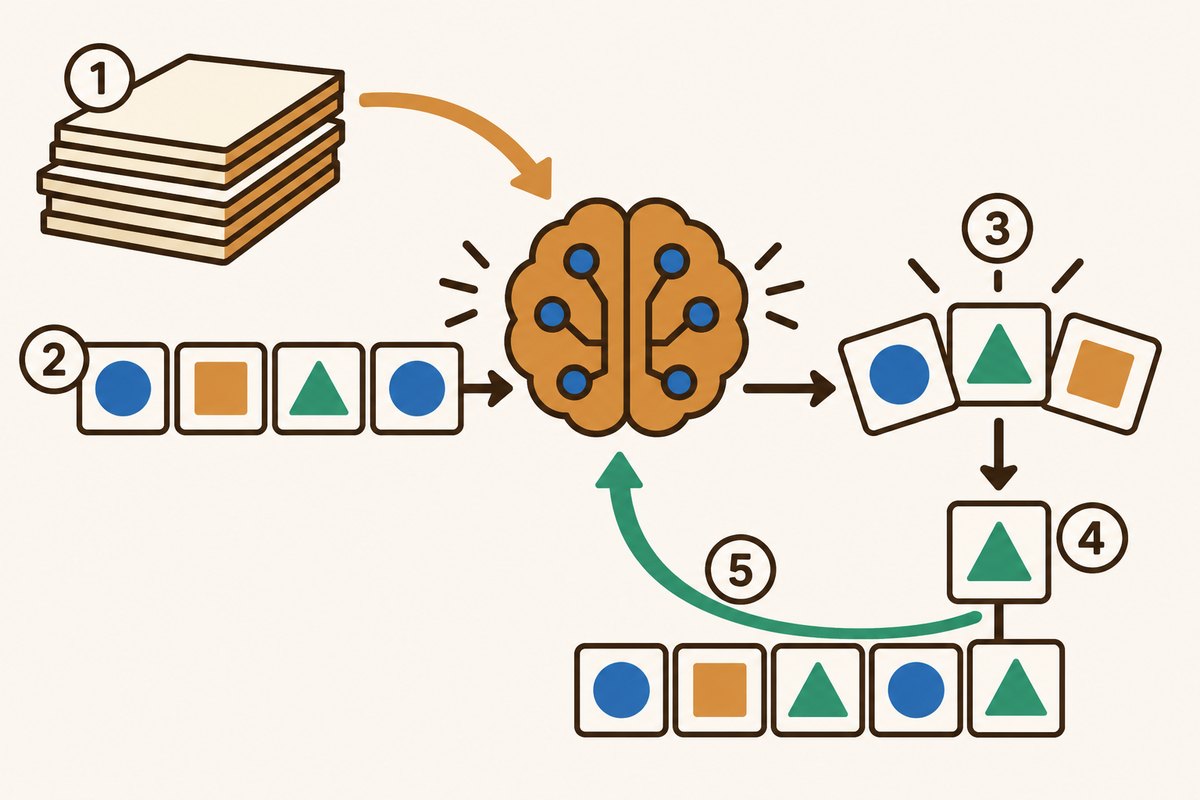
- 1The huge amount of text used for learning
- 2The row of word pieces that make up the text so far
- 3Candidates for the next word piece
- 4The word piece that was chosen
- 5Picking and adding a piece, again and again

What happens inside is still being studied
These models are not built by people writing rules one by one. Instead, their ways of solving problems take shape during training. That is why even the companies that make them still don't understand much of what happens inside, and research continues. A 2025 study found that when writing a poem, the model lines up possible rhyming words for the end of a line before writing the line. It also found that when a "this seems familiar" signal switches on even though the needed information is missing, the model can produce text that sounds right but isn't true. For important things, check other sources too.
Want to know more?
- In earlier Claude models, one token is said to be about 3.5 English characters long.
- There is a limit to how much text the model can look back on while writing an answer, called the "context window." A bigger one makes long texts easier to handle.
- A study on addition found two paths working at the same time: one that works out a rough answer, and one that works out the last digit exactly.
Quick quiz: test yourself
Remember what you just read? Give it a try!How does an AI chatbot build its answer?
Show the answer
- It picks the next word, one at a time
- It copies an answer from the internet
- It looks it up in a fixed answer table
It picks the next word, one at a time It looks at the question and what it has written so far, picks one next token, adds it on, and repeats this to build the answer.
It looks at the question and what it has written so far, picks one next token, adds it on, and repeats this to build the answer.
Next quiz ›Sources
- GlossaryAnthropic(Claude の開発者向け資料)
- Tracing the thoughts of a large language modelAnthropic
This article was written after checking the sources above as of 2026-10-03. Explanations may change as research progresses. Photo credits are shown below each photo.
Next fun fact ▶
 TechnologyHow does a phone screen feel your finger?A phone screen reacts to just a gentle touch of your finger. What exactly is it sensing?

40 surprising animal facts with big photos and short, easy text. A fun-facts book for kids and grown-ups to read together.
See it on Amazon