Is it true that bananas give off radiation?

 The key is the potassium that bananas are so rich in.
Yes. A tiny part of the potassium in bananas is potassium-40, which naturally gives off radiation. But the amount is very small: eating one banana gives you about 0.1 microsieverts. The US Environmental Protection Agency says this poses no radiation risk.
The radiation comes from potassium-40
Bananas are rich in potassium, a mineral our bodies need. A tiny part of all potassium atoms is potassium-40, a kind of potassium that gives off radiation. According to McGill University in Canada, it makes up about 0.012% of all potassium. So bananas do give off a very small amount of radiation. It was not added by people; it occurs naturally.
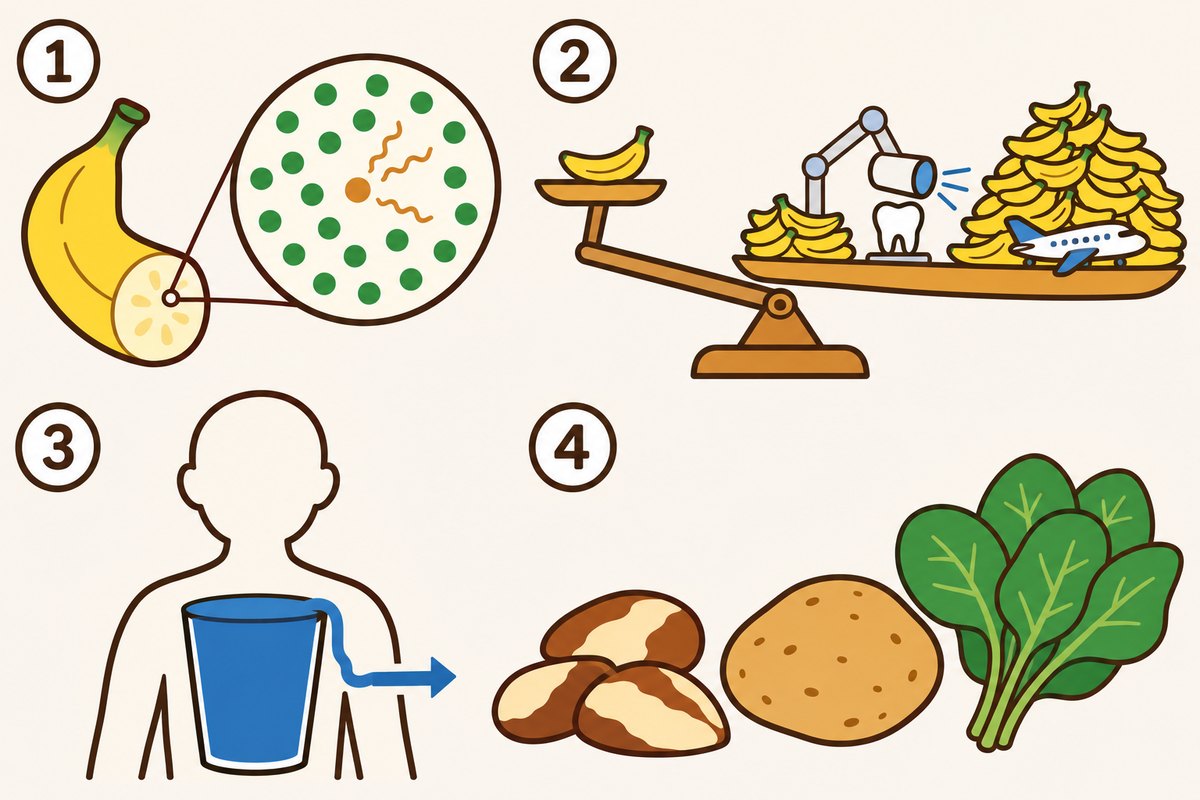
- 1Only a tiny fraction of the potassium in the fruit gives off radiation
- 2Compared with a dental X-ray or a plane trip, one banana is a very small amount
- 3The body's potassium works like a cup: only the overflow leaves, so it does not build up
- 4Brazil nuts, potatoes and spinach also give off a tiny amount
How much from one banana?
The US Environmental Protection Agency (EPA) says eating one banana gives you about 0.1 microsieverts of radiation (the sievert is a unit that shows how much effect radiation has on the body). The EPA calls this a very small amount. You would need to eat about 100 bananas to get the same amount of radiation that a person in the United States gets each day from natural sources.
Measuring in bananas
There is even an idea called the banana equivalent dose, which counts one banana's worth of radiation as 1 and shows other amounts as numbers of bananas. Lecture notes from the University of Glasgow in the UK list one dental X-ray as about 50 bananas, and a flight from London to New York as about 400. Comparing with everyday things makes the amounts easier to picture.
Based on University of Glasgow lecture notes and the US Environmental Protection Agency (EPA).

Why there is no need to worry
The EPA says the natural radiation in food is so low that no special action is needed, and that these foods pose no radiation risk. McGill University also explains that the body keeps its amount of potassium at a constant level. So eating bananas does not make potassium keep building up inside you.
Want to know more?
- According to McGill University, one banana contains about 450 milligrams of potassium.
- Besides potassium, Brazil nuts also contain a small amount of radium, which gives off radiation (EPA).
- Spinach, potatoes, and oranges are also listed among foods that contain a tiny amount of radioactivity.
Quick quiz: test yourself
Remember what you just read? Give it a try!What makes bananas give off radiation?
Show the answer
- Vitamin C
- Potassium-40
- Dietary fiber
Potassium-40 A tiny part of the potassium in bananas is potassium-40, which naturally gives off radiation. The amount is very small and nothing to worry about.
A tiny part of the potassium in bananas is potassium-40, which naturally gives off radiation. The amount is very small and nothing to worry about.
Next quiz ›Sources
- Natural Radioactivity in FoodUS EPA(アメリカ環境保護庁)RadTown
- Is it true that bananas are radioactive?McGill University Office for Science and Society(カナダ・マギル大学)
- P2 Nuclear and Particle Physics: Banana Equivalent DoseUniversity of Glasgow(イギリス・グラスゴー大学)講義資料
This article was written after checking the sources above as of 2026-10-03. Explanations may change as research progresses. Photo credits are shown below each photo.
Next fun fact ▶
 FoodWhy do banana peels turn dark?Before we know it, dark spots appear on a banana's peel. What could they be?

40 surprising animal facts with big photos and short, easy text. A fun-facts book for kids and grown-ups to read together.
See it on Amazon