Why is natto so sticky?

 They are made by natto bacteria, far too small to see.
Natto is stringy because, during fermentation, natto bacteria make a sticky substance called poly-gamma-glutamic acid, a long chain of glutamic acid. The bacteria are thought to store extra nutrients this way when their numbers grow and food seems about to run short.
The strings are long chains
The main ingredient of natto's sticky strings is a substance called poly-gamma-glutamic acid. It is made of glutamic acid, one of the amino acids, linked together in a long chain. Natto bacteria make it during fermentation, and according to Japan's National Food Research Institute (now part of NARO), its molecular weight (a number showing how heavy a molecule is) reaches 5 million. This long substance is what stretches into those sticky strings.
A crowd flips the switch
Natto bacteria do not make poly-gamma-glutamic acid while they are multiplying quickly. They start making it around the time their growth stops. The bacteria release a tiny substance called a pheromone, and the more of them there are, the stronger it gets. Once it passes a certain level, the switch for making poly-gamma-glutamic acid turns on.
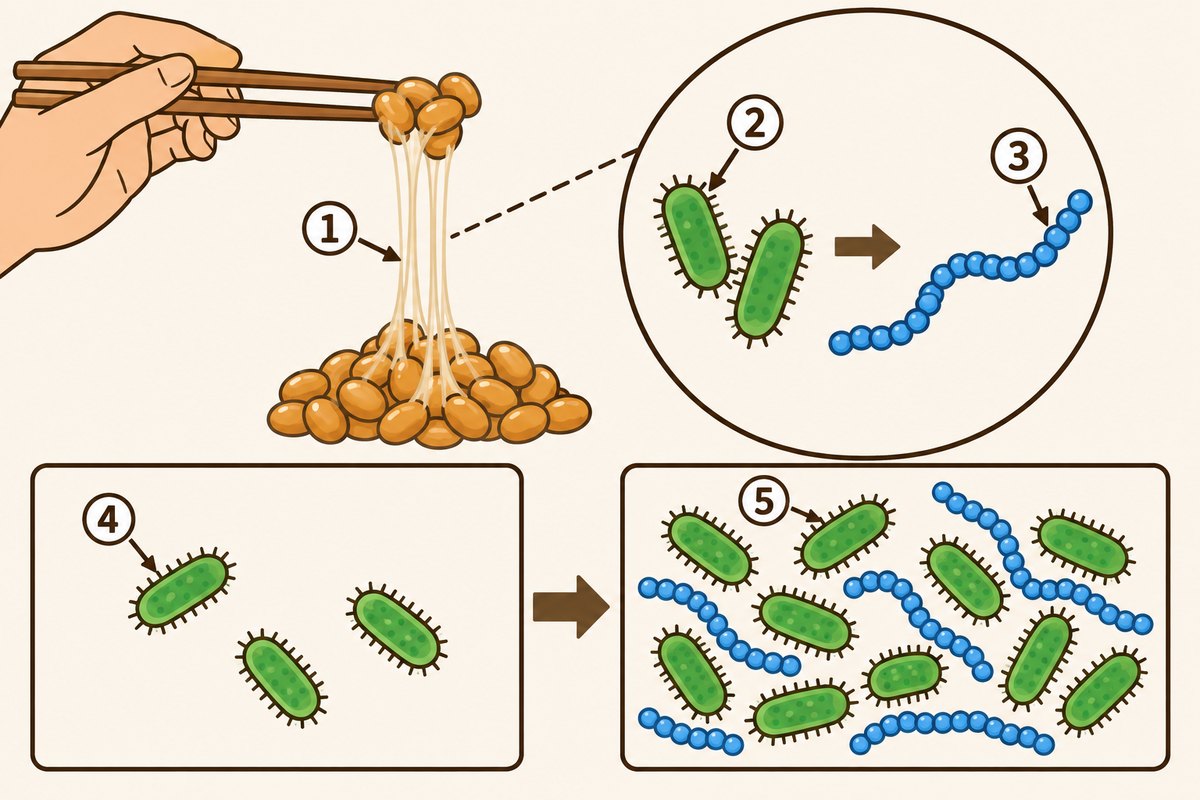
- 1Natto threads stretching when lifted with chopsticks
- 2Natto bacteria
- 3Diagram of γ-polyglutamic acid, a long chain of glutamic acid
- 4Few bacteria, not yet making long chains
- 5Bacteria multiplying and making long chains
Emergency food for bacteria
Being packed together in large numbers is a sign that food will soon run short. Research found that natto bacteria store extra nutrients as poly-gamma-glutamic acid, and later break it down with their own enzymes and take it back in as food. So the strings are thought to be a kind of emergency food for the bacteria. In bacteria grown in an experiment, they started making it around day 2, had the most on day 4, and had almost none left by about day 7.
Based on a research newsletter from the National Food Research Institute (now NARO).

Why the strings can weaken
How well natto strings is an important part of its quality, and strings getting weaker during storage is said to be one cause of lower quality. Also, if a virus that infects natto bacteria (a phage) gets in, it makes an enzyme that chops poly-gamma-glutamic acid to pieces, and fermentation goes wrong. On the other hand, natto bacteria lacking the 2 enzymes used to break it down store several times more poly-gamma-glutamic acid than usual, so they may help make extra-sticky natto.
Want to know more?
- In a lab liquid containing sugar (sucrose) and glutamic acid, a natto bacteria strain made poly-gamma-glutamic acid and levan, a substance made of linked sugars, at the same time.
- Because poly-gamma-glutamic acid soaks up water well, it is being studied for uses such as moisturizing ingredients and thickeners for drinks.
Quick quiz: test yourself
Remember what you just read? Give it a try!What is the main ingredient of natto's sticky strings?
Show the answer
- Starch
- Poly-gamma-glutamic acid
- Soybean oil
Poly-gamma-glutamic acid Poly-gamma-glutamic acid, a long chain of glutamic acid made by natto bacteria during fermentation, is the main ingredient of the strings.
Poly-gamma-glutamic acid, a long chain of glutamic acid made by natto bacteria during fermentation, is the main ingredient of the strings.
Next quiz ›Sources
- 納豆の糸引きのメカニズムを探る 納豆菌はなぜポリグルタミン酸をつくるのか(食総研ニュース No.5)独立行政法人 食品総合研究所(現・農研機構) (in Japanese)
- 納豆のネバネバをズタズタに切る酵素 発酵不良原因酵素の構造解析農研機構 食品総合研究所 (in Japanese)
- Microbial production and chemical transformation of poly-γ-glutamateMicrobial Biotechnology(PMC 掲載の査読論文)
- Simultaneous and selective production of levan and poly(gamma-glutamic acid) by Bacillus subtilisBiotechnology Letters(PubMed 掲載の査読論文)
This article was written after checking the sources above as of 2026-10-03. Explanations may change as research progresses. Photo credits are shown below each photo.
Next fun fact ▶
 FoodHow is miso made from soybeans?Miso goes into miso soup every day. How does that mellow taste come from soybeans?

40 surprising animal facts with big photos and short, easy text. A fun-facts book for kids and grown-ups to read together.
See it on Amazon