Why do banana peels turn dark?

 Let me give you the answer in 30 seconds.
Banana peels turn dark because an enzyme in the peel uses dopamine, a substance found in large amounts in the peel, to make brown pigment. The longer a banana ripens, the more of these brown spots appear. Also, if a banana is kept somewhere colder than 13℃, its peel is damaged by "chilling injury" and quickly turns brownish, even if the banana isn't overripe.
From green to yellow
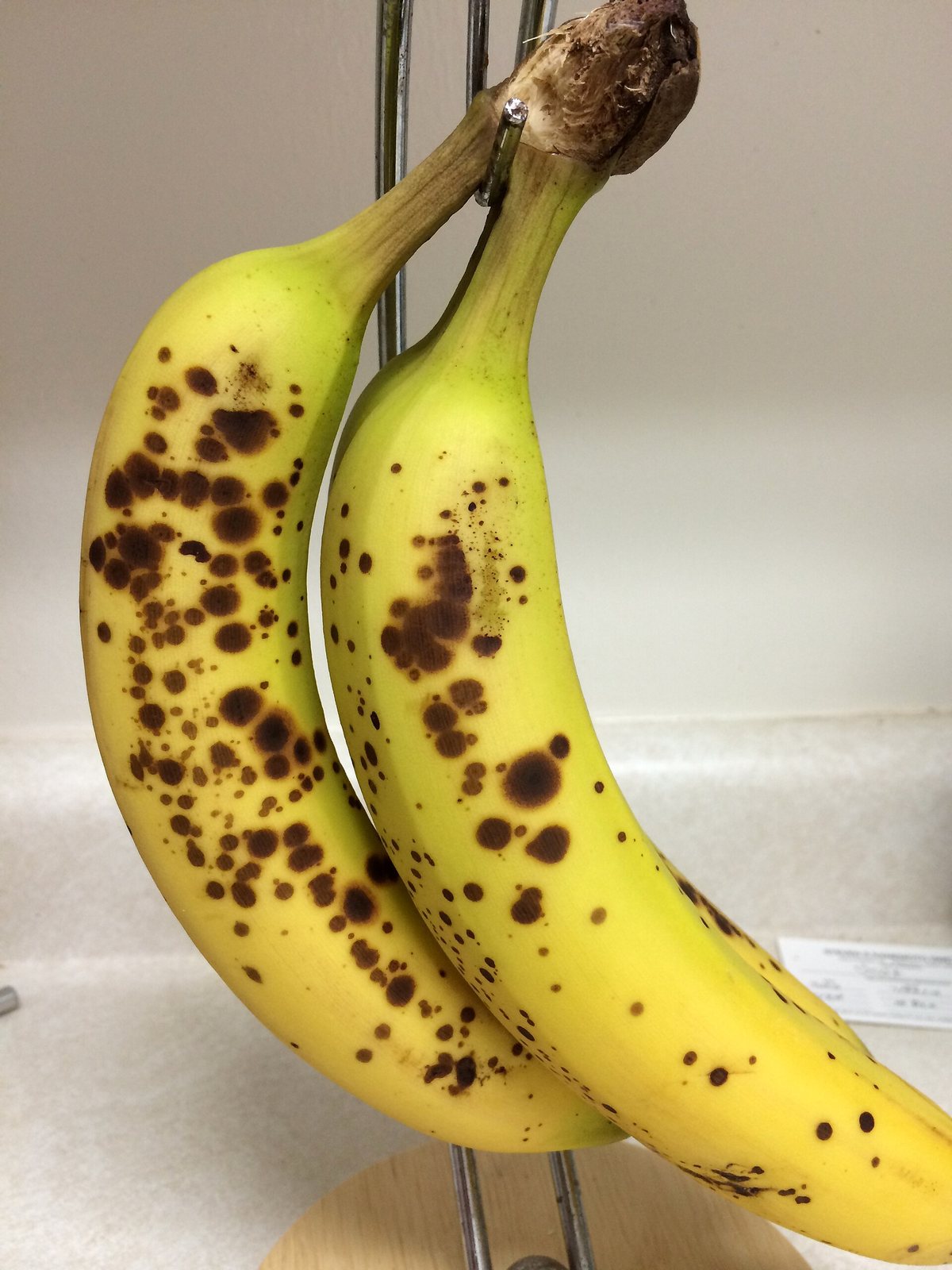
Freshly harvested bananas are green. As they ripen, the green pigment in the peel, chlorophyll, breaks down. The yellow color we see on bananas comes mainly from pigments called carotenoids. You can read more about how fruit ripens in our article "Do apples and bananas make other fruits ripen faster?"
What the brown spots are
Ripe bananas soon get brown spots on their peels. According to a research team from Kasetsart University in Thailand and Osaka Prefecture University in Japan, banana peels contain a lot of a substance called dopamine, and the amount went down as the bananas ripened. Meanwhile, in the outermost layer of the peel, an enzyme called polyphenol oxidase became more active. The team concluded that this enzyme uses dopamine as the material to make the brown pigment in the spots.
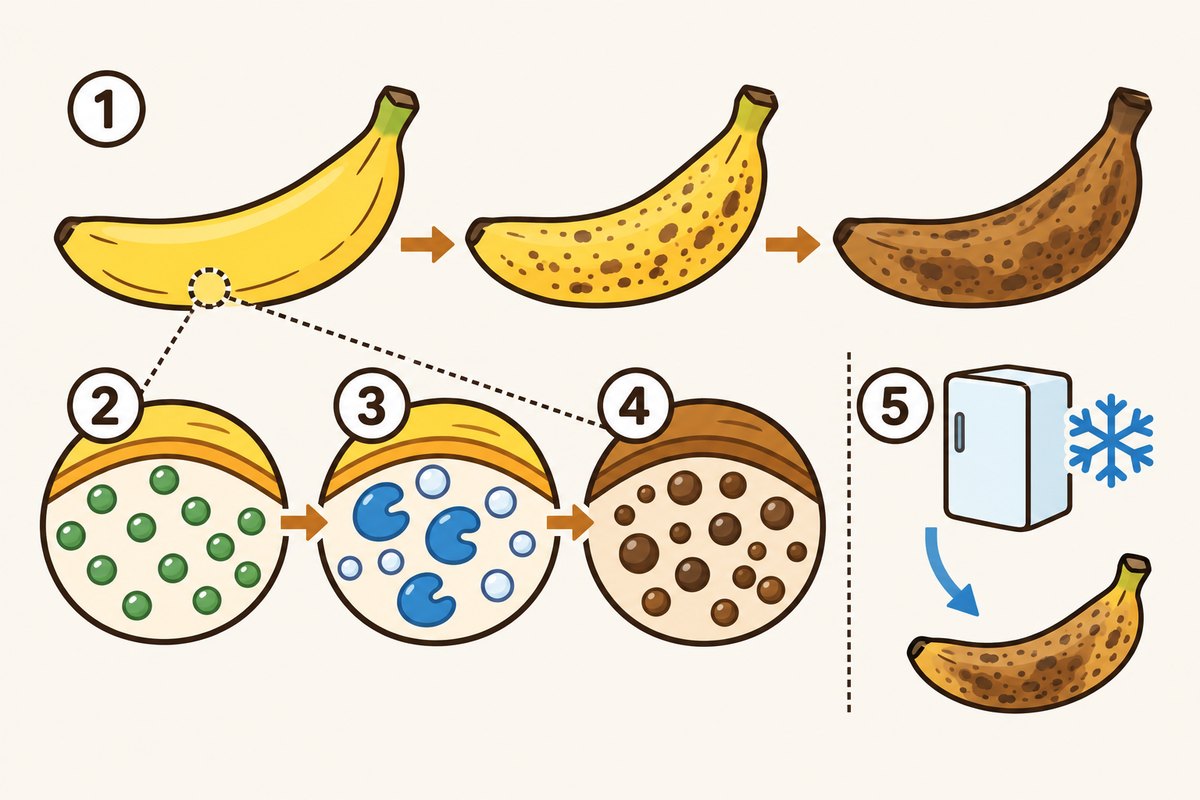
- 1Three stages of the peel changing color over time
- 2Diagram of dopamine in the peel
- 3Diagram of the enzyme reaction working with oxygen
- 4The brown pigment that forms
- 5Peel discoloring from cold, as in a refrigerator
Without oxygen, spots come later
In the same study, when bananas that had started to ripen were kept for 24 hours in nitrogen gas with no oxygen, the spots appeared later, and the dopamine decreased more slowly. The enzyme was just as active as in bananas kept in air, so oxygen is thought to play a part in the color-changing reaction. Cut apples turn brown through a very similar reaction involving an enzyme and oxygen.

Too much cold damages the peel
Bananas are a fruit from warm regions. If they are kept somewhere colder than 13℃, they get "chilling injury," and their peels turn brown or develop small dents. In an experiment by a research team in China, bananas stored at 6℃ began to show brown patches and dents on their peels by day 3, and these got worse as the days went by. This is thought to be why banana peels turn dark quickly in cold places like a refrigerator.
Want to know more?
- If you shine ultraviolet light (black light) on a ripe banana, the peel glows blue. The glow comes from substances made when chlorophyll breaks down.
- Green, unripe bananas do not glow blue under ultraviolet light. It is bananas in the middle of ripening that glow blue.
- Bananas with chilling injury may not only change peel color but also fail to ripen normally.

Quick quiz: test yourself
Remember what you just read? Give it a try!What makes the brown spots on ripe bananas?
Show the answer
- Mold growing on the banana
- Sunburn from sunlight
- An enzyme in the peel
An enzyme in the peel An enzyme in the peel uses a substance called dopamine as material to make brown pigment.
An enzyme in the peel uses a substance called dopamine as material to make brown pigment.
Next quiz ›Sources
- Changes in Concentrations of Phenolic Compounds and Polyphenol Oxidase Activity in Banana Peel during StorageFood Preservation Science(日本食品保蔵科学会)
- Study on Characteristics and Lignification Mechanism of Postharvest Banana Fruit during Chilling InjuryFoods(PubMed Central 収蔵)
- Ripening Bananas Glow An Intense Blue Under Black LightScienceDaily(Wiley-Blackwell 提供資料)
This article was written after checking the sources above as of 2026-10-03. Explanations may change as research progresses. Photo credits are shown below each photo.
Next fun fact ▶
 FoodWhy is natto so sticky?Lift natto with chopsticks and the strings just keep stretching. What are they made of?

40 surprising animal facts with big photos and short, easy text. A fun-facts book for kids and grown-ups to read together.
See it on Amazon