Why don't clouds fall out of the sky?

 The answer is: "They actually are falling, just slowly."
Clouds are actually falling, just very slowly. The water and ice droplets that make up clouds are so tiny that air resistance makes them fall very slowly. Where clouds form, the air is moving upward, and this flow cancels out the falling, so clouds look as if they are floating.
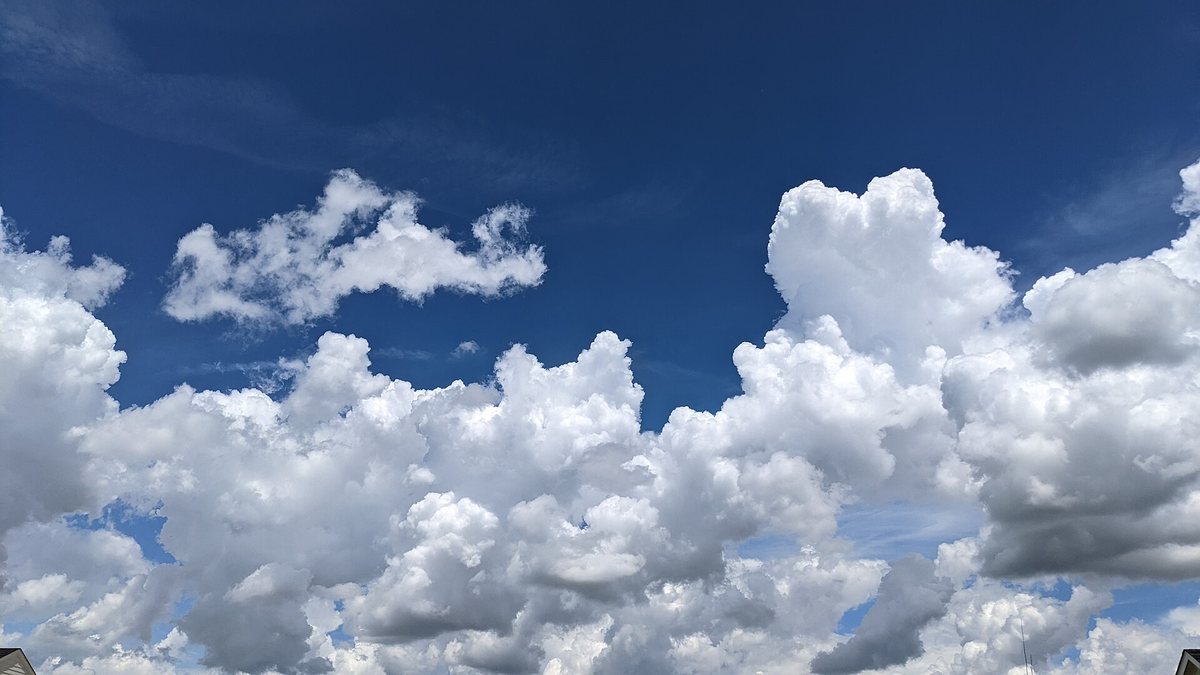
Clouds are made of tiny droplets
A cloud is a collection of tiny water droplets, or ice crystals where it is cold. A water droplet has a radius of only a few micrometers (1 micrometer is 1/1000 of a millimeter) to a few tens of micrometers. At the center of each droplet is an even smaller particle, such as dust, smoke, or salt from sea spray.
Tiny droplets fall slowly
How fast something falls depends on its weight and on how much surface meets the air. As a droplet gets smaller, its weight shrinks much faster than its surface does, so air resistance wins and it hardly falls. Even a fairly large droplet with a radius of 100 micrometers falls only about 27 cm per second. Most cloud droplets are much smaller and slower than this.

Updrafts hold them up
Clouds form and grow in rising air (updrafts). Flat clouds that bring gentle rain have updrafts of a few cm per second, while puffy, towering clouds that bring showers or thunderstorms have updrafts of more than a few meters per second. Either is enough to cancel out the slow fall of the droplets.
Big droplets become rain
Cloud droplets are constantly being born as water vapor turns into water, and vanishing again as they evaporate. That is why clouds keep changing shape. When droplets stick together and become so big and heavy that the updraft can no longer hold them up, they fall to the ground as rain or snow.
Want to know more?
- One estimate says a small cloud of 1 cubic km holds about 1 million kg of water droplets, as heavy as about 500 cars. The same volume of air weighs about 1000 times as much.
- The tiny particles at the center of cloud droplets (condensation nuclei) are about 1/100 the size of a cloud droplet.
- As air rises, the air pressure around it drops, so it expands and cools. When it cools, water vapor turns into water and a cloud forms.

Quick quiz: test yourself
Why don't clouds seem to fall?
Show the answer
- Clouds are lighter than air
- Tiny drops fall very slowly
- Clouds are only water vapor
Tiny drops fall very slowly Cloud droplets are so tiny that they fall very slowly, and rising air cancels out that falling motion.
Cloud droplets are so tiny that they fall very slowly, and rising air cancels out that falling motion.
Next quiz ›Sources
- Why do clouds float when they have tons of water in them?(UCAR COMETの気象学者による解説)Scientific American
- How Clouds FormNOAA(National Oceanic and Atmospheric Administration)
- How do clouds float?Smithsonian National Air and Space Museum(How Things Fly)
This article was written after checking the sources above as of 2026-10-03. Explanations may change as research progresses. Photo credits are shown below each photo.