Why is octopus blood blue?

 The secret is a metal inside the part of the blood that carries oxygen.
Octopus blood is blue because it carries oxygen with "hemocyanin," which contains copper. Human blood looks red because of hemoglobin, which contains iron. Hemocyanin turns blue when it binds oxygen and becomes colorless when it lets the oxygen go.
Copper makes it blue
Human blood looks red because hemoglobin, which contains iron, carries oxygen. In octopus blood, a protein called hemocyanin, which contains copper, does this job instead. According to a science magazine from the Hong Kong University of Science and Technology, copper bound to oxygen absorbs red light and reflects blue light, so the blood looks blue.
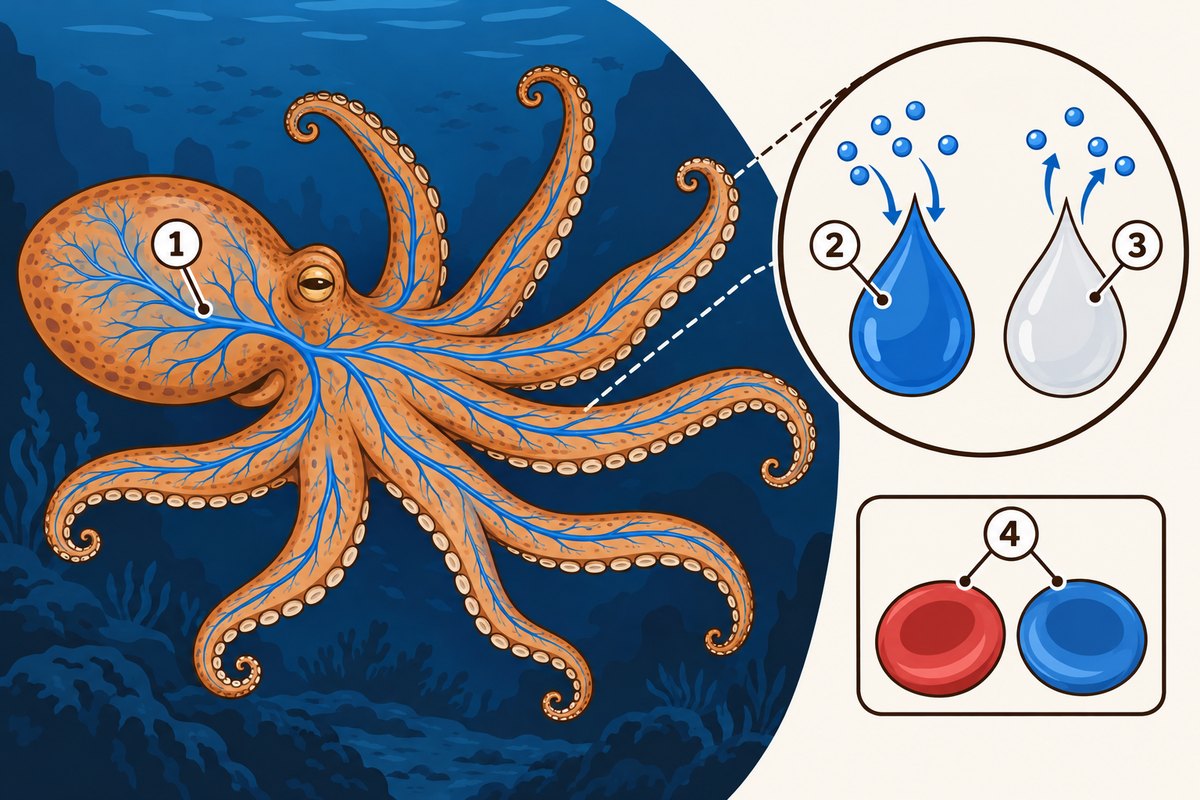
- 1Blue lines showing the blood that carries oxygen inside the octopus
- 2Blood that has picked up oxygen and turned blue
- 3Blood that has let go of its oxygen and become almost colorless
- 4A color-only comparison of red human blood and blue octopus blood (the octopus's blue protein is dissolved in the liquid part of the blood)
No oxygen, no color
According to an explainer from the Protein Data Bank in Europe at EMBL-EBI (the European Molecular Biology Laboratory), hemocyanin turns blue when it binds oxygen and becomes colorless when it lets the oxygen go. Also, while hemoglobin is found inside blood cells, hemocyanin is not packed into cells; it floats freely, dissolved in the liquid part of the blood.

Helpful in cold or low-oxygen seas
The same HKUST science magazine explains that hemoglobin carries oxygen less well at low temperatures, so hemocyanin works better in the deep sea. It also says hemoglobin is very good where there is plenty of oxygen, but in places with little oxygen, hemocyanin is more useful.
How Antarctic octopuses manage
A 2015 study compared an Antarctic octopus with octopuses from south-east Australia and the Mediterranean. Of the 3 species, the Antarctic octopus had the most hemocyanin in its blood. Near 0°C, its hemocyanin had trouble letting go of oxygen, but the large amount of oxygen dissolved in its blood helped make up for it. At 10°C, its hemocyanin could release on average 76.7% of the oxygen it carried, far more than the 2 warm-water species (33.0% and 29.8%). The researchers think that hemocyanin working less well as it gets colder sets a limit on how much cold octopuses can handle.
From a 2015 study in Frontiers in Zoology.
Want to know more?
- Hemocyanin is found only in some invertebrates: octopuses, squid, snails and other mollusks, as well as spiders, scorpions, horseshoe crabs and lobsters.
- Some sea invertebrates carry oxygen with "hemerythrin," which uses iron but turns violet-pink instead of red.
- When we talk about the "color of blood," we usually mean its color when it is bound to oxygen.
Quick quiz: test yourself
Remember what you just read? Give it a try!Which metal makes octopus blood blue?
Show the answer
- Iron
- Copper
- Zinc
Copper Octopus blood carries oxygen with hemocyanin, which contains copper. It looks blue when bound to oxygen.
Octopus blood carries oxygen with hemocyanin, which contains copper. It looks blue when bound to oxygen.
Next quiz ›Sources
- What do snails, spiders, octopods, and the Queen of England have in common?EMBL-EBI(Protein Data Bank in Europe)
- The Astonishing Spectrum of Nature's Palette(Science Focus 第28号)香港科技大学(HKUST)
- Blue blood on ice: modulated blood oxygen transport facilitates cold compensation and eurythermy in an Antarctic octopodFrontiers in Zoology(PMC 掲載の査読論文)
This article was written after checking the sources above as of 2026-10-03. Explanations may change as research progresses. Photo credits are shown below each photo.
Next fun fact ▶
 AnimalsHow many hearts does an octopus have?Do you know how many hearts an octopus has? It's quite different from us.

40 surprising animal facts with big photos and short, easy text. A fun-facts book for kids and grown-ups to read together.
See it on Amazon