How do bats fly in the dark?

 First, let me give you the answer in 30 seconds.
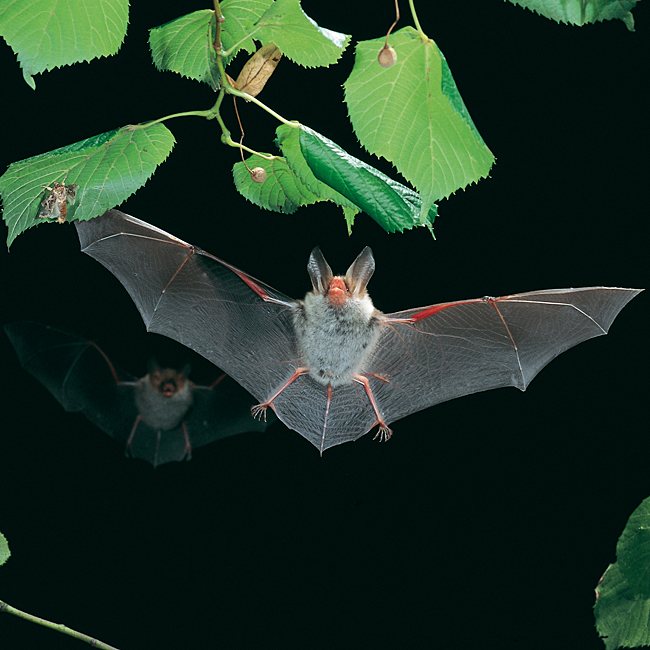
Many bats make high-pitched sounds (ultrasound) that human ears cannot hear, and listen to the sounds that bounce back off trees and insects to learn what is around them and where their prey is. This is called echolocation. However, bats are not blind, and some kinds rely on their eyes and their sense of smell.
Listening to the echoes of high sounds
Many bats fly while making high sounds that people cannot hear. These sounds hit trees, buildings, and insects, bounce back, and return to the bat's ears. Bats' ears are good at picking out their own calls, and bats are thought to use the returning sounds to build something like a sound map of what is where around them.
Calls speed up near an insect
When chasing an insect, a bat changes the way it calls. Once it finds prey, it makes short sounds quickly, one after another, to check exactly where the insect is before closing in. It also calls more often when it gets close to obstacles or to a place to land. Each kind of bat also has its own pattern of calls, so researchers can tell which kind of bat it is from recordings of its calls.
Are bats blind?
People sometimes say that "bats are blind," but this is a misunderstanding. Bats have eyes, and some kinds see well. While some kinds fly using echoes, other kinds find their food by relying on smell and sight.

Using eyes and sound together
Even bats with good eyesight still use sound. The Egyptian fruit bat has large eyes and can see in fairly dim light, but it also clicks its tongue to make a clicking sound and uses the echoes. Field observations found that even when flying in bright daylight, it kept making these sounds while avoiding trees and walls or swooping down to drink water. It is thought to use its eyes and sound together.
Want to know more?
- Most bat calls cannot be heard by people, but the calls of the spotted bat can sometimes be faintly heard by people with good hearing.
- There are more than 1,500 kinds of bats in the world. The biggest have a wingspan of about 2 m, and the smallest weigh only about 2 g.
- The Egyptian fruit bat is known to remember landmarks so it can fly back again and again to food that is far away.

Quick quiz: test yourself
What do most bats rely on to fly in the dark?
Show the answer
- Feeling things with whiskers
- Earth's magnetism
- Echoes of their calls
Echoes of their calls They make high sounds people can't hear and listen to the echoes to sense what is around them. This is called echolocation.
They make high sounds people can't hear and listen to the echoes to sense what is around them. This is called echolocation.
Next quiz ›Sources
- Echolocation - BatsU.S. National Park Service
- Bats: Vision or echolocation, why not both? (Current Biology 2022)Angeles Salles / PubMed Central (NIH)
- Types of batsBat Conservation Trust
This article was written after checking the sources above as of 2026-10-03. Explanations may change as research progresses. Photo credits are shown below each photo.