Why can a cricket match last for days?

 Let me go through what the rules say, one step at a time.
A Test match takes days because each team bats twice, and the result is decided only after all of those innings are finished. Under the rules of the International Cricket Council (ICC), it is scheduled for five days, and if there is no result after five days, it is a draw.
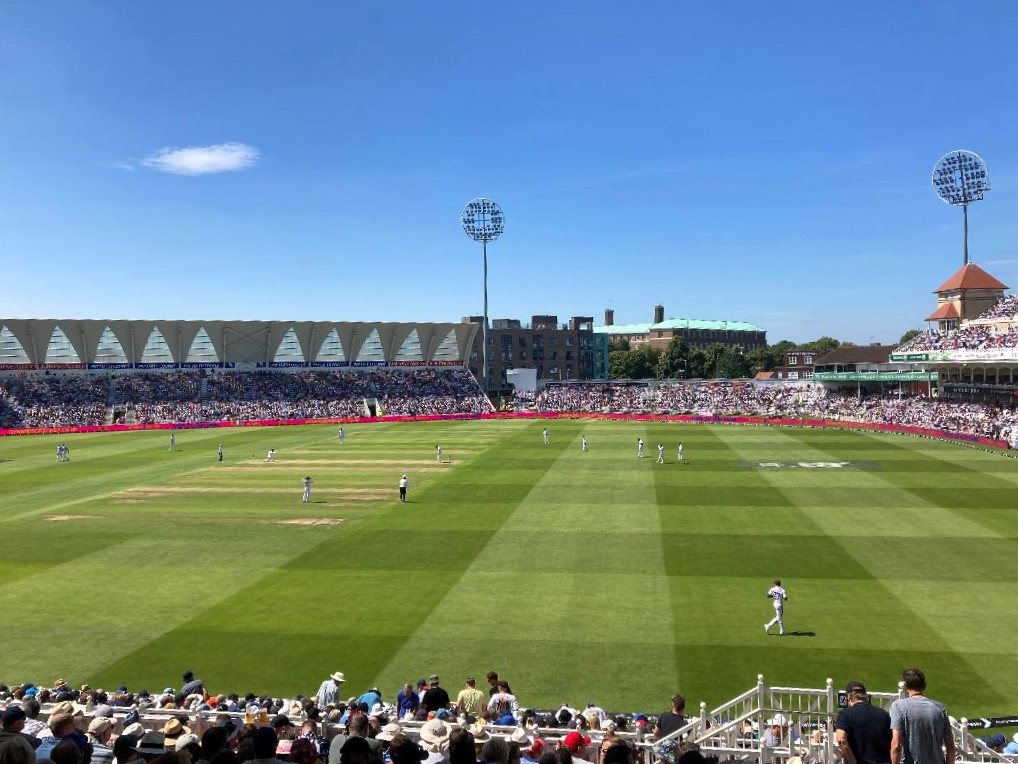
A Test match is scheduled for five days
One of cricket's best-known international matches is the Test match. Under the rules of the International Cricket Council (ICC), a Test match is scheduled for five days, with six hours of play planned each day. There are clear reasons built into the rules for why it takes so long.
Each team bats twice
The biggest reason is that each team bats twice. The team with more runs across its two innings wins, so nothing is decided until all the innings of both teams are over. One innings lasts until the batting side has no batters left who can play, or until its captain declares the innings closed.

Rules about balls bowled each day
There is also a rule about how many balls are bowled each day. On every day except the last, play continues until at least 90 overs (one over is six balls) have been bowled, and if that number is not reached by the scheduled finishing time, play can be extended by up to 30 minutes. With so many deliveries to get through, it naturally takes time.
No result means a draw
If there is no result after five days, nobody wins and the match is a draw. In the ICC's rules, a match is a draw when it is neither won nor a "tie," which means all the innings are finished and the scores are level. On the other hand, a match ends as soon as the result is decided, so some matches do not use all five days.
How one-day formats differ
Cricket also has formats that finish in a single day. Under the ICC's rules, in an ODI (one-day international) each team bats once, for up to 50 overs, and in a T20I each team bats once, for up to 20 overs. Both are scheduled for one day. Changing just the number and length of innings changes the length of a match a great deal.
Numbers are from the ICC playing conditions.
Want to know more?
- If the team that batted first leads by 200 runs or more, it can choose to make the other team bat again straight away. This is called the "follow-on."
- On the last day (day five), at least 75 overs must be bowled. The final hour, however, follows a separate calculation.
- In a Test match, a new ball is used at the start of every innings. After 80 overs, the fielding team can ask for a new ball.

Quick quiz: test yourself
Why does a Test match take days?
Show the answer
- Matches are played every other day
- Each team bats twice
- Play continues until a result
Each team bats twice In a Test match each team bats twice, and nothing is decided until all those innings are over. It is scheduled for five days.
In a Test match each team bats twice, and nothing is decided until all those innings are over. It is scheduled for five days.
Next quiz ›Sources
- ICC Men's Test Match Playing Conditions (effective from October 2026)International Cricket Council (ICC)
- ICC Men's One-Day International Playing Conditions (effective from October 2026)International Cricket Council (ICC)
- ICC Men's Twenty20 International Playing Conditions (effective from October 2026)International Cricket Council (ICC)
This article was written after checking the sources above as of 2026-10-03. Explanations may change as research progresses. Photo credits are shown below each photo.