Where did the kendama come from?

 If we trace it back, we arrive at a French toy from the 16th century.
The kendama is thought to come from the bilboquet, a toy played in 16th-century France in which you catch a ball in a cup. It is said to have reached Japan through the Netherlands in the Edo period. In the Taisho era, the "Sun-and-Moon Ball" made in Hatsukaichi, Hiroshima, with 3 cups and a spike, became the model for today's kendama.
It began with the French bilboquet
The kendama is thought to come from the bilboquet, a toy played in 16th-century France. You catch a ball tied to a string in a cup. The bilboquet is said to have come to Japan through the Netherlands during the Edo period (1603-1867).
Made in Meiji-era Hatsukaichi
In the Meiji era (1868-1912), woodworkers in Hatsukaichi, Hiroshima, began making kendama and other wooden toys. Hatsukaichi was known for woodworking and was also the gateway for people visiting Itsukushima Shrine on Miyajima, so the toys were sold to passing pilgrims and travelers. Early kendama were simple, though: some had just 1 cup, and some were only a ball stuck on a stick.
The "Sun-and-Moon Ball" set today's shape
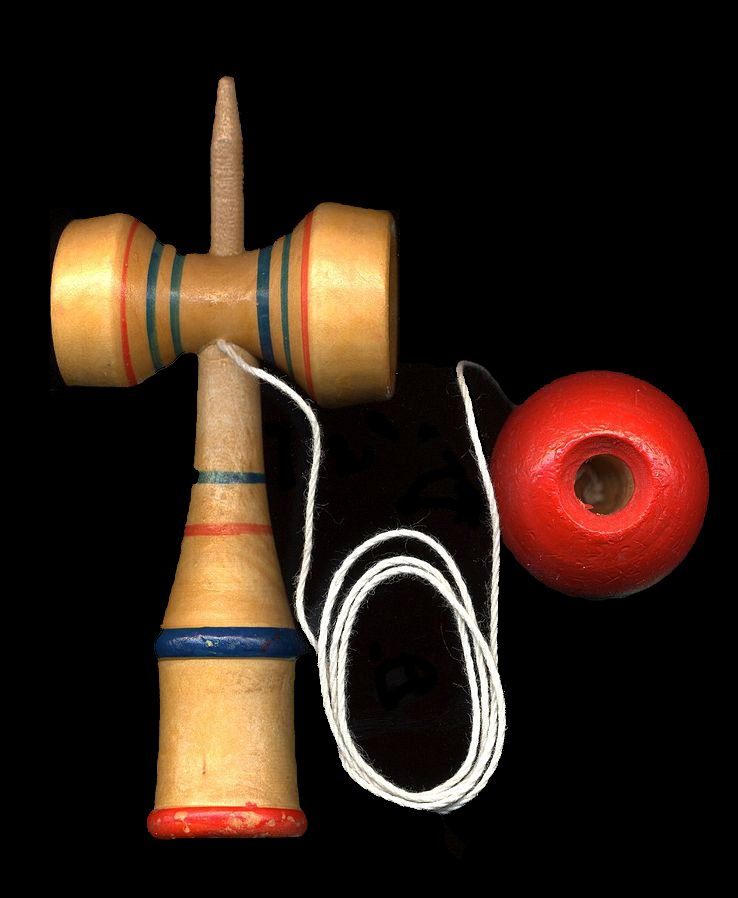
The modern shape was created by a craftsman named Egusa Hamaji. According to the Japan Tourism Agency, in 1918 he remade the toy with 3 cups, a handle and a spike. Seeing the round ball as the sun and the curved, crescent-shaped cups as the moon, he named it the "Sun-and-Moon Ball." He had a factory in Hatsukaichi make it, and Hatsukaichi became the birthplace of the modern kendama. Hiroshima Prefecture's introduction says production began in Taisho 10.
Based on explanations from the Japan Tourism Agency and Hiroshima Prefecture.

Kendama around the world
When kendama was most popular, in the 1970s, Hatsukaichi made 400,000 a year, 70% of all kendama made in Japan. Later, as makers dropped out, kendama making in Hatsukaichi stopped for a time, but it was revived in 2001. Today, kendama is also growing popular as a street sport, especially in the United States.
Want to know more?
- Since 2011, Hatsukaichi City has given a locally made kendama to every first-grade student in the city.
- In 2014, the "Kendama World Cup," a contest of kendama tricks, was held in Hatsukaichi.
Quick quiz: test yourself
Remember what you just read? Give it a try!In the name "Sun-and-Moon Ball," which part was seen as the sun?
Show the answer
- The handle
- The cups
- The round ball
The round ball The round ball was seen as the sun and the crescent-shaped cups as the moon, which gave it the name "Sun-and-Moon Ball."
The round ball was seen as the sun and the crescent-shaped cups as the moon, which gave it the name "Sun-and-Moon Ball."
Next quiz ›Sources
- けん玉(地域観光資源の多言語解説文データベース)観光庁 (in Japanese)
- けん玉発祥100周年。生誕の地、廿日市と木工の歴史を紐解く(徹底解剖!ひろしまラボ)広島県 (in Japanese)
This article was written after checking the sources above as of 2026-10-03. Explanations may change as research progresses. Photo credits are shown below each photo.
Next fun fact ▶
 CultureWhere did kite flying begin?Kites dancing in the New Year sky. Where were they born?

40 surprising animal facts with big photos and short, easy text. A fun-facts book for kids and grown-ups to read together.
See it on Amazon