Where did kite flying begin?

 People often say China, but in truth no one is certain.
Kites are often said to have been invented in China, but no one knows for sure when or where they began. China has many old records and legends, while Southeast Asia and the Pacific islands also have very old kite traditions. Kites are said to have reached Japan from China before the Heian period.
Legends from China
According to an article from the Library of Congress's folklife center, the philosopher Han Fei Zi wrote down a story in the 3rd century BCE about Mozi and Lu Ban building a wooden kite, and Lu Ban flying on it for three days. But no evidence of wooden kites from that time has been found, and many people, including historians in China, see it as a legend. The Japanese encyclopedia Nipponica also mentions a tradition that the Han general Han Xin made a kite in the 200s BCE.
Leaf kites in Southeast Asia and the Pacific
The same article says kites have been used for fishing since prehistoric times, and that this seems to have begun in Malaysia with kites made from leaves. Leaf kites are still made in Indonesia today, and the islands of Polynesia have myths about a kite god. Some say kites were invented separately in China and Malaysia, others that they spread from one place as people moved, and the question is not settled.
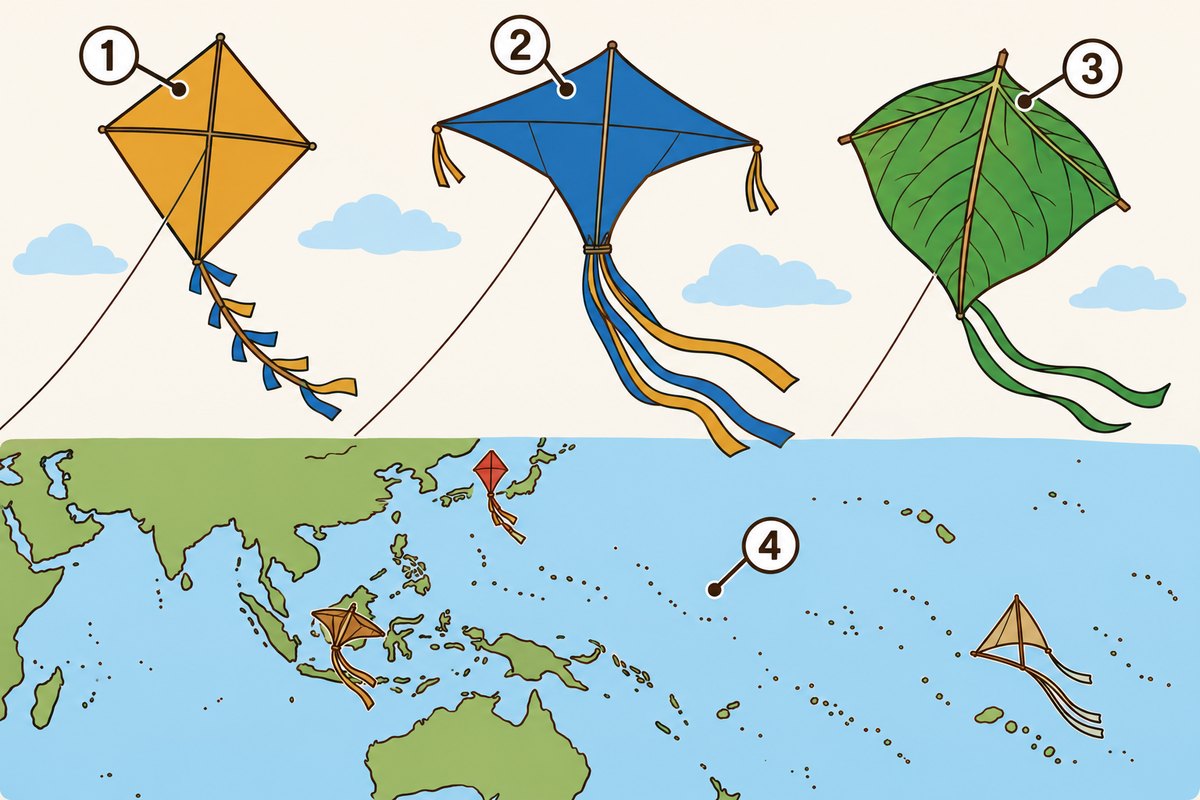
- 1A diamond-shaped kite
- 2A kite with a long tail
- 3A kite made from a big leaf
- 4East Asia, Southeast Asia and the Pacific islands, where kites have a long history

Kites come to Japan
Kites reached Japan from China before the Heian period and were called "shiroshi" or "shien." In the Edo period, they became a popular New Year game for children, and they were sometimes flown to celebrate a child growing up. In the Kansai region they are also called "ikanobori," and the kanji character for kite, 凧, was created in Japan.
To the West, and India's kite festival
Kites are said to have reached the West by way of the Netherlands in the 16th century. In the Indian state of Gujarat, during Uttarayan (Makar Sankranti), the festival that marks the turn from winter toward summer, kites fill the sky above rooftops all over town, and people hold kite fights to cut each other's strings. Ahmedabad has hosted an International Kite Festival since 1989.
Want to know more?
- In 1752, the American Benjamin Franklin used a kite to show that lightning is an electrical discharge.
- In China, the 60 days from the start of spring to the Qingming festival were traditionally the season for flying kites.
- Kites are fragile and rarely survive in archaeological sites, so no one knows how old they are, the Library of Congress article says.
Quick quiz: test yourself
Remember what you just read? Give it a try!Where was the kanji character for kite, 凧, created?
Show the answer
- Japan
- China
- India
Japan The character 凧 was created in Japan. In China, kites are called "zhiyuan" or "fengzheng."
The character 凧 was created in Japan. In China, kites are called "zhiyuan" or "fengzheng."
Next quiz ›Sources
- Kites Rise on the Wind: The Origin of KitesLibrary of Congress(アメリカ議会図書館)Folklife Today
- 凧(日本大百科全書・精選版 日本国語大辞典などの解説)コトバンク(小学館) (in Japanese)
- International Kite FestivalGujarat Tourism(インド・グジャラート州観光局)
This article was written after checking the sources above as of 2026-10-03. Explanations may change as research progresses. Photo credits are shown below each photo.
Next fun fact ▶
 CultureWhere was Sudoku born?Sudoku spread around the world with a Japanese name. But it was not born in Japan.

40 surprising animal facts with big photos and short, easy text. A fun-facts book for kids and grown-ups to read together.
See it on Amazon