Why does a maneki-neko raise one paw?

 Let me tell you the answer in thirty seconds.
The raised paw of a maneki-neko (beckoning cat) is said to be a gesture that calls people and good fortune to come. In Japan, people beckon with the palm facing down and the fingers curled. The idea that the left and right paws have different meanings is popular, but it is a folk saying.
The raised paw is a beckoning gesture
A maneki-neko raises a paw because it is calling in people and good fortune. In Japan, when you call someone over, you hold your hand with the palm down and fold your fingers downward, again and again. The figure is said to be modeled on this beckoning. In much of the West, the signal for "come here" is the opposite: the palm faces up and the hand pulls toward yourself, so the way of beckoning differs from country to country.
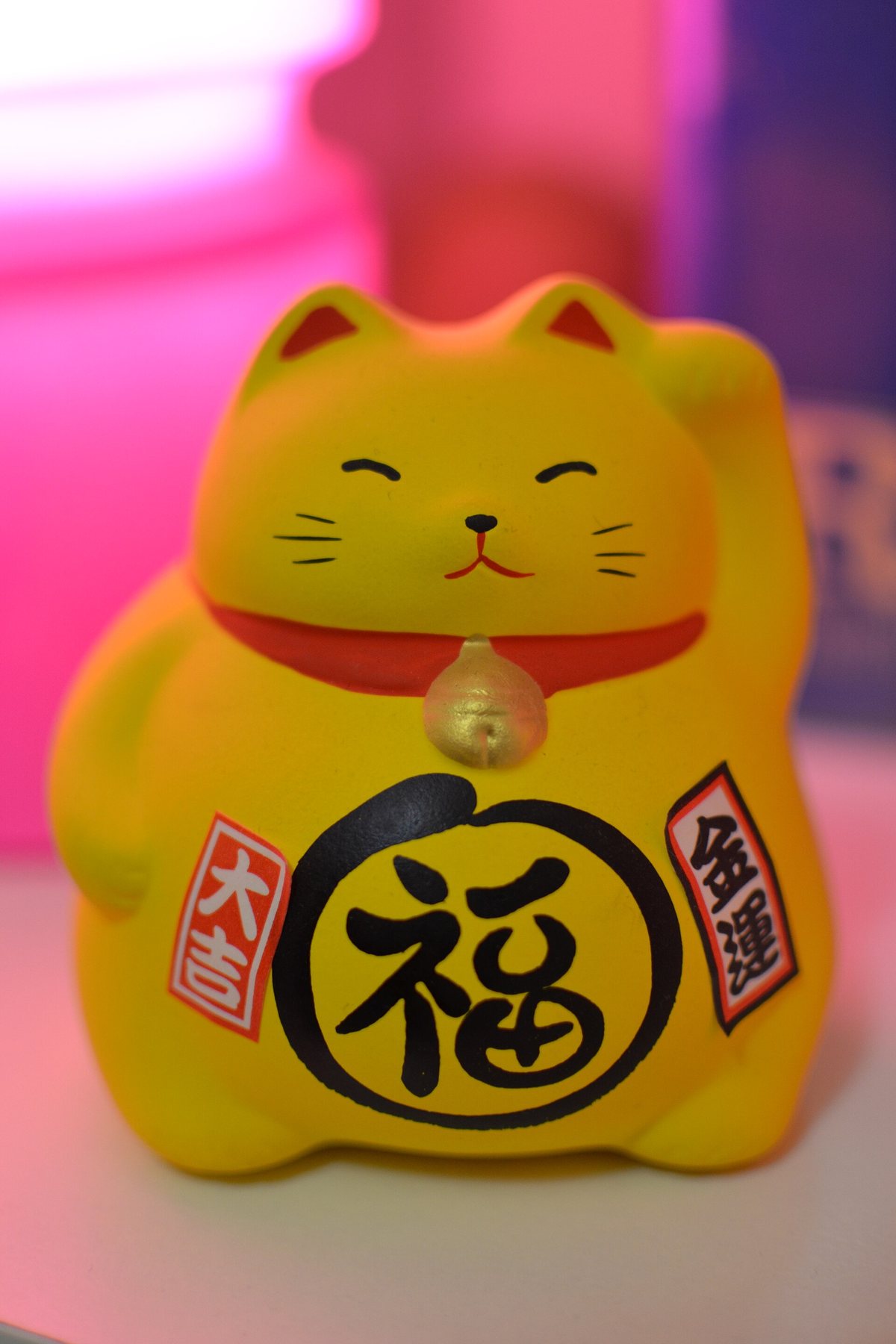
Sayings about the left and right paws
Some maneki-neko raise the left paw and some raise the right. A commonly heard explanation is that the left paw calls in people, customers and good relationships, while the right paw calls in money luck and good fortune. A left-pawed cat is sometimes said to be female and a right-pawed cat male. However, this is a popular folk saying, regional differences are also said to exist, and there is no single settled answer.
The cat story at Gotoku-ji temple
At Gotoku-ji temple in Setagaya, Tokyo, a story is passed down that a lord returning from a falconry trip was beckoned by a cat at the temple gate and stopped by. The temple introduces that lord as Ii Naotaka, the lord of Hikone, and says the temple was restored with his support in 1633. The cat that brought good fortune came to be called "Manekineko," written with characters meaning "fortune-beckoning cat." The cats at this temple hold no gold coin and raise the right paw, which the temple explains as a teaching that good fortune comes to those who feel gratitude.

Imado has another story
Other places have their own stories. In Imado in Asakusa, the Imado-yaki clay cat called "Marujime-neko," made at the end of the Edo period, is said to be the oldest surviving clay maneki-neko. There is also a theory that clay cats made in Imado-yaki and sold around Sensoji temple became very popular. So the maneki-neko is said to have appeared around the end of the Edo period, but its exact beginning is not known.
Want to know more?
- A Chinese book of the 9th century says that guests will come when a cat washes its face and its paw rises above its ear, and this is also counted as one possible origin.
- At Jisho-in temple in Tokyo, a tradition is told of a black cat that beckoned and led people to the temple and saved someone.

Quick quiz: test yourself
What does a maneki-neko's raised paw signal?
Show the answer
- A cheerful hello
- A sign to stop
- A call for people and luck
A call for people and luck The raised paw is said to be a beckoning gesture. In Japan, beckoning is done with the palm down and the fingers curled.
The raised paw is said to be a beckoning gesture. In Japan, beckoning is done with the palm down and the fingers curled.
Next quiz ›Sources
- 招福猫児(招き猫)について大谿山 豪徳寺【公式サイト】 (in Japanese)
- 招き猫の由来と種類(SKYWARD+)JAL Brand Communications (in Japanese)
- 招き猫の歴史と由来(SKYWARD+)JAL Brand Communications (in Japanese)
- What is maneki-neko?──Japanese Culture Snippets Vol.2NICHIGO PRESS(Dr Shunichi Ikeda, ANU)
This article was written after checking the sources above as of 2026-10-03. Explanations may change as research progresses. Photo credits are shown below each photo.