How does AI translation actually translate?

 It turns the whole sentence into numbers, then builds the translation word by word.
AI translation (neural machine translation) is built from huge numbers of parallel texts, meaning the same sentences written in two languages. It turns the whole original sentence into lists of numbers, then builds the translation one word at a time. Each time it adds a word, it works out which words in the original to focus on, so it can choose a translation that fits the meaning.
Writing rules, or learning from parallel texts
Research on automatic translation has been going on since the 1940s. According to Japan's National Institute of Information and Communications Technology (NICT), there are two main approaches: translating with rules written by hand, and learning how to translate automatically from huge numbers of parallel texts. NICT itself started research in 2013 on building translation from parallel texts with neural networks, one kind of AI system.
Turning the whole sentence into numbers
According to Google researchers, older systems broke a sentence into words and phrases and translated them mostly separately. The AI translation announced in 2016 treats the whole sentence as one unit. First, it turns the words of the original sentence into a list of number patterns (called vectors) that capture their meaning. Only after reading the whole sentence does it build the translation, one word at a time.
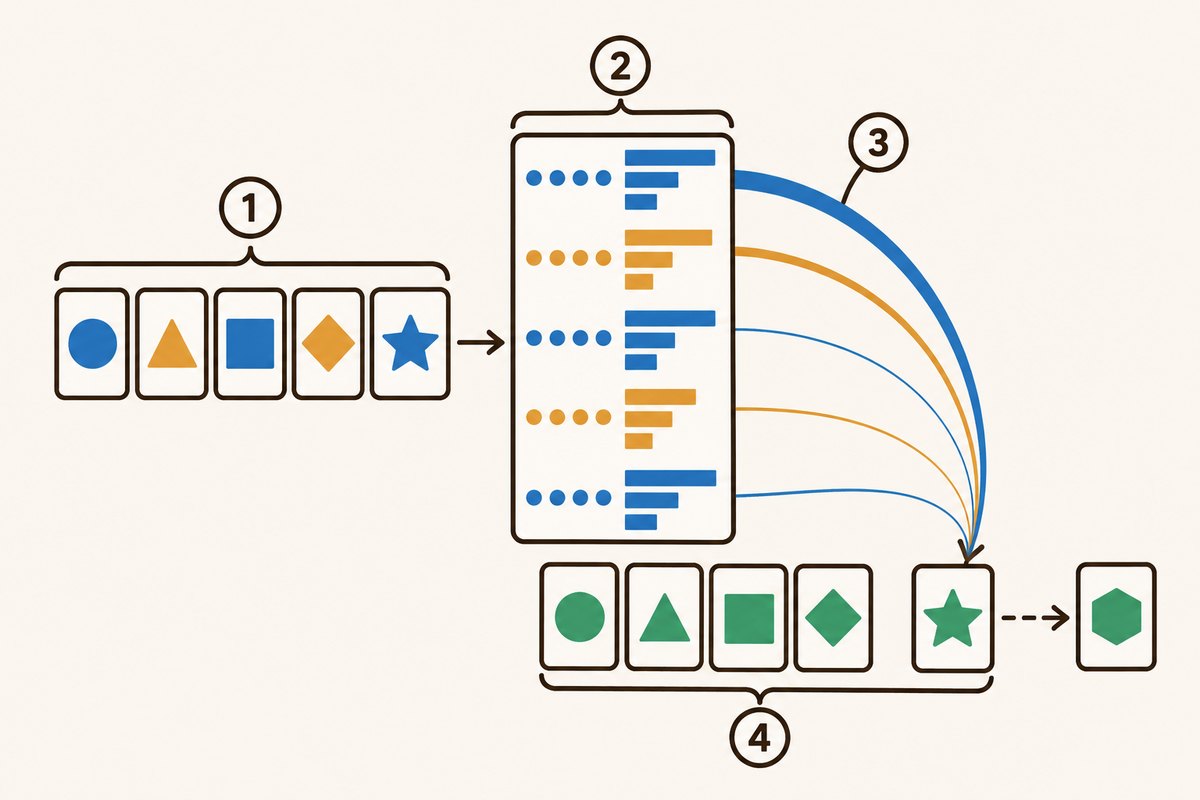
- 1Cards standing for the original sentence
- 2The sentence's meaning turned into rows of numbers
- 3How strongly each part is focused on (line thickness)
- 4The translation, built one word at a time
Working out which words to focus on
Each time it makes a word, it weighs how important each part of the original sentence is and uses that as a guide. The "Transformer," announced by Google in 2017, directly calculates the relationships between all the words in a sentence. For example, the English word "bank" can mean a place that keeps money or the side of a river. If the word "river" is in the same sentence, the system can focus on it and choose the "riverside" meaning.

It can still make mistakes
The 2016 AI translation cut translation errors by 55 to 85% or more compared with the older method on several major language pairs. Even so, the researchers wrote that it can still make mistakes a human translator would never make, such as dropping words, mistranslating people's names or rare words, and translating one sentence at a time without considering the sentences around it. For important text, it is safer to have a person check it too.
Want to know more?
- In 2016, the Google Translate app and website switched all of their Chinese-to-English translation to this AI translation.
- The AI translation NICT announced in 2017 was reported to produce translations whose meaning came across around 9 out of 10 times in fields such as disaster prevention, shopping and taxis.
- The Transformer was tested on translating English to German and English to French.
Quick quiz: test yourself
Remember what you just read? Give it a try!How does AI translation handle the original sentence?
Show the answer
- It translates each word separately
- It treats the whole sentence as one unit
- It reorders words by dictionary order
It treats the whole sentence as one unit AI translation treats the whole sentence as one unit, turns it into number patterns, and then builds the translation one word at a time.
AI translation treats the whole sentence as one unit, turns it into number patterns, and then builds the translation one word at a time.
Next quiz ›Sources
- 身近になった多言語自動翻訳情報通信研究機構(NICT) (in Japanese)
- ニューラル機械翻訳で音声翻訳アプリVoiceTraが更なる高精度化を実現情報通信研究機構(NICT)のプレスリリース(共同通信PRワイヤー) (in Japanese)
- A Neural Network for Machine Translation, at Production ScaleGoogle Research
- Transformer: A Novel Neural Network Architecture for Language UnderstandingGoogle Research
This article was written after checking the sources above as of 2026-10-03. Explanations may change as research progresses. Photo credits are shown below each photo.
Next fun fact ▶
 TechnologyHow does wireless charging work without a cable?No cable at all, and your phone charges just by being set down. It almost feels like magic, doesn't it?

40 surprising animal facts with big photos and short, easy text. A fun-facts book for kids and grown-ups to read together.
See it on Amazon