What are Saturn's rings made of?

 From far away they look like a single sheet, but they are actually made of countless icy particles.
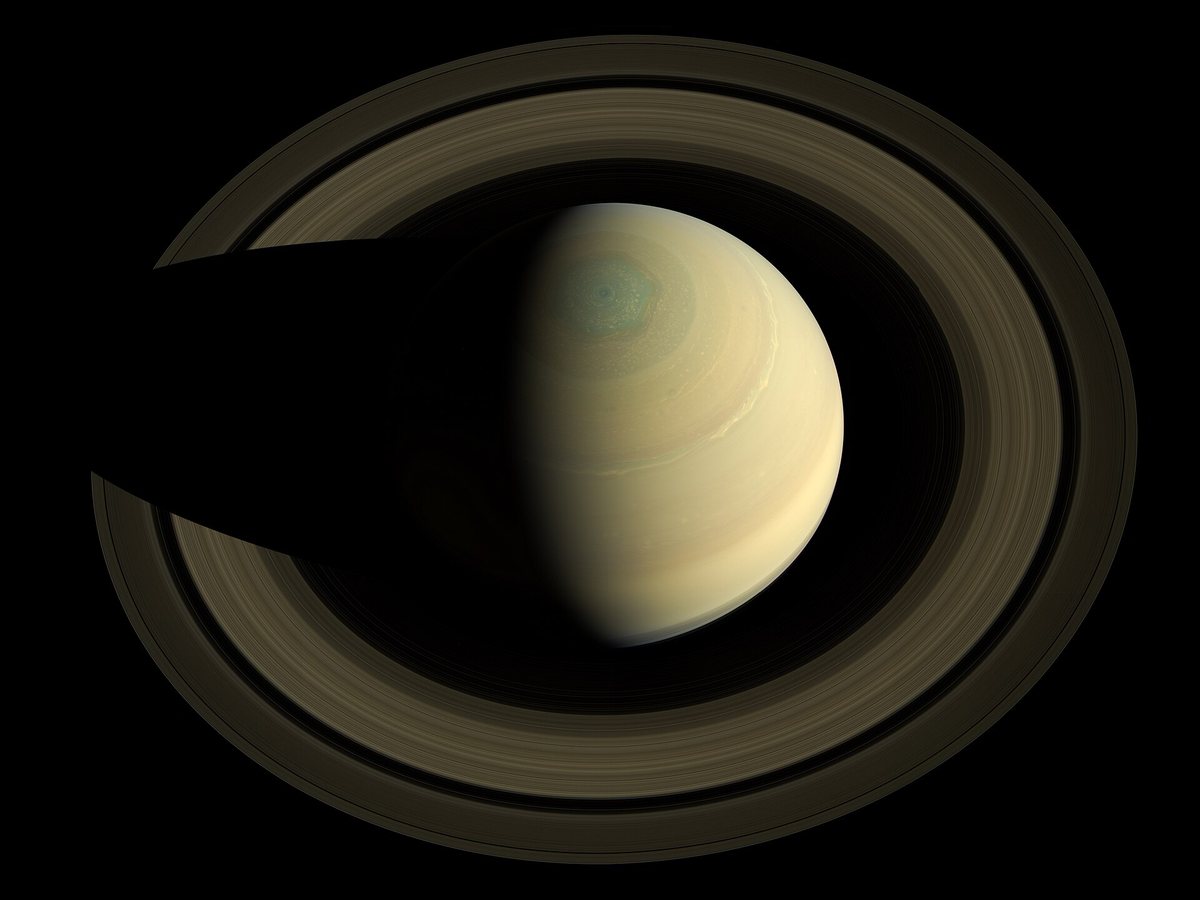
Saturn's rings look like a solid disk from far away, but they are really made of countless particles of water ice and ice-covered rock. The particles range from smaller than a grain of sand to as large as mountains. How the rings formed is still not known for sure.
A collection of tiny particles
Saturn's rings look like a solid sheet from far away, but they are actually a collection of tiny particles. Observations by NASA's Cassini spacecraft and others show that the rings are made almost entirely of chunks of water ice, and scientists think ice-covered rocks are also mixed in. The particles range from smaller than a grain of sand to as large as mountains.
A surprising width and thickness
The rings are about 400,000 kilometers wide—about the distance from Earth to the Moon. Yet in places they are only about 100 meters thick. What looks like one ring is thought to be made of 500 to 1,000 narrow ringlets with gaps between them.

How the rings formed
How the rings formed is still not known for sure. Scientists think they may be pieces of comets, asteroids, or shattered moons that broke up before reaching Saturn.
Moons add particles to the rings
NASA's Cassini spacecraft also found that water-ice particles spraying from Saturn's moon Enceladus supply much of the material for the E ring, a diffuse ring outside the bright main rings. So the rings are still receiving particles from moons and changing over time.
Want to know more?
- Saturn is the second-largest planet in our solar system, with an equatorial diameter of about 120,500 kilometers.
- Saturn spins quickly: one day lasts only about 10.7 hours. One year, one trip around the Sun, takes about 29.4 Earth years.
- Galileo Galilei first observed Saturn's rings with a telescope in 1610. At first he thought they might be handles or separate planets.
Quick quiz: test yourself
What are Saturn's rings mainly made of?
Show the answer
- Only rock fragments
- Chunks of water ice (icy particles)
- Metal dust
Chunks of water ice (icy particles) NASA's observations show that Saturn's rings are made almost entirely of chunks of water ice, with particles ranging from smaller than a grain of sand to as large as mountains.
NASA's observations show that Saturn's rings are made almost entirely of chunks of water ice, with particles ranging from smaller than a grain of sand to as large as mountains.
Next quiz ›Sources
- Saturn: FactsNASA Science
- RingsNASA Science
- Why does Saturn have rings?NASA Space Place
- All About SaturnNASA Space Place
This article was written after checking the sources above as of 2026-10-03. Explanations may change as research progresses. Photo credits are shown below each photo.